CX-Neptune

· 20 min read

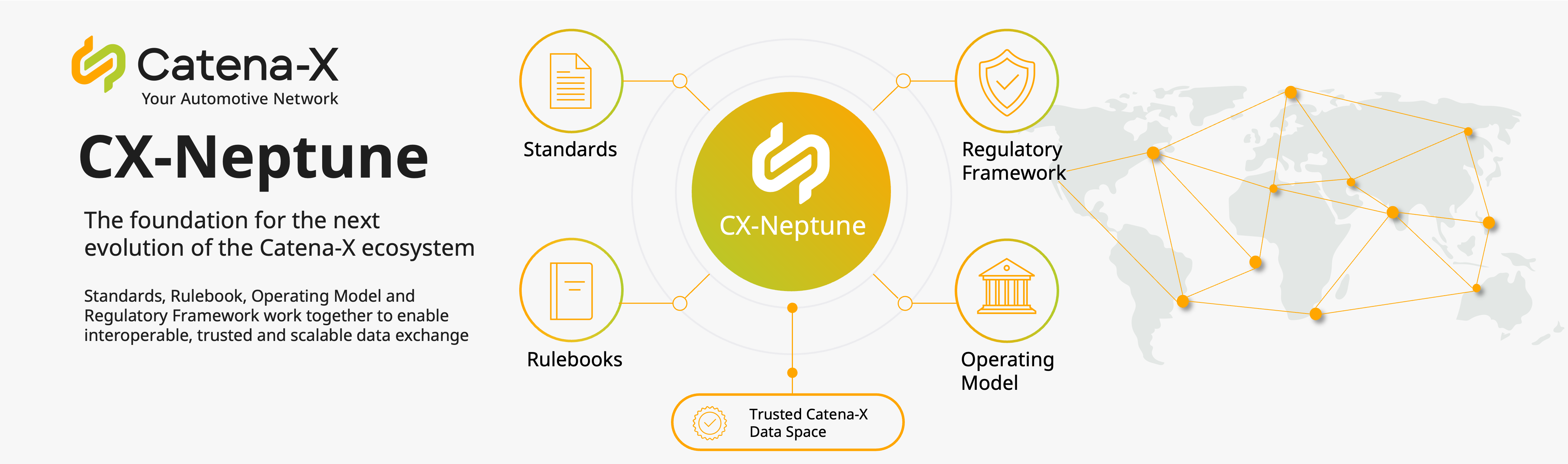
CX-Neptune Release Banner

Named after the planet Neptune, CX-Neptune symbolizes depth, stability, and the exploration of new frontiers within the Catena-X data space. As a major release, CX-Neptune sets the strategic direction and introduces key architectural foundations that shape the further evolution of the ecosystem.

CX-Neptune therefore serves as the central anchor, establishing the core innovations that are gradually refined, stabilized, and extended throughout the cycle.

Built together by the Catena-X community

CX-Neptune is the result of the joint work of many companies across the automotive value chain.
Every standard, every rulebook chapter and every document in this release was shaped in committees, working groups and expert groups by people who contributed their time, their domain knowledge and their willingness to find common ground instead of company-specific solutions. A sincere thank you to all member companies and their experts who contributed to CX-Neptune: by drafting and reviewing standards, by challenging concepts, by piloting new use cases, by maintaining the operating model and regulatory framework.

This collaborative effort is what turns individual requirements into interoperable standards and what makes a data space that works for the whole ecosystem, not just for a single participant.

Want to shape the next release?

Contributions are open to all members. Join a committee, working group or expert group and help
define the standards you will work with tomorrow.


CX-Neptune at a glance

ComponentVersionWhat changed
Operating Model3.1.2Consolidated role prerequisites and clearer OSP role and mandatory nomination for OSP
Regulatory Framework3.0.4Reworked Contract Modularization guidance, three new countries assessed
Standards8 new
18 updated
17deprecated
New Car SBOM extensions, Supply Chain & Quality split into focused standards, network foundation simplified
RulebooksPCF v4.1Update to PCF Rulebook and Certification Framework
Tractus-X26.06 & 26.09Referenz Implementation and KITs can be found in the Eclipse Tractus-X release notes
Release highlights
  • One protocol version only – DSP 0.8 and DCP 0.8 are dropped, cutting implementation effort for connector and wallet providers
  • Car SBOM family gains a shared foundation plus two new extensions for US connected-vehicle regulation and open-source licence compliance
  • Traceability is retired and replaced by focused standards for blocking notifications, special characteristics, zero-km failures and certificates of analysis
  • Contracting made approachable – Quick Start Guide, Clause Library and FAQ lower the entry barrier for contract modularization

Catena-X Operating Model

With the release of version 3.1.2 of the Operating Model, the Who and How chapters have been updated. The release introduces consolidated guidance on role prerequisites and aligns the onboarding process description with the binding standard CX-0006.

Chapter: Who – Roles in the Catena-X Ecosystem

  • New summary table outlining the prerequisites for obtaining roles in the Catena-X dataspace, providing a single consolidated reference for all role types.
  • Updated the description of the Onboarding Service Provider (OSP) role for greater clarity
  • Becoming an Onboarding Service Provider now requires a nomination by the Catena-X Board in addition to certification.

Chapter: How – Data Space Operations

  • Streamlined the onboarding process section: the detailed process description has been consolidated in standard CX-0006, which is now the single binding source. This removes duplicated content and prevents contradictions between the Operating Model and the standard.

Impact for ecosystem participants

AudienceImpact
All role holders and applicantsPrerequisites for every ecosystem role are now available in one consolidated table
Onboarding Service Provider (OSP)Certification alone is no longer sufficient, a nomination by the Catena-X Board is now required

Further Information


Regulatory Framework

With the release of version 3.0.4 of the Regulatory Framework, the Contracting chapter and the Country Clearance List have been updated. The release introduces expanded guidance on contract modularization, including a quick start guide, contract options, precedence rules, a clause library and an FAQ, and adds three newly assessed countries to the Country Clearance List.

Contracting: Easier access to Contract Modularization

Setting up contracts in Catena-X should not require a legal deep dive. The guidance on Contract Modularization has therefore been reworked to answer the questions users actually have:

  • "Where do I start?" – A new Quick Start Guide walks first-time users through the essentials, key concepts and a suggested reading path.
  • "Which contract option fits my case?" – Illustrated overviews explain the contractual scenarios and the mandatory and optional steps of contract modularization.
  • "What happens if clauses contradict each other?" – The contract precedence rules are now visualized and explained. A new section covers both how conflicts between an RC agreement and a referenced external contract are resolved, and how the CX-0152 JSON schema prevents mutually exclusive clauses in the first place.
  • "Do I have to write clauses from scratch?" – The new Clause Library lists all permissions, prohibitions and obligations with their legal texts.
  • "What does this term mean?" – A new Glossary defines all terms used.
  • "Someone must have asked this before." – A new FAQ collects the most common questions from practice.
info

The entire guidance was rewritten in simpler, consistent language.

Country Clearance List: Three new countries assessed

Three additional countries have been evaluated and can now be considered in your data exchange planning:

  • Morocco and Paraguay – added to the Allow List
  • Republic of Moldova – added to the Conditional List

Impact for ecosystem participants

  • Contracting: No changes to binding contractual content – all additions are explanatory and support the practical application of contract modularization.
  • Country Clearance List: Data exchange with partners in Morocco and Paraguay is possible without additional conditions. For the Republic of Moldova, the requirements of the Conditional List apply – please verify before exchanging data.

Further Information


Catena-X Standards

With the CX-Neptune release, several Catena-X standards have been updated, and new standards have been introduced across multiple domains. These updates refine existing standards, address evolving requirements, and extend the Catena-X ecosystem with new use cases and capabilities.

info

To make it easier to understand how the updated and newly introduced standards relate to each other, you can explore their dependencies in the Dependency Graph. The graph provides a visual overview of the relationships between standards and helps you identify which standards depend on or are related to a specific standard.

Engineering

This release makes engineering data exchange less ambiguous and puts vehicle software transparency on a common footing. Master data and requirements standards now clearly state which type of digital twin to use, and the Car SBOM family gets a shared foundation plus two new extensions for US connected-vehicle regulation and open-source licence compliance.

StandardStatusValueChangelog
CX-0133 Online Control and SimulationDeprecatedYou should no longer build new solutions around this standard.-
CX-0154 Master Data ManagementUpdatedEngineering master data now fits together between carmakers and suppliers. Until now it was unclear which type of digital twin to use, which led to mismatched data and manual rework in CAD/PDM exchange. The update defines "PartRole" and clear criteria for choosing PartType vs. PartRole, aligned with CX-0126 Industry Core.Changelog
CX-0155 Requirements EngineeringUpdatedMakes the exchange of engineering requirements consistently usable in practice. An introduction, a defined area of application and the PartRole definition were added; open review findings that were blocking certification are resolved.Changelog
CX-0158 Car SBOMUpdatedOne consistent way to describe software components for the base standard and both new extensions: the relationship-based approach was replaced by SPDX profiles, all sub-standards must now comply with the base standard, and outdated references were removed. This avoids duplicate certification effort for the extensions.Changelog
CX-0158-1 Car SBOM for ICTS Connected VehiclesNewLets carmakers prove which software is inside a connected vehicle – required by a new US regulation. Built directly on CX-0158 as the base standard (and not allowed to contradict it), so there is one harmonised evidence path instead of bespoke one-to-one agreements with every partner.Changelog
CX-0158-2 Car SBOM for FOSS ComplianceNewHelps carmakers prove they respect open-source licences in vehicle software. Covers licence, copyright and attribution information plus certification criteria for OEMs, Tier-1/Tier-N suppliers and tool providers – today every company and tool handles this differently.Changelog

Sustainability

This release focuses on making sustainability data trustworthy, comparable and easier to certify rather than adding new topics. The carbon footprint standard is cleaned up and moved to the current data model so old and new applications keep working together, Digital Product Passport and Battery Passport are corrected and restructured for clearer certification, and safety data sheets move from PDF e-mails to a standardised digital exchange.

StandardStatusValueChangelog
CX-0136 Use Case PCFUpdatedKeeps existing and newly built carbon footprint applications working together and enables automated certification. The data model moves to v10.0.0 (v7.0.0 retired), duplicated content is replaced by references to standalone standards, and the interface can now state which data model version is requested. In addition, the PCF Rulebook v4.1 clarifies definitions and methodology, improves the handling of forward-looking PCFs and biogenic carbon, refines system boundary and electricity rules and adds sector-specific requirements – so carbon figures from different companies become comparable and trustworthy.Changelog
CX-0143 Use Case Circular Economy - Digital Product PassportUpdatedFixes a long-standing search error that prevented finding the correct business partner, removes obsolete backward compatibility and brings the certification criteria into the current format.Changelog
CX-0160 Battery PassportUpdatedOne standard covering three different use cases was hard to certify. It is now being split by use case (with a clearer name), the certification criteria use the new template, and bug fixes become mandatory instead of optional.Changelog
CX-0162 ESDScomNewTurns safety data sheets – today PDFs sent by e-mail – into structured, machine-readable data with a standardised model for SDS and extended SDS. Cuts administrative effort and supports REACH and regional legal requirements.Changelog

Network Service

The network foundation is being simplified and better documented. Business partner data becomes easier to find and covers real company structures, outdated connectivity and wallet protocol versions are dropped so only one version has to be implemented, and a central service that had been running unstandardised since day one is now written down.

StandardStatusValueChangelog
CX-0001 Participant Agent RegistrationDeprecatedYou should no longer build new solutions around this standard.-
CX-0010 Business Partner NumberUpdatedProtects the promise that every business partner number is globally unique and stable. Rules and guidance for issuing and using site numbers (BPNS) are sharpened and aligned with CX-0012, CX-0074 and CX-0076, so service providers no longer issue them inconsistently.Changelog
CX-0012 Business Partner Data Pool APIUpdatedMakes business partner data far easier to find and understand: one generic search across legal entities, sites and addresses, plus the ability to represent ownership hierarchies, company succession and headquarter relocations. Less bilateral workaround, lower integration effort.Changelog
CX-0018 Dataspace ConnectivityUpdatedOnly one connection protocol version needs to be supported – the old DSP 0.8 is dropped entirely. Simpler and cheaper to implement, plus additional transfer types and the groundwork for future connector features (EDC-V / Virtual Participation). Connector providers must be ready for the phase-out.Changelog
CX-0053 Discovery Finder and BPN Discovery Service APIsDeprecatedYou should no longer build new solutions around this standard.-
CX-0055 Data Processing Patterns for IT System IntegrationDeprecatedYou should no longer build new solutions around this standard.-
CX-0074 Business Partner Gate APIUpdatedKeeps the upload side in sync with the search side by adding the new relation types, relation qualifiers and golden record relations. Otherwise the new information simply could not be uploaded.Changelog
CX-0076 Golden Record End to End Requirements StandardUpdatedEnsures the written standard matches what the live system already does: one address can now be assigned to several sites within one legal entity. This keeps business partner data quality comparable across providers.Changelog
CX-0077 Data Quality DashboardDeprecatedYou should no longer build new solutions around this standard.-
CX-0078 Bank Data Verification DashboardDeprecatedYou should no longer build new solutions around this standard.-
CX-0079 Natural Person Screening DashboardDeprecatedYou should no longer build new solutions around this standard.-
CX-0080 BPDM Fraud Prevention ServiceDeprecatedYou should no longer build new solutions around this standard.-
CX-0116 Sanction Party Watchlist DashboardDeprecatedYou should no longer build new solutions around this standard.-
CX-0149 Wallet RequirementsUpdatedSame simplification for digital identity wallets: the old DCP v0.8 is dropped, only v1.0 remains, and legacy requirements are cleaned up. Less baggage and easier future implementations.Changelog
CX-0152 Policy Constrains for Data ExchangeUpdatedSupports new business cases (Electronic Control Unit data exchange) and introduces schema-based checking, so rule validation can be adapted instead of rebuilt. Remains the single source of truth for data usage rules.Changelog
CX-0167 Bpn Did ResolutionNewDocuments a central service that has been running since day one but was never standardised – the link between business partner numbers and dataspace identities. Removes a hidden dependency, makes audits possible and allows alternative providers.Changelog

Supply Chain & Quality

The broad Traceability standard is replaced by focused, standalone standards for individual business needs – blocking information, special characteristics, zero-km failures and certificates of analysis. Together they replace processes that are still largely handled by e-mail and PDF today, and the remaining quality and disruption standards are sharpened and corrected.

StandardStatusValueChangelog
CX-0059 Use Case Behaviour Twin Endurance PredictorDeprecatedYou should no longer build new solutions around this standard.-
CX-0105 Asset Tracking Use CaseDeprecatedYou should no longer build new solutions around this standard.-
CX-0115 Manufacturing Capability ExchangeDeprecatedYou should no longer build new solutions around this standard.-
CX-0123 Quality Use Case StandardUpdatedMakes clear what quality solutions are actually certified for after the old Traceability standard was split up. Renamed to "Field Quality", the scope is narrowed, required data models are sharpened, the 8D model and dependencies on retired standards are removed, and warranty test data is provided.Changelog
CX-0125 Traceability Use CaseDeprecatedSplit into standalone standards (Field Quality, Blocking Notifications, Special Characteristics, …) so companies only implement and certify what they actually need.-
CX-0129 Request for Quotation ExchangeDeprecatedYou should no longer build new solutions around this standard.-
CX-0138 Use Case Behaviour Twin Endurance EstimatorDeprecatedYou should no longer build new solutions around this standard.-
CX-0141 Use Case Behaviour Twin Health IndicatorDeprecatedYou should no longer build new solutions around this standard.-
CX-0142 Shop Floor Information ServiceDeprecatedYou should no longer build new solutions around this standard.-
CX-0146 Supply Chain Disruption NotificationsUpdatedFixes an error from the previous release where the technical specification contradicted its own examples, so implementers could not tell which one was correct. Specification and examples are now aligned – without the fix, disruption messages fail between partners.Changelog
CX-0150 Logistics Use CaseDeprecatedYou should no longer build new solutions around this standard.-
CX-0163 Special CharacteristicsNewEnables automated exchange of measurement values that are relevant for vehicle type approval – today still sent manually by e-mail. Provided via digital twins based on the Industry Core, with the required usage policies defined.Changelog
CX-0164 Blocking NotificationsNewOne common, automated way to tell partners that certain parts must not be used – today largely done by hand. Blocks can be created, updated and reversed (status "CANCELED"), with automatic feedback from the partner. Reusable across use cases and with lower integration effort.Changelog
CX-0165 Certificate of AnalysisNewReplaces millions of PDF certificates sent yearly by e-mail or EDI with machine-readable data. Saves manual typing and avoids errors; already proven in a pilot between three companies.Changelog
CX-0166 ZeroKM FailureNewLets carmakers and suppliers detect quality deviations before a car reaches the customer, through standardised failure reporting from OEM to supplier. Faster root-cause analysis, lower failure cost, shorter response times and a more resilient supply chain.Changelog

Industry Core

The shared basis for part data is brought up to the current data models. Providers must now offer major versions in parallel, which starts proper life-cycle management in live operations so upgrades no longer break existing data connections.

StandardStatusValueChangelog
CX-0126 Industry Core: Part TypeUpdatedKeeps data providers and data users compatible: references now point to the current data model versions (v3.0.0), and data that differs only in major version must be offered in parallel. This marks the start of proper life-cycle management in live operations, so upgrades no longer break existing connections.Changelog
CX-0127 Industry Core: Part InstanceUpdatedSame benefit as CX-0126, applied to individual parts: without the update to the current data model versions (v3.0.0) and the parallel provisioning rule, part-level data would not be consumable by CX-Neptune solutions. Note: the related certification patch is postponed.Changelog

Further Information


Rulebooks

Sustainability

The PCF Rulebook is not a standard but the methodology behind the numbers: it defines how a product carbon footprint has to be calculated. Version 4.1 improves methodological clarity and consistency and brings the rules closer to established industry and sector-specific methodologies, the precondition for carbon figures from different companies actually being comparable.

RulebookStatusValue
CX-NFR-PCF-RulebookUpdatedMakes carbon-footprint calculations more consistent between companies, so the results are easier to compare, trust and use across the supply chain.

Certification

The Conformity Assessment Framework is now maintained and published as Markdown in the same documentation library as the Catena-X Standards. The reason for the transition is consistency: the Conformity Assessment Framework is released together with the standards, so framework and standards are always aligned. In addition, the framework is easier to access and to read than the previous PDF.

Highlights
  • Modular system made normative, incl. role and use case lists for all six certifiable roles and the ESP function-to-standard table.
  • New Provider Base rules: TISAX Level 2 mandatory, defined alternative certifications (four categories) and a three-month compliance period.
  • Release support & certificate validity clarified: certification against the "Current" and "Maintained" release, validity for release N and N+1.
  • Extension of certificates for unchanged standards: where a standard has not changed or has only received patch changes, its validity can be extended to the following major release upon request to the association (currently nominated: CX-0128) — all other standards of the product remain subject to regular recertification.
RulebookStatusValue
CX-NFR-CAFUpdatedReleased with the standards:

- CABs have always received the updated certification catalog and modular system — the difference is that the CAF is now published via the documentation library and updated at the same time as the standards.

- Better readability and access: deep-linkable chapters, searchable content and structured tables instead of a slide-based PDF.

- Clear normative status: the modular system chapter is explicitly binding — the certification scope is derived from role + use case, without room for interpretation.

Tractus-X reference implementations

The open-source reference implementations for CX-Neptune are provided by the Eclipse Tractus-X project. They follow their own release cadence and are documented independently of this release note.

info

Catena-X does not maintain a separate changelog for the reference implementations. For component versions, upgrade notes and breaking changes, please refer to the Tractus-X release documentation directly.

Further Information

caution

Please note that a Tractus-X release contains several Referenz Implementations and KITs. Certification is always granted against the Catena-X standards, not against a specific Tractus-X version.


CX-Titan

· 30 min read

Catena-X Standards

With the CX-Titan release, several Catena-X standards have been updated and new standards have been introduced across multiple domains. Updates focus on refining existing specifications, while newly introduced standards extend the ecosystem with additional use cases and capabilities.

Engineering

The Engineering domain has been extended with new standards that strengthen requirements management and software transparency across the ecosystem.

StandardStatus
CX-0158 Car SBOMAdded

Industry Core

The Industry Core standards continue to evolve to support the core digital twin concepts and foundational capabilities of the Catena-X ecosystem.

StandardStatus
CX-0002 Digital Twins in Catena-XUpdated
CX-0151 Industry Core: BasicsUpdated

Network Service

Updates in the Network Services domain improve onboarding, identity management, and connectivity mechanisms within the Catena-X dataspace. A new standard introduces additional capabilities for identity verification.

StandardStatus
CX-0001 Participant Agent RegistrationUpdated
CX-0006 Registration and Initial OnboardingUpdated
CX-0018 Dataspace ConnectivityUpdated
CX-0049 DID DocumentUpdated
CX-0050 CX-Specific CredentialsUpdated
CX-0135 Business Partner Company Certificate ManagementUpdated
CX-NFR-IdP Identity ProofingAdded

Supply Chain and Quality

The Supply Chain & Quality domain introduces new functionality while updating several existing standards to further support data exchange across operational supply chain processes.

StandardStatus
CX-0123 Quality Use CaseUpdated
CX-0125 Traceability Use CaseUpdated
CX-0128 Demand and Capacity Management Data ExchangeUpdated
CX-0150 Logistics Use CaseUpdated
CX-0153 Tariffs Use CaseUpdated
CX-0156 GeometryUpdated
CX-0157 PURISAdded

Sustainability

The Sustainability domain continues to expand with additional standards supporting transparency and circular economy initiatives.

StandardStatus
CX-0143 Use Case Circular Economy – Digital Product PassportUpdated
CX-0159 Material AccountingAdded

Semantic Modelling

The semantic modelling foundation of Catena-X has been further refined with an update to the core modelling framework.

StandardStatus
CX-0003 SAMM Aspect Meta ModelUpdated

Further Information

Details can be found in the changelog

To view the Titan version of the Standards, please refer to the Overview Page of the standards and select CX-Titan.


Catena-X Operating Model

With the release of version 3.1.1, the Operating Model introduces improvements to clarity and consistency across governance, roles, lifecycle management, and service descriptions. The update mainly includes minor refinements, such as clearer terminology, alignment with normative specification language, and the removal of outdated or misleading references

Why: Introduction

References to the former Whitepaper have been removed. The Library is now the primary reference source for Catena-X documentation.

Why: Understanding the Catena-X Data Space

The diagram Catena-X Ecosystem has been updated. The relationship between the Association and Tractus-X has been clarified. The diagram now correctly states that the Association “sponsors, promotes, and coordinates” Tractus-X rather than governing it.

Who: Roles in the Catena-X ecosystem

Normative Terminology

The roles defined in the Operating Model have been updated to align with the terminology used in Catena-X standards. Normative language (MUST, SHOULD, MAY) is now consistently applied to express requirements and recommendations. These adjustments clarify the wording and ensure alignment without introducing changes to the underlying governance structure or role responsibilities. In addition, a reference table has been added to explain the meaning and usage of the terms MUST, SHOULD, and MAY, supporting a consistent interpretation across the Operating Model.

Enablement Service Provider (ESP)

Clarification has been added for Enablement Service Providers (ESPs) regarding the listing of enablement services on the marketplace. ESPs MUST list standalone enablement services on the marketplace. Enablement services that are bundled with other offerings MAY be provided without being listed separately on the marketplace.

Attestation Provider (AtP)

Clarified that details on AtP roles and qualification requirements are defined in domain-specific normative documents such as rulebooks. The documentation now also references the official list of accredited AtPs published by the Association.

Digital Clearing House (DCH)

The description of the Digital Clearing House role has been simplified to improve clarity.

Data Provider and Consumer (DPC)

Removed the requirement that forced Consumers and Providers to demonstrate value creation through data exchange, as this cannot be verified and is inherent to the concept of a dataspace.

Diagrams and Role Relationships

Added the missing label to the arrow Sandbox Provider → Association to ensure all relationship arrows are consistently labeled and the diagram remains clear and coherent.

What: Service Map

The Policy Hub has been removed from Core Services A because no standard currently exists for this service.

How: Life Cycle Management

The term “breaking change” has been removed from the operating model. The lifecycle documentation now explicitly aligns with the 1+1 principle, meaning that old and new versions must coexist and no change should disrupt the operation of the dataspace. Furthermore specific dates were removed from the release schedule to make the structure reusable and easier to maintain.

Documentation Simplification

The modular system diagrams have been removed from the Operating Model documentation. The modular system is now published and maintained within the official standards documentation. The Operating Model continues to define the governance framework describing how the modular system is created, maintained, and governed, while the authoritative content is hosted externally in the standards documentation.

Further Information

Details can be found in the changelog

To view the Titan version of the Operating Model, please refer to the Operating Model documentation and select CX-Titan.


Tractus-X reference implementations

The CX-Titan release combines the Eclipse Tractus-X releases 25.12 and 26.03.

Community Contribution

As with all Tractus-X releases, Titan was made possible through the contributions of a broad community of developers, architects, documentation authors, and reviewers across the Eclipse Tractus-X project. The combined releases include contributions from over 199 contributors and more than 29 committers, reflecting the collaborative nature of the project.

We would like to sincerely thank the community for their outstanding collaboration. Contributors from many organizations worked together. We highly appreciate everyone’s contributions and look forward to continuing this journey together with the community.

Committer

matbmoser lgblaumeiser stephanbcbauer tom-rm-meyer-ISST CDiezRodriguez AndrYurk nicoprow ReneSchroederLJ ther3sa SujitMBRDI rafaelmag110 mgarciaLKS bmg13 agg3fe typecastcloud dhiren-singh-007 ds-jhartmann nitin-vavdiya Phil91 saudkhan116 ndr-brt mhellmeier saadanzari manojava-gk evegufy almadigabor maximilianong ntruchsess florianrusch

Contributor

jSchuetz88 jalvaro-lks AYaoZhan shijinrajbosch arnoweiss ds-hzimmer aqsamuzaffar pratapipatelbcone gerbigf marcelruland MDSBarbosa BirgitBoss corinastolz tobzahn ClosedSourcerer Grand-Thibault pkINOVIA tfjanjua bosserf MonikaJacobsen TorstenHirsch pjuaristi-ikerlan ds-asmierzchalski correiaafonso12 Alaitz1 HannesKrug dddenes LukasSchmetz farhin23 mrpeterbasista christianerhardt sb3nz ronjaquensel efficient0482 sm29105 ds-sdileo johannes-wunderlich wehrstedt-jan sachinargade123 leandro-cavalcante izuru0 OlgaIvkovic manourym BrunoMiguelNogueira zanpi8020 JordanGerada3 JulianSchererZF Akash-IAV stanfaldin kunyao-cofinity-x vasil-tenev InRiPa marvinhubl jacewski-bosch timdah sschul33 Kuehner-A Grameimi hokonohara anneramsauer zygokaktus thackerronak flarrinaga SmietaJa borjakhet juliapampus sberkei kkotowiczz Jarosch-Mitko Shiraiku rogocoffee adkumar1 saloniGargFEDev SanaSalem01 FrankSchnicke Cvetanka-ZF MartinEnders th0masgl ghost mbarbero kairoaraujo bilge-erdem axelalbrechtatsap samuelroywork Usmanfee lanfrans jakoballgaier wahidulazam mittalVaghela marctuerke devajipatil DanielaWuensch yuri1969 thatgeeman luisramosbosch jschu1 Moritz72 marcofranke heurtematte arnabcx saitejeswar1 theobisproject aef24 CQzhangjiawang prosonulhaque-tvs atextor AntjeFischer hschwabe ChetanT-System simonlet fst-itaya HendrikHahn1996 ebroda Frank-Globisch CarlesContell ShahinRashidbayliCofinityX Jochen-Fischer hkny MathiasIAV jigargadhiya-ss felipebustillo Perlot maxeclairs hillgach MaximilianHauer lholthof BojanOD CeciPePe kss682 FEILSTE gobica swleeSTrain M-Busk fredg02 AntonSahrCoac thomas-henn dorkabcox klanir123 mmaeffert drhansbeck fgazer94 MWADCM rahulmohang JSterthues HabibaAbderrahim ribafish ipa-big konradge Zead-Alshu22 eschrewe tanvirrb scode-cpu estroem JATN1506 ajithsimons perdasilva parktaejojo sltfae thorstendikmann PascalRoessnerDSA ufh7fe dirk-qualisys DorottyaSimonZF AmirMattarx Sebastian-Wurm albireo411 hilariosiemens seb-l0 reginePrivat martinaprox tobikleinfrd finnhonsberg florianrusch-zf jridderbusch umar-tvs ybidois nurulshuvotvs sourabhpatil178 NRomOrt DrDanielMetz ChMThiel SebastianOpriel hemantsonu20 akshayadsap daodaocrazy plhplh khmroshan sahadat-tvs lukaszkampl charmi-v max-wies-cofinity GitFlars borisschnebel amitpatil-ops oadiazp pscheich BlackRose01 susef Kapunto

Highlights

These are just a few highlights from the 25.12 and 26.03 releases.

KIT 2.0 Architecture

A major redesign of how the KIT ecosystem is visualized and structured has been introduced. The KIT 2.0 Architecture provides a clearer layered representation of the Eclipse Tractus-X ecosystem, improving discoverability and navigation across the growing collection of KITs.

For further information, please refer to the following link.

Golden Record Business Partner Number (BPN) Service

Enhancements improve the reliability and governance of shared business partner data. Immutable history for management relations protects historical accuracy, while automated confidence calculations and contributor metrics increase transparency and trust in Golden Records. Support for relation validity periods allows more accurate modeling of changing business relationships.

Industry Core Hub

New capabilities enhance digital twin and digital product passport management. Improved submodel handling, EcoPass and DPP support, and Notification API integration enable more efficient data exchange and event-driven communication between ecosystem services. Security and architecture improvements further strengthen platform stability.

Tractus-X SDK

SDK updates improve developer experience and ecosystem interoperability. Notification services, alignment with the latest EDC and DSP standards, improved documentation, and security updates simplify the development of Tractus-X compatible applications.

Tractus-X Connector

Connector improvements strengthen the core data exchange infrastructure. Enhanced discovery mechanisms, credential caching, and preparation for multi-tenant architectures improve scalability, performance, and interoperability across dataspace participants.

Identity Hub

Identity Hub enhancements improve decentralized identity and credential management in the ecosystem. Configurable integration options, improved documentation, and demonstration flows simplify the implementation of credential issuance and verification processes.

Further Information

Details can be found in the changelog


General Website improvements

The CX-Titan release introduces several enhancements to the Catena-X website, aimed at improving navigation, usability, and accessibility of information for all ecosystem participants. These updates make the website more intuitive, informative, and aligned with the evolving needs of the Catena-X community.

The main navigation was updated to clearly separate normative and non-normative content, making it easier to find official specifications versus supporting information.

New Knowledge Resources

  • Glossary: Provides standardized definitions for key terms used across the Catena-X ecosystem.

Non-Functional Requirements

Previously only available on the website, the Certification Framework has now been integrated into the non-functional requirements. This improves clarity on compliance and evaluation expectations for ecosystem participants.

Copyright © 2026 Catena-X Automotive Network e.V. All rights reserved. For more information, please see Catena-X Copyright Notice.

CX-Saturn

· 6 min read

Catena-X Standards

  • 4 new standards introduced, expanding the foundation for digital engineering master data, requirements exchange, tariffs, and policy constraints (CX-0154, CX-0155, CX-0153, CX-0152)

  • 15 standards updated to further improve quality, interoperability, and usability

  • Improved processes for supply chain disruption and traceability, supporting more robust risk management and transparency (CX-0146, CX-0125)

  • Enhanced APIs and data models for product carbon footprint, quality management, and circular economy, enabling more efficient and reliable data exchange (CX-0136, CX-0123, CX-0143)

  • Finalized protocols and clearer policy implementation for dataspace connectivity, including update to the final versions of DSP 2025-1 and DCP 1.0, ensuring secure and future-proof integration (CX-0018, CX-0001, CX-0152)

  • Extended support for Digital Twins, including update of AAS interfaces based on Release 25-01 of the Specifications of the Asset Administration Shell (IDTA), strengthening asset management and integration (CX-0002)

  • Improved Business Partner Data Management (BPDM) standards, especially for master data and gate APIs, for better management of business partner data (CX-0012, CX-0074)

  • Updated identity and credential management with new requirements for wallets and verifiable credentials, now supporting "Bring Your Own Wallet" (CX-0149, CX-0049, CX-0050)

  • 1 standard deprecated to consolidate the standards landscape and improve user-friendliness (CX-0013)

Catena-X Operating Model

With the CX-Saturn release, the Operating Model strengthens compliance, clarifies governance rules, enhances lifecycle management, and refreshes the service map. The outlook on Self-Sovereign Identity (SSI) has been realigned, highlighting interoperability and standardization as key priorities.

Roles & Compliance

  • TISAX Requirements
    • TISAX Level 2 becomes mandatory for all OSPs, ESPs, and BAPs effective July 2025, with a 12-month grace period.
    • TISAX Level 3 becomes mandatory for CSP-A and CSP-B roles.
  • Registration
    • Roles including CSP-A, CSP-B, OSP, BAP, AP, and DPC must be registered in the Catena-X data space.
  • New Roles
    • Digital Clearing House: Defined as the trust anchor for onboarding, legal entity verification, and digital self-descriptions, with support for multiple regional DCHs; clarified prerequisites and current limitations.
    • Attestation Provider: Defined as an independent verifier to strengthen trust and assurance within the Catena-X ecosystem.

Governance & Policies

  • Internal systems do not need to be listed on the public marketplace.
  • Reinforced that all data space participants must comply with governance components such as Trust ID and related mechanisms.
  • Removed reference to the deprecated CX-0008 Standard.

Lifecycle Management

  • Introduced an Environments section, including details on the Int environment.

Service Map

  • Updated to reflect the current state of services.
  • Assigned relevant standards to each service.

Strategic Outlook

  • The chapter on “Further Integration of SSI Technologies” was refocused:
    • Shift from purely technical decentralization towards a broader SSI concept.
    • Transition from CSP-provided wallets to a bring-your-own-wallet approach.
    • Enablement of all entities to issue, present, and verify credentials, regardless of role.
    • Increased emphasis on interoperability across data spaces and alignment with global standards.

Further Information

Details can be found in the changelog

Catena-X Regulatory Framework

The latest update to the Catena-X Regulatory Framework includes adjustments to country clearance lists, the addition of a new contracting chapter, and an updated version of the Data Exchange Governance. These changes ensure that regulatory requirements are accurately reflected and consistently applied.

Updates to Country Clearance Lists

  • Ukraine has been added to the Allow List, including additional country information.
  • Mexico has been added to the Allow List.
  • Turkey has been added to the Allow List.

New Chapter

  • Contracting has been introduced as a new chapter in the Regulatory Framework.

Updated Version of Data Exchange Governance

  • A new version of Data Exchange Governance (dated 30 September 2025) has been published.

Further Information

Details can be found in the changelog.

Tractus-X reference implementations

The Saturn release combines the Eclipse Tractus-X releases 25.06 and 25.09.
This ensures a solid baseline of updated components together with new capabilities for data sovereignty, interoperability, and traceability. Non-compatible or other compatible versions of the Tractus-X release or the apps are listed below. If a version is interoperable with the initial release version and those features and with all other listed versions its listed as compatible.

Compatible versions

CX-Jupiter

ComponentVersions
Tractus-X Connector
(Eclipse Dataspace Components Connector)
0.7.7
0.8.0
0.8.1
0.9.0
0.10.0

CX-Saturn

ComponentVersions
Tractus-X Connector
(Eclipse Dataspace Components Connector)
0.11.1 [Latest]
warning

Please ensure that you carefully review the current known knowns, familiarize yourself with the updated policy changes, and adhere to the migration guidelines.

Important: Please be aware that based on the Catena-X standard CX-0018 you MUST use the Tractus-X Connector version 0.11.1 and higher to be compatible.

Non-compatible versions

ComponentVersions
N/AN/A

Further Scope Clarification

To uphold the integrity and reliability of the onboarding process, there will be a temporary change of the standards. This change is in-line with a feature supported in the current reference implementation.

Impact: CSP-B & OSP roles:

  • CX-0006.
    • The standard has been slightly adjusted. Onboarding service providers and core service providers must continue to support the possibility of creating a Self-Description (SD) of the Legal Person. However, this requirement is no longer strictly tied to the initial registration process; the creation of the SD can now occur at a later stage. For any SDs that are issued, they must be stored in a central location and must comply with GAIA-X standards and guidelines.

The functionality of Catena-X and the security framework will remain unaffected furthermore the validation of company data and identifiers will continue as usual.

CX-Io

· 4 min read

Catena-X Standards

  • 2 new standards, completing the set of Catena-X' initial use cases
  • 12 updated standards to ensure quality
  • 1 deprecated standards in the course of consolidation to achieve more user-friendliness
  • updated modular certification framework (see Operating Model)

details to be found here

Catena-X Operating Model

  • updated to version 3.0.5
  • only patch changes e.g. clarification of the Sandbox, update modular System covering the new standards and update glossary etc.

details to be found here

Catena-X Regulatory Framework

  • only patch changes in comparison to CX-Jupiter

details to be found here

Tractus-X reference implementations

A comprehensive, coherent and compatible set of development artefacts. Highlights include:

Portal

  • Enhance the App/Service registration process
    • Reduces necessity of creating multiple services to enable the usage of multiple technical users; leads to more flexibility for the app/service provider
  • Optimization of the Service/App Subscription Process
    • Enhances security and user experience
  • Automatic Setting of the Catena-X Membership Flag
    • Automates the flag-setting process, making onboarding more efficient
  • Integration of the Gaia-X Clearinghouse Interface
    • The new API provides more flexibility from a Gaia-X perspective. The Portal backend must switch to the new API for proper data validation during company onboarding and SD document creation

SSI Credential Issuer

  • Support for Bitstring Status List
    • Ensures compliance with the updated W3C standard.
  • Process Status List API
    • Enables the retriggering of failed process steps to improve stability

EDC

  • Empty Asset Selector
    • Blocks contract definitions with an empty asset selector to prevent erroneous data publication
  • Policy Checks
    • Adds policy validation APIs and validation during policy creation
  • Restart Broken Transfers
    • Automatically restarts an abandoned data transfer, e.g., after a data plane crash

IRS

  • Efficient Orchestration of EDC Negotiations
    • Reduces unnecessary duplicate negotiations and improves performance
  • Remediation of technical Debt
    • Improved calculation of order and batch statuses, along with integration of progress indicators.
  • Limitation of Parallel Job Execution
    • Reduces system load and prevents resource exhaustion

details to be found here

Details on compatible and non-compatible versions

By default, the versions listed in the Tractus-X changelog are the recommended versions. Non-compatible or other compatible versions of the Tractus-X release or the apps are listed below. If a version is interoperable with the initial release version and those features and with all other listed versions its listed as compatible.

Compatible versions

ComponentVersionsComments
Eclipse Data Space Connector
(Tractus-X EDC)
0.7.7
0.8.0
0.8.1
0.9.0 [Latest]

Non-compatible versions

ComponentVersions
N/AN/A

Further Scope Clarification

To uphold the integrity and reliability of the onboarding process, there will be a temporary change of the standards. This change is in-line with a feature supported in the current reference implementation.

Impact: CSP-B & OSP roles:

  • CX-0006.
    • The standard has been slightly adjusted. Onboarding service providers and core service providers must continue to support the possibility of creating a Self-Description (SD) of the Legal Person. However, this requirement is no longer strictly tied to the initial registration process; the creation of the SD can now occur at a later stage. For any SDs that are issued, they must be stored in a central location and must comply with GAIA-X standards and guidelines.

The functionality of Catena-X and the security framework will remain unaffected furthermore the validation of company data and identifiers will continue as usual.

CX-Jupiter

· 3 min read

Catena-X Standards

  • 13 new standards, completing the set of Catena-X' initial use cases
  • 35 updated standards to ensure quality, coherence and the implementation of our "breaking change" via SSI
  • 67 deprecated standards in the course of consolidation to achieve more user-friendliness
  • updated modular certification framework

details to be found here

Catena-X Operating Model

  • updated to version 3.0 enabling many new ecosystem components such as the OSP role, Catena-X Sandboxes and an overhaul to release management focused on stability and reliability

details to be found here

Catena-X Regulatory Framework

  • introduced the official Catena-X ODRL profile including standardized Catena-X policies.
  • adding various pre-defined use case frameworks, e.g. Circular Economy, Demand and Capacity Management, etc.
  • moving China to White List, allowing onboarding of Chinese companies to the Catena-X network

details to be found here

Tractus-X reference implementations

A comprehensive, coherent and compatible set of development artefacts. Highlights include:

  • an update to the Multi-OpCo solutions
  • the full implementation of the Industry Core KIT
  • the advancement of Self Sovereign Identity concepts
  • several improvements to the user-friendliness of KITs based on feedback received to date, making Tractus-X overall more accessible and welcoming to newcomers and veterans alike.

details to be found here

Details on compatible and non-compatible versions

By default, the versions listed in the Tractus-X changelog are the recommended versions. Non-compatible or other compatible versions of the Tractus-X release or the apps are listed below. If a version is interoperable with the initial release version and those features and with all other listed versions its listed as compatible.

Compatible versions

ComponentVersionsComments
Eclipse Data Space Connector
(Tractus-X EDC)
0.7.3
0.7.4
0.7.5
0.7.6
0.7.7 [Latest]
Versions ≤ 0.7.5 are effected by a security issue details here.

[Latest] – latest released version
[Recommended] – recommended by the Catena-X association (Compatible with the Catena-X Standards and [End-to-End] tested)

Non-compatible versions

ComponentVersions
N/AN/A

Further Scope Clarification

To uphold the integrity and reliability of the onboarding process, there will be a temporary change of the standards. This change is in-line with a feature supported in the current reference implementation.

Impact: CSP-B & OSP roles:

  • CX-0006.
    • The standard has been slightly adjusted. Onboarding service providers and core service providers must continue to support the possibility of creating a Self-Description (SD) of the Legal Person. However, this requirement is no longer strictly tied to the initial registration process; the creation of the SD can now occur at a later stage. For any SDs that are issued, they must be stored in a central location and must comply with GAIA-X standards and guidelines.

The functionality of Catena-X and the security framework will remain unaffected furthermore the validation of company data and identifiers will continue as usual.