CX-0146 Supply Chain Disruption Notifications 1.0.0
ABSTRACT
The Catena-X Supply Chain Disruption Notifications Standard is created for all members of the automotive supply chain. The aim is to have a functionality to easily and quickly inform the affected supply chain partners in case of supply chain disruptions at some point in the value chain. Having this information is key to be able to take the right countermeasures and make the whole value chain more resilient. Recent incidents (e.g. semi-conductor-crisis or COVID pandemic) have demonstrated the requirement for such a fast standardized process among all partners.
FOR WHOM IS THE STANDARD DESIGNED
COMPARISON WITH THE PREVIOUS VERSION OF THE STANDARD
This is the first version of the standard.
1 INTRODUCTION
This standard focuses on any kind of supply chain disruptions and aims to tackle the following challenges:
- information exchange between supply chain partners regarding their short-/mid- and long-term demand and capacity status is slow and error prone
- lack of standards complicates the exchange of information
- lack of trust between the partners involved prevents the exchange of data
- current IT solutions provide bilateral (i.e. one-to-one) data exchange and often do not scale well (i.e. one-to-n)
This often leads to shortages, high expenses for "fire fighting" in the supply chain, production disruptions, and ultimately to dissatisfied customersCustomer In the context of OSim, the receiver of produced goods from a supplier..
The Supply Chain Disruption Notifications exchange contributes to the early detection and management of supply chain disruptions (e.g. bottlenecks, capacity surpluses, etc.).
This is enabled by the following standardized components:
- common understanding of the Supply Chain Disruption Notifications objects as a basis for its exchange between partners in a sovereign manner through a data model and the associated semantics
- application interoperability through the description of an APIAPI An API is a way for two or more computer programs to communicate with each other. for the actual notification exchange
- processes for the actual notification provisioning in order to support the contextual and legal correctness
In summary, the standardization provides a unified and streamlined method for notification exchange between supplierSupplier In the context of OSim, the producer of goods. and customerCustomer In the context of OSim, the receiver of produced goods from a supplier., thus improving efficiency, reducing errors, and ensuring quick responses to any potential supply chain related challenges.
1.1 AUDIENCE & SCOPE
This section is non-normative
This standard is intended for:
- Data Provider
- Data Consumer
- Business Application Provider
who are involved in a customerCustomer In the context of OSim, the receiver of produced goods from a supplier. and supplierSupplier In the context of OSim, the producer of goods. relationship within the automotive industry.
For clarity on the roles and responsibilities of each actor, please see Chapter 5.2. The scope of this standard is the exchange of Supply Chain Disruption Notifications. It does not cover any specific countermeasures between partners in the one-to-one business relationship as a result of the notification process.
Illustrations and descriptions of roles are provided to help explain concepts and processes but are not mandatory (see Chapter 5.2).
This standard requires that data consumers, providers and business application providers must adopt the uniform business logic (according to Chapter 5), data models and data exchange protocols to ensure interoperable data exchange.
This standard focuses on direct one-to-one business relationships between customersCustomer In the context of OSim, the receiver of produced goods from a supplier. and suppliersSupplier In the context of OSim, the producer of goods..
1.2 CONTEXT AND ARCHITECTURE FIT
This section is non-normative
This standard defines the data models and APIsAPI An API is a way for two or more computer programs to communicate with each other. required for the exchange of Supply Chain Disruption Notifications. Implementing it ensures that:
- all actors exchange Supply Chain Disruption Notifications in an identical manner.
- all actors process Supply Chain Disruption Notifications data in an identical manner.
- all actors exchange Supply Chain Disruption Notifications data only via a connector conformant to [CX-0018].
- all actors interpret the exchanged Supply Chain Disruption Notifications data in an identical manner.
The APIsAPI An API is a way for two or more computer programs to communicate with each other. must only be used in the context of Catena-X and must only be accessible via a connector conformant to [CX-0018].
1.3 CONFORMANCE AND PROOF OF CONFORMITY
This section is non-normative
Non-mandatory sections include authoring guidelines, diagrams, examples and notes. All other content is mandatory.
The capitalized key words such as MAY, MUST, MUST NOT, OPTIONAL, RECOMMENDED, REQUIRED, SHOULD and SHOULD NOT are to be interpreted as defined in [BCP 14] [RFC2119] [RFC8174].
Participants must demonstrate conformity with Catena-X standards. Conformity Assessment Bodies (CABs) verify that standards are correctly applied.
Proof of Conformity for Data Models
Participants must implement and conform to the standardized Data Models as outlined in Chapter 3.
Proof of Conformity for APIsAPI An API is a way for two or more computer programs to communicate with each other.
Participants must implement and conform to the standardized APIsAPI An API is a way for two or more computer programs to communicate with each other. as detailed in Chapter 4.
Proof of Conformity for Process & Core Business Logic
Participants must implement and conform to the Supply Chain Disruption Notifications core business logic as described in Chapter 5.
1.4 EXAMPLES
The following JSONs provide an example of the value-only serialization of the Supply Chain Disruption Notification aspect modelAspect Model A formal, machine-readable semantic description (expressed with RDF/Turtle) of data accessible from an aspect. Note 1: An Aspect Model must adhere to the Semantic Aspect Meta Model (SAMM) and be compliant with its validity rules. Note 2: Aspect Models are logical data models that can be used to detail a conceptual model to describe the semantics of runtime data related to a concept; elements of an Aspect Model can/should refer to terms of a standardized Business Glossary (if existing). for a sample notification. The notification informs about a strike resulting in a demand reduction between 12.12.2023 and 17.12.2023.
{
  "affectedSitesSender": [
    "BPNS7588787849VQ"
  ],
  "affectedSitesRecipient": [
    "BPNS6666787765VQ"
  ],
  "materialNumberSupplier": [
    "MNR-8101-ID146955.001"
  ],
  "contentChangedAt": "2023-12-13T15:00:00+01:00",
  "startDateOfEffect": "2023-12-13T15:00:00+01:00",
  "materialNumberCustomer": [
    "MNR-7307-AU340474.002"
  ],
  "leadingRootCause": "strike",
  "effect": "demand-reduction",
  "notificationId": "urn:uuid:d8b6b4ca-ca9c-42d9-8a34-f62591a1c68a",
  "relatedNotificationId": "urn:uuid:d8b6b4ca-ca9c-42d9-8a34-f62591a1c68a",
  "sourceNotificationId": "urn:uuid:d8b6b4ca-ca9c-42d9-8a34-f62591b7d13c",
  "text": "Capacity reduction due to ongoing strike.",
  "expectedEndDateOfEffect": "2023-12-17T08:00:00+01:00",
  "status": "open"
}
1.5 TERMINOLOGY
This section is non-normative
The following terms are especially relevant for the understanding of the standard:
| Name | Description |
|---|---|
| Aspect ModelAspect Model A formal, machine-readable semantic description (expressed with RDF/Turtle) of data accessible from an aspect. Note 1: An Aspect Model must adhere to the Semantic Aspect Meta Model (SAMM) and be compliant with its validity rules. Note 2: Aspect Models are logical data models that can be used to detail a conceptual model to describe the semantics of runtime data related to a concept; elements of an Aspect Model can/should refer to terms of a standardized Business Glossary (if existing). | An Aspect ModelAspect Model A formal, machine-readable semantic description (expressed with RDF/Turtle) of data accessible from an aspect. Note 1: An Aspect Model must adhere to the Semantic Aspect Meta Model (SAMM) and be compliant with its validity rules. Note 2: Aspect Models are logical data models that can be used to detail a conceptual model to describe the semantics of runtime data related to a concept; elements of an Aspect Model can/should refer to terms of a standardized Business Glossary (if existing). is a structured, machine-readable description of data. It utilizes the Turtle file format to serialize a Resource Description Framework (RDF) graph, that relates to a specific Aspect. It must follow the Semantic Aspect Meta Model (SAMM) guidelines, meaning it uses defined elements and rules from SAMM. Aspect ModelsAspect Model A formal, machine-readable semantic description (expressed with RDF/Turtle) of data accessible from an aspect. Note 1: An Aspect Model must adhere to the Semantic Aspect Meta Model (SAMM) and be compliant with its validity rules. Note 2: Aspect Models are logical data models that can be used to detail a conceptual model to describe the semantics of runtime data related to a concept; elements of an Aspect Model can/should refer to terms of a standardized Business Glossary (if existing). help to clarify the meaning of data at runtime and should link to standardized Business Glossary terms, if available. |
| Bottleneck | A facility, function, department, or resource whose capacity is less than the demand placed upon it. For example, a bottleneck machine or work center exists where jobs are processed at a slower rate than they are demanded (Source: ASCM Supply Chain Dictionary, 17th edition). |
| Business Partner Number Legal Entity (BPNLBPNL The unique identifier of a legal entity of a partner within Catena-X (e.g., a company).) | A BPNLBPNL The unique identifier of a legal entity of a partner within Catena-X (e.g., a company). is a unique identifier for a company or partner within the Catena-X network. |
| Business Partner Number Site (BPNSBPNS The unique identifier of a partner site within Catena-X (e.g., a specific factory).) | A BPNSBPNS The unique identifier of a partner site within Catena-X (e.g., a specific factory). is a unique identifier for a specific location, such as a factory, within the Catena-X network. |
| Capacity | 1. The capability of a system to perform its expected function. 2. The capability of a worker, machine, work center, plant, or organization to produce output per time period. (Source: ASCM Supply Chain Dictionary, 17th edition) |
| Comment | A feature that allows two business partners to exchange messages about material demand and capacity, facilitating direct collaboration and quick issue resolution. |
| Comments | These are purely text-based exchanges without the transfer of documents or attachments. |
| CustomerCustomer In the context of OSim, the receiver of produced goods from a supplier. | A role within the Supply Chain Disruption Notifications process. Participating companies can have multiple roles at the same time. CustomersCustomer In the context of OSim, the receiver of produced goods from a supplier. provide demands to and receive capacities from suppliersSupplier In the context of OSim, the producer of goods.. |
| Digital Twin | Based on [CX-0002] Standard a digital twin (DT) describes a digital representation of an assetAsset On the Data Provider side, an Asset describes the data set which will be shared or can be consumed by a Data Consumer. sufficient to meet the requirements of a set of use cases. For detailed information please refer to [CX-0002] Digital Twins in Catena-X. |
| Material | The elements, constituents, or substances of which something is composed or can be made. Usually referred to by a material number. |
| (Material) demand | A need for a particular product or component. The demand could come from any number of sources (e.g., a customerCustomer In the context of OSim, the receiver of produced goods from a supplier. order or forecast, an interplant requirement, a branch warehouse request for a service part, or the manufacturing of another product). At the finished goods level, demand data is usually different from sales data because demand does not necessarily result in sales (i.e., If there is no stock, there will be no sale (Source: ASCM Supply Chain Dictionary, 17th edition). Material demand may comprise multiple demand series by location and demand categories. When the term is written as one word (MaterialDemand), the term refers specifically to the respective aspect modelAspect Model A formal, machine-readable semantic description (expressed with RDF/Turtle) of data accessible from an aspect. Note 1: An Aspect Model must adhere to the Semantic Aspect Meta Model (SAMM) and be compliant with its validity rules. Note 2: Aspect Models are logical data models that can be used to detail a conceptual model to describe the semantics of runtime data related to a concept; elements of an Aspect Model can/should refer to terms of a standardized Business Glossary (if existing).. |
| SupplierSupplier In the context of OSim, the producer of goods. | A role within the Supply Chain Disruption Notifications process. Participating companies can have multiple roles at the same time. SuppliersSupplier In the context of OSim, the producer of goods. provide capacities to and receive demands from customersCustomer In the context of OSim, the receiver of produced goods from a supplier.. |
| Surplus | A surplus is a situation in which an oversupply exists. |
Table 1: List of terminology helpful for understanding the standard
Additional terminology used in this standard can be looked up in the glossary on the association homepage.
2 RELEVANT PARTS OF THE STANDARD FOR SPECIFIC USE CASES
This section is normative
2.1 SUPPLY CHAIN DISRUPTION NOTIFICATIONS
2.1.1 LIST OF STANDALONE STANDARDS
The following Catena-X standards are prerequisite for the implementation of this standard and therefore MUST be considered / implemented by the relevant parties specified in each of them.
| Number | Standard | Version |
|---|---|---|
| [CX-0001] | EDC Discovery APIAPI An API is a way for two or more computer programs to communicate with each other. | 1.0.2 |
| [CX-0003] | SAMM Aspect Meta Model | 1.1.0 |
| [CX-0006] | Registration and initial onboarding | 2.0.0 |
| [CX-0010] | Business Partner Number (BPNBPN A BPN is the unique identifier of a partner within Catena-X.) | 2.0.0 |
| [CX-0018] | Dataspace Connectivity | 3.0.0 |
| [CX-0126] | Industry Core Part Type | 2.0.0 |
Table 2: List of mandatory standards
The usage of this standard MAY be complemented with the following Catena-X standards to further extend the range of shortage prevention possibilities:
| Number | Standard | Version |
|---|---|---|
| [CX-0118] | Delivery Information Exchange | 2.0.0 |
| [CX-0120] | Short Term Material Demand Exchange | 2.0.0 |
| [CX-0121] | Planned Production Output Exchange | 2.0.0 |
| [CX-0122] | Item Stock Exchange | 2.0.0 |
| [CX-0128] | Demand and Capacity Management Data Exchange | 2.0.0 |
| [CX-0145] | Days of Supply Exchange | 1.0.0 |
Table 3: List of non-mandatory, but complementary standards
2.1.2 DATA REQUIRED
No additional data requirements.
2.1.3 ADDITIONAL REQUIREMENTS
CONVENTIONS FOR USE CASE POLICY IN CONTEXT DATA EXCHANGE
In alignment with our commitment to data sovereignty, a specific framework governing the utilization of data within the Catena-X use cases has been outlined. A set of specific policies on data offering and data usage level detail the conditions under which data may be accessed, shared, and used, ensuring compliance with legal standards.
For a comprehensive understanding of the rights, restrictions, and obligations associated with data usage in the Catena-X ecosystem, we refer users to
- the detailed ODRL policy repository [CX-ODRL]. This document provides in-depth explanations of the terms and conditions applied to data access and utilization, ensuring that all engagement with our data is conducted responsibly and in accordance with established guidelines.
- the ODRL schema template. This defines how policies used for data sharing/usage should get defined. Those schemas MUST be followed when providing services or apps for data sharing/consuming.
ADDITIONAL DETAILS REGARDING ACCESS POLICIES
A Data Provider may tie certain access authorizations ("Access Policies") to its data offers for members of Catena-X and one or several Data Consumers. By limiting access to certain Participants, Data Provider maintains control over its anti-trust obligations when sharing certain data. In particular, Data Provider may apply Access Policies to restrict access to a particular data offer for only one Participant identified by a specific business partner number.
- Membership
- BPNLBPNL The unique identifier of a legal entity of a partner within Catena-X (e.g., a company).
ADDITIONAL DETAILS REGARDING USAGE POLICIES
In the context of data usage policies (“Usage Policies”), Participants and related services MUST use the following policy rules:
- Use Case Framework (“FrameworkAgreement”)
- at least one use case purpose (“UsagePurpose”) from the above mentioned ODRL policy repository.
Additionally, respective usage policies MAY include the following policy rule:
- Reference Contract (“ContractReference”).
Details on namespaces and ODRL policy rule values to be used for the above-mentioned types are provided via the ODRL policy repository [CX-ODRL].
2.1.4 DIGITAL TWINS AND SPECIFIC ASSET IDs
This version of the document does not define any requirements for standardized integration and governance of digital twins for a notification. Supply Chain Disruption Notifications do not rely on Asset Administration ShellAsset Administration Shell The AAS is a digital representation of an asset; it is a form of a digital twin. or Digital Twin APIsAPI An API is a way for two or more computer programs to communicate with each other.. This standard utilizes the Catena-X Material Global AssetAsset On the Data Provider side, an Asset describes the data set which will be shared or can be consumed by a Data Consumer. ID as an optional property in the DemandAndCapacityNotification aspect modelAspect Model A formal, machine-readable semantic description (expressed with RDF/Turtle) of data accessible from an aspect. Note 1: An Aspect Model must adhere to the Semantic Aspect Meta Model (SAMM) and be compliant with its validity rules. Note 2: Aspect Models are logical data models that can be used to detail a conceptual model to describe the semantics of runtime data related to a concept; elements of an Aspect Model can/should refer to terms of a standardized Business Glossary (if existing)., that needs to be compliant to standard [CX-0126] Industry Core: Part Type.
3 ASPECT MODELS
This section is normative
3.1 ASPECT MODEL "Demand and Capacity Notification"
3.1.1 INTRODUCTION
This section describes the DemandAndCapacityNotification semantic model used in the Catena-X network. For the complete semantics and detailed description of its properties refer to the SAMM model in Chapter 3.1.5.1.
Business partners that are exchanging (sending and receiving) Demand and Capacity Notifications MUST implement the data model DemandAndCapacityNotification.
Every data provider of DemandAndCapacityNotification MUST provide the data conformant to the semantic model specified in this document.
Every business application relying on DemandAndCapacityNotification MUST be able to consume data conformant to the semantic model specified in this document.
This semantic model MUST be made available in the central Semantic Hub.
Data consumers and data provider MUST comply with the license of the semantic model defined in Chapter 3.1.3.
In the Catena-X data space DemandAndCapacityNotification MUST be exchanged via a connector conformant to [CX-0018].
The JSON Payload of data providers MUST be conformant to the JSON Schema as specified in this document.
The characteristics BPNLBPNL The unique identifier of a legal entity of a partner within Catena-X (e.g., a company). and BPNSBPNS The unique identifier of a partner site within Catena-X (e.g., a specific factory). MUST be used according to the standard [CX-0010].
3.1.2 SPECIFICATIONS ARTIFACTS
The modeling of the semantic model specified in this document was done in accordance to the "semantic-driven workflow" to create a submodel template specification [SMT].
This aspect modelAspect Model A formal, machine-readable semantic description (expressed with RDF/Turtle) of data accessible from an aspect. Note 1: An Aspect Model must adhere to the Semantic Aspect Meta Model (SAMM) and be compliant with its validity rules. Note 2: Aspect Models are logical data models that can be used to detail a conceptual model to describe the semantics of runtime data related to a concept; elements of an Aspect Model can/should refer to terms of a standardized Business Glossary (if existing). is written in SAMM 2.1.0 as a modeling language conformant to [CX-0003] as input for the semantic driven workflow.
Like all Catena-X data models, this model is available in a machine-readable format on GitHub conformant to [CX-0003].
3.1.3 LICENSE
This Catena-X data model is made available under the terms of the Creative Commons Attribution 4.0 International (CC-BY-4.0) license, which is available at Creative Commons.
3.1.4 IDENTIFIER OF SEMANTIC MODEL
The semantic model has the unique identifier
urn:samm:io.catenax.demand_and_capacity_notification:2.0.0
This identifier MUST be used by the data provider to define the semantics of the data being transferred.
3.1.5 FORMATS OF SEMANTIC MODEL
3.1.5.1 RDF TURTLE
The RDF turtle file, an instance of the Semantic Aspect Meta Model, is the master for generating additional file formats and serializations. It can be found under the following link:
The open source command line tool of the Eclipse Semantic Modeling Framework is used for generation of other file formats like for example a JSON Schema, aasx for Asset Administration ShellAsset Administration Shell The AAS is a digital representation of an asset; it is a form of a digital twin. Submodel Template or a HTML documentation.
3.1.5.2 JSON SCHEMA
A JSON Schema can be generated from the RDF Turtle file. The JSON Schema defines the Value-Only payload of the Asset Administration ShellAsset Administration Shell The AAS is a digital representation of an asset; it is a form of a digital twin. for the APIAPI An API is a way for two or more computer programs to communicate with each other. operation "GetSubmodel".
3.1.5.3 AASX
An AASX file MUST be generated from the RDF Turtle file. The AASX file defines one of the requested artifacts for a Submodel Template Specification conformant to [SMT].
4 APPLICATION PROGRAMMING INTERFACES
This section is normative
4.1 "DEMAND AND CAPACITY NOTIFICATION" API
The "DemandAndCapacityNotification APIAPI An API is a way for two or more computer programs to communicate with each other." defined in this section enables the exchange of the Demand and Capacity Notifications between Catena-X participants in an interoperable manner. Figure 1 shows a high level overview of the intended data exchange flow without including a Connector. In practice, the data must be exchanged via a Connector as described in Chapter 3.1.1.
 Figure 1: Demand and Capacity Notification APIAPI An API is a way for two or more computer programs to communicate with each other. overview
The APIAPI An API is a way for two or more computer programs to communicate with each other. relies on synchronous communication between the involved parties.
- The data exchange is initiated by the data provider.
- The data provider is submitting a request to the data consumer.
- The data consumer accepts a valid request and confirms the successful receipt.
The lifecycle of a DemandAndCapacityNotification is defined by the set of states shown in Figure 2. The data provider, i.e. the initiator of the Demand and Capacity Notification, must use the status "open" when opening a thread for the first time.
To mark a notification as resolved, the data provider MUST send the updated notification, where
- the
notificationIdMUST be equal to the notification ID of the notification that should be updated and - the status MUST be equal to "resolved".
Refer to Chapter 5 for the handling of notification updates.
 Figure 2: States of the Demand and Capacity Notifications
4.1.1 PRECONDITIONS AND DEPENDENCIES
To use this standard the participants MUST have an existing business relationship.
To participate in the Catena-X dataspace, both the data consumer and the data provider MUST be registered and onboarded as defined in [CX-006].
A dataspace connector conformant to [CX-0018] MUST be used to make the APIAPI An API is a way for two or more computer programs to communicate with each other. available to network participants.
The APIAPI An API is a way for two or more computer programs to communicate with each other. endpoint defined in Chapter 4.1.2.1 MUST therefore be offered as data assetAsset On the Data Provider side, an Asset describes the data set which will be shared or can be consumed by a Data Consumer. / contract offer as defined in [CX-0018].
4.1.2 API SPECIFICATION
4.1.2.1 API ENDPOINTS & RESOURCES
Catena-X participants interested in exchanging Demand and Capacity Notifications MUST define and implement a single endpoint supporting the HTTPHTTP HTTP is an application-layer protocol for transmitting hypermedia documents (such as HTML). It was designed for communication between web browsers and web servers, but can also be used for other purposes. POST request. The structure of the endpoint MAY be freely chosen. The address of the endpoint MUST be provided as part of the Data AssetAsset On the Data Provider side, an Asset describes the data set which will be shared or can be consumed by a Data Consumer. defined in Chapter 4.1.3.
4.1.2.2 DATA EXCHANGE
The DemandAndCapacityNotification data MUST be sent from the sender to the receiver using an HTTPHTTP HTTP is an application-layer protocol for transmitting hypermedia documents (such as HTML). It was designed for communication between web browsers and web servers, but can also be used for other purposes. POST request. The data format described here MUST be followed for the exchange of the Demand and Capacity Notification.
The endpoints are defined in the table below based on their role in the data exchange process.
Note: Expressions in double curly braces {{}} must be substituted with a corresponding value.
| Role | Endpoint | Route | REQUIRED | HTTPHTTP HTTP is an application-layer protocol for transmitting hypermedia documents (such as HTML). It was designed for communication between web browsers and web servers, but can also be used for other purposes. Method | Purpose |
|---|---|---|---|---|---|
| Receiver | Request Endpoint | {{DEMAND-AND-CAPACITY-NOTIFICATION-API-ENDPOINT}} | Yes | POST | This endpoint receives the DemandAndCapacityNotification to the sender requests. |
Table 4: Endpoint in the data exchange process
The serialized JSON MUST NOT be larger than 15 MiB in size.
The "Demand and Capacity Notification APIAPI An API is a way for two or more computer programs to communicate with each other." endpoint MUST be implemented by all Catena-X participants who wish to receive DemandAndCapacityNotification data. Senders MUST be able to send DemandAndCapacityNotification object to their receivers.
The data payload itself MUST be a valid JSON string.
All attributes marked as mandatory in the aspect modelAspect Model A formal, machine-readable semantic description (expressed with RDF/Turtle) of data accessible from an aspect. Note 1: An Aspect Model must adhere to the Semantic Aspect Meta Model (SAMM) and be compliant with its validity rules. Note 2: Aspect Models are logical data models that can be used to detail a conceptual model to describe the semantics of runtime data related to a concept; elements of an Aspect Model can/should refer to terms of a standardized Business Glossary (if existing). standard MUST be included in the dataset. Attributes marked as optional MAY be included in the data set.
The usage of the attributes in the data model MUST follow the attribute descriptions of the respective aspect modelAspect Model A formal, machine-readable semantic description (expressed with RDF/Turtle) of data accessible from an aspect. Note 1: An Aspect Model must adhere to the Semantic Aspect Meta Model (SAMM) and be compliant with its validity rules. Note 2: Aspect Models are logical data models that can be used to detail a conceptual model to describe the semantics of runtime data related to a concept; elements of an Aspect Model can/should refer to terms of a standardized Business Glossary (if existing). and the definitions in Chapter 3.1.
While some attributes are technically a string, not any string is valid. For example, each entry of affectedSitesSender MUST be formatted as a BPNSBPNS The unique identifier of a partner site within Catena-X (e.g., a specific factory).. In that case, the aspect modelAspect Model A formal, machine-readable semantic description (expressed with RDF/Turtle) of data accessible from an aspect. Note 1: An Aspect Model must adhere to the Semantic Aspect Meta Model (SAMM) and be compliant with its validity rules. Note 2: Aspect Models are logical data models that can be used to detail a conceptual model to describe the semantics of runtime data related to a concept; elements of an Aspect Model can/should refer to terms of a standardized Business Glossary (if existing). will have constraints describing how a valid value should look like.
When consuming a payload, that contains unknown properties not described within the data model but is otherwise correct, those properties MUST be ignored.
Message Header
Note: This is not the HTTPHTTP HTTP is an application-layer protocol for transmitting hypermedia documents (such as HTML). It was designed for communication between web browsers and web servers, but can also be used for other purposes. Header but rather part of the HTTPHTTP HTTP is an application-layer protocol for transmitting hypermedia documents (such as HTML). It was designed for communication between web browsers and web servers, but can also be used for other purposes. Body.
When exchanging data described in this chapter, the POST request payload MUST be structured as follows:
{
    "header": <messageHeader>,
    "content": {
        "demandAndCapacityNotification": <DemandAndCapacityNotification>
    }
}
This format keeps the header, which includes metadata about the message, separated from the content, which includes the actual data being exchanged.
The master reference for generating additional file formats and serializations is the RDF turtle file,
which is an instance of the Semantic Aspect Meta Model. The RDF turtle file for the messageHeaderObject
is defined in a centralized shared aspect modelAspect Model A formal, machine-readable semantic description (expressed with RDF/Turtle) of data accessible from an aspect. Note 1: An Aspect Model must adhere to the Semantic Aspect Meta Model (SAMM) and be compliant with its validity rules. Note 2: Aspect Models are logical data models that can be used to detail a conceptual model to describe the semantics of runtime data related to a concept; elements of an Aspect Model can/should refer to terms of a standardized Business Glossary (if existing). and can be accessed at the following URL:
The RDF turtle file provides detailed description on how to use the message header.
The following table lists all fields of the message header and how they are used.
| Field | REQUIRED | Purpose | Datatype | Example value |
|---|---|---|---|---|
| messageId | Yes | Unique ID identifying the message. The purpose of the ID is to uniquely identify a single message, therefore it MUST NOT be reused. This ID must not be confused with the notification id within the payload and thus, should be different. | UUID v4 [RFC4122] | urn:uuid:375e75f0-913e-4b71-a96c-366fc8f6bf8f |
| relatedMessageId | No | For the "Demand and Capacity Notification" this information MUST NOT be set. Correlations of notifications is handled within the payload as described in Chapter 5. | UUID v4 [RFC4122] | |
| context | Yes | This field MUST contain the namespace of the Demand and Capacity Notification APIAPI An API is a way for two or more computer programs to communicate with each other. that is sent within the content section of the message. The version is not specified according to the SAMM version of the DemandAndCapacityNotification SAMM model in use. | URI | CX-DemandAndCapacityNotification:1.0 |
| version | Yes | This field MUST specify the version of the header's aspect modelAspect Model A formal, machine-readable semantic description (expressed with RDF/Turtle) of data accessible from an aspect. Note 1: An Aspect Model must adhere to the Semantic Aspect Meta Model (SAMM) and be compliant with its validity rules. Note 2: Aspect Models are logical data models that can be used to detail a conceptual model to describe the semantics of runtime data related to a concept; elements of an Aspect Model can/should refer to terms of a standardized Business Glossary (if existing). that has been used to create the header. | Version of the shared aspect modelAspect Model A formal, machine-readable semantic description (expressed with RDF/Turtle) of data accessible from an aspect. Note 1: An Aspect Model must adhere to the Semantic Aspect Meta Model (SAMM) and be compliant with its validity rules. Note 2: Aspect Models are logical data models that can be used to detail a conceptual model to describe the semantics of runtime data related to a concept; elements of an Aspect Model can/should refer to terms of a standardized Business Glossary (if existing). MessageHeader | 3.0.0 |
| senderBpn | Yes | The business partner number (BPNLBPNL The unique identifier of a legal entity of a partner within Catena-X (e.g., a company).) of the responding party. | BPNLBPNL The unique identifier of a legal entity of a partner within Catena-X (e.g., a company). according to [CX-0010] | BPNL7588787849VQ |
| receiverBpn | Yes | The business partner number (BPNLBPNL The unique identifier of a legal entity of a partner within Catena-X (e.g., a company).) of the receiving party. | BPNLBPNL The unique identifier of a legal entity of a partner within Catena-X (e.g., a company). according to [CX-0010] | BPNL6666787765VQ |
| sentDateTime | Yes | The date and time including time zone offset on which the request has been created. | [ISO8601] with time zone | 2023-06-19T21:24:00+07:00 |
Table 5: Message header fields used in the Demand and Capacity Notification APIAPI An API is a way for two or more computer programs to communicate with each other.
Message Content
The message content consists of a single demandAndCapacityNotifcation object containing a single
JSON-serialization of the DemandAndCapacityDemand SAMM model (see Chapter 3) following the rules
defined in Chapter 5.
Message Example
The following JSON provides an example of the value-only serialization of the Supply Chain Disruption Notification aspect modelAspect Model A formal, machine-readable semantic description (expressed with RDF/Turtle) of data accessible from an aspect. Note 1: An Aspect Model must adhere to the Semantic Aspect Meta Model (SAMM) and be compliant with its validity rules. Note 2: Aspect Models are logical data models that can be used to detail a conceptual model to describe the semantics of runtime data related to a concept; elements of an Aspect Model can/should refer to terms of a standardized Business Glossary (if existing). for a sample notification including a message header.
{
  "header": {
    "senderBpn": "BPNL7588787849VQ",
    "context": "CX-DemandAndCapacityNotification:1.0",
    "messageId": "3b4edc05-e214-47a1-b0c2-1d831cdd9ba9",
    "receiverBpn": "BPNL6666787765VQ",
    "sentDateTime": "2023-06-19T21:24:00+07:00",
    "version": "3.0.0"
  },
  "content": {
    "demandAndCapacityNotification": {
      "affectedSitesSender": [
        "BPNS7588787849VQ"
      ],
      "affectedSitesRecipient": [
        "BPNS6666787765VQ"
      ],
      "materialNumberSupplier": [
        "MNR-8101-ID146955.001"
      ],
      "contentChangedAt": "2023-12-13T15:00:00+01:00",
      "startDateOfEffect": "2023-12-13T15:00:00+01:00",
      "relatedNotificationId": "urn:uuid:d05cef4a-b692-45bf-87cc-eda2d84e4c04",
      "materialNumberCustomer": [
        "MNR-7307-AU340474.002"
      ],
      "leadingRootCause": "strike",
      "materialGlobalAssetId": [
        "urn:uuid:48878d48-6f1d-47f5-8ded-a441d0d879df"
      ],
      "effect": "demand-reduction",
      "notificationId": "urn:uuid:d9452f24-3bf3-4134-b3eb-68858f1b2362",
      "text": "Capacity reduction due to ongoing strike.",
      "expectedEndDateOfEffect": "2023-12-17T08:00:00+01:00",
      "sourceNotificationId": "urn:uuid:c69cb3e4-16ad-43c3-82b9-0deac75ecf9e",
      "status": "resolved"
    }
  }
}
4.1.2.3 UUID generation and handling
When exchanging DemandAndCapacityNotification data, the usage of UUIDv4 is REQUIRED in order to reduce the probability of collision as well as to eliminate certain attack vectors. For technical purposes the UUIDv4 MUST be treated as unique within the supplierSupplier In the context of OSim, the producer of goods.-customerCustomer In the context of OSim, the receiver of produced goods from a supplier. relationship.
The UUIDv4 MUST be generated according to RFC4122.
4.1.2.5 AVAILABLE DATA TYPES
The APIAPI An API is a way for two or more computer programs to communicate with each other. MUST use JSON as the payload is transported via HTTPSHTTP HTTP is an application-layer protocol for transmitting hypermedia documents (such as HTML). It was designed for communication between web browsers and web servers, but can also be used for other purposes..
4.1.3 DATA ASSET STRUCTURE
The endpoints introduced in Chapter 4.1.2 MUST NOT be directly called neither from a provider nor from a consumer. Rather, these MUST be called via a connector conformant to [CX-0018]. Therefore, the endpoints MUST be offered as data assetsAsset On the Data Provider side, an Asset describes the data set which will be shared or can be consumed by a Data Consumer.. To make these assetsAsset On the Data Provider side, an Asset describes the data set which will be shared or can be consumed by a Data Consumer. easily identifiable in the connector's catalog, each assetAsset On the Data Provider side, an Asset describes the data set which will be shared or can be consumed by a Data Consumer. MUST be configured with a set of properties as described in the corresponding sections below.
The APIAPI An API is a way for two or more computer programs to communicate with each other. version described in this standard MUST be published in the property
https://w3id.org/catenax/ontology/common#version
as version 1.0 in the assetAsset On the Data Provider side, an Asset describes the data set which will be shared or can be consumed by a Data Consumer.. The requester of an assetAsset On the Data Provider side, an Asset describes the data set which will be shared or can be consumed by a Data Consumer. MUST be able to handle multiple assetsAsset On the Data Provider side, an Asset describes the data set which will be shared or can be consumed by a Data Consumer.
for this endpoint, being differentiated only by the version. The requester SHOULD choose the
assetAsset On the Data Provider side, an Asset describes the data set which will be shared or can be consumed by a Data Consumer. with the highest compatible version number implemented by themselves. If the requester cannot
find a compatible version with their own, the requester MUST terminate the data transfer.
The following table provides an overview of the data assetsAsset On the Data Provider side, an Asset describes the data set which will be shared or can be consumed by a Data Consumer. that the parties MUST offer to be able to provision and/or consume DemandAndCapacityNotification data.
| Party | REQUIRED | AssetAsset On the Data Provider side, an Asset describes the data set which will be shared or can be consumed by a Data Consumer. | Purpose |
|---|---|---|---|
| Consumer | Yes | "Demand and Capacity Notification APIAPI An API is a way for two or more computer programs to communicate with each other." | Allows a provider to submit a Demand and Capacity Notification. |
Table 6: Data assetsAsset On the Data Provider side, an Asset describes the data set which will be shared or can be consumed by a Data Consumer.
Data AssetAsset On the Data Provider side, an Asset describes the data set which will be shared or can be consumed by a Data Consumer. Structure for "Demand and Capacity Notification APIAPI An API is a way for two or more computer programs to communicate with each other. Endpoint"
To receive DemandAndCapacityNotification data, the receiver MUST register a data assetAsset On the Data Provider side, an Asset describes the data set which will be shared or can be consumed by a Data Consumer. specifying the address of the "Demand and Capacity Notification APIAPI An API is a way for two or more computer programs to communicate with each other." Endpoint described in Chapter 4.1.2.
The data assetAsset On the Data Provider side, an Asset describes the data set which will be shared or can be consumed by a Data Consumer. MUST be configured with the set of properties as defined in the table below.
| Property | Purpose | Usage & Constraints |
|---|---|---|
| @id | Identifier of the assetAsset On the Data Provider side, an Asset describes the data set which will be shared or can be consumed by a Data Consumer.. | The assetAsset On the Data Provider side, an Asset describes the data set which will be shared or can be consumed by a Data Consumer. ID MUST be unique and therefore MUST NOT be reused elsewhere. |
| properties.http://purl.org/dc/terms/type | Defines the "Demand and Capacity Notification APIAPI An API is a way for two or more computer programs to communicate with each other." endpoint according to the Catena-X taxonomy. | MUST be set to {"@id": "https://w3id.org/catenax/taxonomy#DemandAndCapacityNotificationApi"} to allow filtering the data assetsAsset On the Data Provider side, an Asset describes the data set which will be shared or can be consumed by a Data Consumer. catalog for the respective "Demand and Capacity Notification APIAPI An API is a way for two or more computer programs to communicate with each other.". |
| properties.https://w3id.org/catenax/ontology/common#version | The version of the standard defining the implemented APIAPI An API is a way for two or more computer programs to communicate with each other.. | MUST correspond to the version of the standard defining the "Demand and Capacity Notification APIAPI An API is a way for two or more computer programs to communicate with each other.". The value MUST be set to "1.0" for APIsAPI An API is a way for two or more computer programs to communicate with each other. implementing this standard. |
| dataAddress.properties. @type | Type of the DataAddress node. | MUST be set to "DataAddress". |
| dataAddress.properties. baseUrl | Defines the HTTPSHTTP HTTP is an application-layer protocol for transmitting hypermedia documents (such as HTML). It was designed for communication between web browsers and web servers, but can also be used for other purposes. endpoint of the corresponding "Demand and Capacity Notification APIAPI An API is a way for two or more computer programs to communicate with each other." endpoint. | The {{DEMAND_AND_CAPACITY_NOTIFICATION_REQUEST_ENDPOINT}} refers to an URL under which the APIAPI An API is a way for two or more computer programs to communicate with each other. endpoint is available. HTTPSHTTP HTTP is an application-layer protocol for transmitting hypermedia documents (such as HTML). It was designed for communication between web browsers and web servers, but can also be used for other purposes. transport protocol MUST be used. |
| dataAddress.properties. proxyBody | Defines whether the endpoint allows to proxy the HTTPSHTTP HTTP is an application-layer protocol for transmitting hypermedia documents (such as HTML). It was designed for communication between web browsers and web servers, but can also be used for other purposes. body. | MUST be set to "true" to allow the APIAPI An API is a way for two or more computer programs to communicate with each other. endpoint to receive a HTTPSHTTP HTTP is an application-layer protocol for transmitting hypermedia documents (such as HTML). It was designed for communication between web browsers and web servers, but can also be used for other purposes. body via the HTTPSHTTP HTTP is an application-layer protocol for transmitting hypermedia documents (such as HTML). It was designed for communication between web browsers and web servers, but can also be used for other purposes. request. |
| dataAddress.properties. proxyMethod | Defines whether the endpoint allows to proxy the HTTPSHTTP HTTP is an application-layer protocol for transmitting hypermedia documents (such as HTML). It was designed for communication between web browsers and web servers, but can also be used for other purposes. method. | MUST be set to "true" to allow the APIAPI An API is a way for two or more computer programs to communicate with each other. endpoint to receive POST requests. |
| dataAddress.properties. type | Defines the type of data plane extension handling the data exchange. | MUST be set to "HttpData" to provide an APIAPI An API is a way for two or more computer programs to communicate with each other. via an HTTPSHTTP HTTP is an application-layer protocol for transmitting hypermedia documents (such as HTML). It was designed for communication between web browsers and web servers, but can also be used for other purposes. proxy endpoint. |
Table 7: Data assetsAsset On the Data Provider side, an Asset describes the data set which will be shared or can be consumed by a Data Consumer. request properties
When searching the Catalog of a provider, a consumer MUST use the following properties AND their values to identify the Data AssetAsset On the Data Provider side, an Asset describes the data set which will be shared or can be consumed by a Data Consumer. specifying "Demand and Capacity Notification APIAPI An API is a way for two or more computer programs to communicate with each other.". In the connector Data AssetAsset On the Data Provider side, an Asset describes the data set which will be shared or can be consumed by a Data Consumer. descriptions the APIAPI An API is a way for two or more computer programs to communicate with each other. version valid for this standard is mentioned for the property https://w3id.org/catenax/ontology/common#version. The requester of a Data AssetAsset On the Data Provider side, an Asset describes the data set which will be shared or can be consumed by a Data Consumer. MUST be able to handle multiple Data AssetAsset On the Data Provider side, an Asset describes the data set which will be shared or can be consumed by a Data Consumer. for this endpoint, being differentiated only by the version. The requester SHOULD choose the Data AssetAsset On the Data Provider side, an Asset describes the data set which will be shared or can be consumed by a Data Consumer. set with the highest compatible version number implemented by themselves. If the requester cannot find a compatible version with their own, the requester MUST terminate the data transfer.
| Property | Value |
|---|---|
| properties.dct:type | {"@id": "https://w3id.org/catenax/taxonomy#DemandAndCapacityNotificationApi"} |
Table 8: Data assetsAsset On the Data Provider side, an Asset describes the data set which will be shared or can be consumed by a Data Consumer. request properties values
Because the data assetAsset On the Data Provider side, an Asset describes the data set which will be shared or can be consumed by a Data Consumer. reflects the existing contractual relationship between a customerCustomer In the context of OSim, the receiver of produced goods from a supplier. and its suppliersSupplier In the context of OSim, the producer of goods., only one data assetAsset On the Data Provider side, an Asset describes the data set which will be shared or can be consumed by a Data Consumer. with the aforementioned combination of properties AND their values MUST be visible to the data consumer at any time to avoid ambiguity.
An example Data AssetAsset On the Data Provider side, an Asset describes the data set which will be shared or can be consumed by a Data Consumer. definition is given below.
Note: Expressions in double curly braces {{}} must be substituted with a corresponding value.
{
    "@context": {
        "@vocab": "https://w3id.org/edc/v0.0.1/ns/",
        "cx-taxo": "https://w3id.org/catenax/taxonomy#",
        "cx-common": "https://w3id.org/catenax/ontology/common#",
        "dct": "https://purl.org/dc/terms/"
    },
    "@id": "{{DEMAND_AND_CAPACITY_NOTIFICATION_API_ASSET_ID}}",
    "properties": {
        "dct:type": {
            "@id": "cx-taxo:DemandAndCapacityNotificationApi"
        },
        "cx-common:version": "1.0",
        "description": "Demand and Capacity Notification API Endpoint"
    },
    "dataAddress": {
        "@type": "DataAddress",
        "type": "HttpData",
        "proxyBody": "true",
        "proxyMethod": "true",
        "baseUrl": "{{DEMAND_AND_CAPACITY_NOTIFICATION_API_ENDPOINT}}",
        "method": "POST",
        "contentType": "application/json"
    }
}
4.1.4 ERROR HANDLING
Every APIAPI An API is a way for two or more computer programs to communicate with each other. endpoint defined in Chapter 4.1.2 MUST respond to incoming requests with HTTPHTTP HTTP is an application-layer protocol for transmitting hypermedia documents (such as HTML). It was designed for communication between web browsers and web servers, but can also be used for other purposes. status codes
as described in [RFC9110]. All of the following HTTPHTTP HTTP is an application-layer protocol for transmitting hypermedia documents (such as HTML). It was designed for communication between web browsers and web servers, but can also be used for other purposes. status codes, except for codes 200 and 201,
MUST be interpreted as failures. Therefore, it may be sufficient for a business application to
simply check if the status code is 200 or 201 or not. If not, the request failed. The status codes
for each endpoint are defined in the following sections.
HTTPHTTP HTTP is an application-layer protocol for transmitting hypermedia documents (such as HTML). It was designed for communication between web browsers and web servers, but can also be used for other purposes. Codes for Demand and Capacity Notification Response Endpoint
| Status Code | Description | Usage |
|---|---|---|
400 | Response body malformed or validation failed as defined in Chapter 4.1.5 | When the HTTPHTTP HTTP is an application-layer protocol for transmitting hypermedia documents (such as HTML). It was designed for communication between web browsers and web servers, but can also be used for other purposes. Body is not matching the APIAPI An API is a way for two or more computer programs to communicate with each other. description, the consumer MUST respond with error code 400 |
401 | Not authorized | When the authorization of the response fails, the consumer MUST respond with error code 401 |
404 | Endpoint not found | When the HTTPHTTP HTTP is an application-layer protocol for transmitting hypermedia documents (such as HTML). It was designed for communication between web browsers and web servers, but can also be used for other purposes. path is not available, the consumer MUST respond with error code 404 |
405 | Method not allowed | In case the HTTPHTTP HTTP is an application-layer protocol for transmitting hypermedia documents (such as HTML). It was designed for communication between web browsers and web servers, but can also be used for other purposes. call is not a POST, the provider MUST respond with error code 405 |
503 | Service unavailable | The server is not ready to handle the request |
Table 9: Request error handling
Further status codes may be included in a later revision of this standard. The ability to send and receive one status code per sent or received list item might be included in a later revision of this standard.
4.1.5 VALIDATING PAYLOAD
The following tables are supposed to answer questions regarding what business logic MUST be executed when receiving a DemandAndCapacityNotification which has been formed in a specific way.
The order of rules is indicated by the 'Number' row. The rules MUST be executed in exactly this order, starting from the lowest number.
The first rule that matches MUST be executed. All other rules MUST be ignored.
'value' indicates the actual value written in quotation marks and without any specific formatting (e.g. italic).
Valid value indicates that the value is valid according to aspect modelAspect Model A formal, machine-readable semantic description (expressed with RDF/Turtle) of data accessible from an aspect. Note 1: An Aspect Model must adhere to the Semantic Aspect Meta Model (SAMM) and be compliant with its validity rules. Note 2: Aspect Models are logical data models that can be used to detail a conceptual model to describe the semantics of runtime data related to a concept; elements of an Aspect Model can/should refer to terms of a standardized Business Glossary (if existing)., APIAPI An API is a way for two or more computer programs to communicate with each other. and process.
Invalid value indicates that the value is invalid according to aspect modelAspect Model A formal, machine-readable semantic description (expressed with RDF/Turtle) of data accessible from an aspect. Note 1: An Aspect Model must adhere to the Semantic Aspect Meta Model (SAMM) and be compliant with its validity rules. Note 2: Aspect Models are logical data models that can be used to detail a conceptual model to describe the semantics of runtime data related to a concept; elements of an Aspect Model can/should refer to terms of a standardized Business Glossary (if existing)., APIAPI An API is a way for two or more computer programs to communicate with each other. and process.
Any value indicates that the value can by anything, valid or not.
A whitespace or an empty cell indicates that for this specific rule that row is not applicable.
| Number | 1 | |
|---|---|---|
| Properties | ||
| Meta Properties | Any property | invalid value |
| All other properties | Any value | |
| Actions | Business Logic | Ignore received values |
| Return Code | 400 - Bad Request |
| Number | 2 | |
|---|---|---|
| Properties | affectedSitesSender | One or more BPNSBPNS The unique identifier of a partner site within Catena-X (e.g., a specific factory). do not match to the sending Connector's registered BPNSBPNS The unique identifier of a partner site within Catena-X (e.g., a specific factory). |
| Meta Properties | Any property | |
| All other properties | Any value | |
| Actions | Business Logic | Ignore received values |
| Return Code | 400 - Bad Request |
| Number | 3 | |
|---|---|---|
| Properties | affectedSitesRecipient | One or more BPNSBPNS The unique identifier of a partner site within Catena-X (e.g., a specific factory). do not match BPNSBPNS The unique identifier of a partner site within Catena-X (e.g., a specific factory). that I am responsible for |
| Meta Properties | Any property | |
| All other properties | Any value | |
| Actions | Business Logic | Ignore received values |
| Return Code | 400 - Bad Request |
| Number | 4 | |
|---|---|---|
| Properties | notificationId | Valid UUID which matches a received notificationId of the same partner |
contentChangedAt | Valid Timestamp which is older than or equal to the Timestamp of contentChangedAt from the previously received notification. | |
| Meta Properties | Any property | |
senderBpn | Not equal to the senderBpn which originally sent the notification with this notificationId | |
| All other properties | Valid value | |
| Actions | Business Logic | Ignore received values due to old content |
| Return Code | 400 - Bad Request |
| Number | 5 | |
|---|---|---|
| Properties | notificationId | Valid UUID which matches a received notificationId of the same partner |
status | Equal to "resolved" | |
| Meta Properties | Any property | |
senderBpn | Not equal to the senderBpn which originally sent the notification with this notificationId | |
| All other properties | Valid value | |
| Actions | Business Logic | Ignore received values |
| Return Code | 400 - Bad Request |
| Number | 6 | |
|---|---|---|
| Properties | notificationId | Valid UUID which matches a received notificationId of the same partner |
contentChangedAt | Valid Timestamp which is newer than the Timestamp of contentChangedAt from the previously received notification. | |
| Meta Properties | Any property | |
| All other properties | Valid value | |
| Actions | Business Logic | Overwrite all existing values with received values |
| Return Code | 200 - OK |
| Number | 7 | |
|---|---|---|
| Properties | notificationId | Valid UUID which does not match any received notificationId of the same partner |
| Meta Properties | Any property | |
| All other properties | Valid value | |
| Actions | Business Logic | Accept new notification |
| Return Code | 200 - OK |
5 PROCESSES
This section is normative
5.1 SUPPLY CHAIN DISRUPTION NOTIFICATION PROCESS
Supply Chain Disruption Notifications (further called "notification(s)" in Chapter 5) are a collaboration functionality business partners MAY use to interact with each other. Focus is to quickly inform the relevant business partners in the supply chain about an upcoming disruption. Notifications functionality SHOULD be used by any value chain partner, if the expected impact goes beyond the regular one-to-one business relationship between one-up and one-down and might therefore be relevant for part or even the whole supply chain network. Typical cases in real business are force major events (e.g. natural disaster, production incidents, wars, pandemics etc.). Even though a notification MUST be always sent between one-up and one-down partner, the intention is, that the recipient will further forward the adjusted notification up or down the supply chain. If, after internal evaluation, the recipient decides to inform further business partners, the notification MUST be modified and cannot simply be identically forwarded. This results into a new notification ID.
Therefore a partner MUST be able to receive and process notifications. Being able to send notifications is highly RECOMMENDED in order to participate in a collaborative environment and make full use of the notifications feature. Furthermore, notifications MUST work in both directions (up- and downstream). In case a business partner needs to send a notification up- and downstream the supply chain at the same time, two individual notifications MUST be sent resulting into individual notification IDsIDS The International Data Space enables 'smart services' and business processes across companies and industries while ensuring data sovereignty and self-determined control of data use. (see Figure 4).
The notification consists of a message header (see Table 5) and a notification payload (see Table 10) which MUST be filled by the sender of the notification and are explained in the mentioned tables. Mandatory (M) fields MUST be filled to correctly send a notification and optional (O) fields MAY be filled by the sender. Once completely and correctly filled, the notification can be shared with one-up or one-down business partners. Each partner receiving a notification MAY decide, after having evaluated the impact, if they need to inform their potentially affected business partners up- or downstream the supply chain (depending on the notification direction) following the same process logic as written above. Each new notification MUST receive its individual notification ID and a sender of a notification MAY link a reference to a previously sent notification ID or source notification ID. Only the referred notification ID itself is added to the notification (neither content nor other information e.g. at which tier-level the incident started). If several value chain partners e.g. refer to the same initially shared notification ID within their notification, a recipient is able to understand the impact of the problem. The sender of the notification MUST respect data privacy laws and MUST follow antitrust rules. Update of further objects (e.g. MaterialDemand) is not directly part of the notifications functionality as this happens in separate collaboration between one-up and one-down (e.g. comment function). Updating a notification content results into an update of the ContentChangedAt using the same notification ID. With that information the recipient is able to identify when the content of the original notification was updated. Resolving a notification MUST be done only by the sender and this update of the notification follows the same logic via new ContentChangedAt timestamp as described before.
Demand and Capacity Notification Payload Description
| Field name / Structure | Mandatory / Optional | Data type | Description | Example |
|---|---|---|---|---|
| Notification ID | M | UUID | Unique ID identifying the notification. | urn:uuid:d9452f24-3bf3-4134-b3eb-68858f1b2362 |
| Affected Sites Sender | O | Collection - BPNSBPNS The unique identifier of a partner site within Catena-X (e.g., a specific factory). - String | The affected Business Partner site Numbers of the sender.It is RECOMMENDED to send the senderBpnsBPN A BPN is the unique identifier of a partner within Catena-X.. It MUST be possible to select multiple senderBpnsBPN A BPN is the unique identifier of a partner within Catena-X.. | BPNS7588787849VQ |
| Affected Sites Recipient | O | Collection - BPNSBPNS The unique identifier of a partner site within Catena-X (e.g., a specific factory). - String | The affected Business Partner site Numbers of the recipient.It is RECOMMENDED to send the recipient BpnsBPNS The unique identifier of a partner site within Catena-X (e.g., a specific factory).. It MUST be possible to select multiple recipient BPNSBPNS The unique identifier of a partner site within Catena-X (e.g., a specific factory).. | BPNS6666787765VQ |
| Leading Root Cause | M | Enumeration | Possible values: - strike - natural disaster - production incident - pandemic / epidemic - logistics disruption - war - other | strike |
| Effect | M | Enumeration | Notification Category / ImpactFrom a business perspective, demand or capacity reduction are the most relevant values in connection with above mentioned root causes. For technical completeness demand or capacity increase are also added to the value list. | demand-reduction, capacity-reduction, capacity-increase, demand-increase |
| Text | O | String | Free text description for notification (max. 4000 characters) | "HelloWorld" |
| Material Number CustomerCustomer In the context of OSim, the receiver of produced goods from a supplier. | O | Collection - ID - String | If the customerCustomer In the context of OSim, the receiver of produced goods from a supplier. is the sender to send CustomerCustomer In the context of OSim, the receiver of produced goods from a supplier. Material number is RECOMMENDED. It MUST be possible to send n customerCustomer In the context of OSim, the receiver of produced goods from a supplier. material numbers. | MNR-7307-AU340474.002 |
| Material Number SupplierSupplier In the context of OSim, the producer of goods. | O | Collection - ID - String | If the supplierSupplier In the context of OSim, the producer of goods. is the sender sending supplierSupplier In the context of OSim, the producer of goods. material number is RECOMMENDED. It MUST be possible to send n supplierSupplier In the context of OSim, the producer of goods. material numbers. | MNR-8101-ID146955.001 |
| Material Global AssetAsset On the Data Provider side, an Asset describes the data set which will be shared or can be consumed by a Data Consumer. ID | O | Collection - ID - String | MaterialGlobalAssetID references a digital twin. Via a digital twin a recipient is able to identify the own affected material numbers as the digital twin connects sender and recipient material numbers. If a digital twin is available it is RECOMMENDED only exchanging the digital twin material number. | urn:uuid:48878d48-6f1d-47f5-8ded-a441d0d879df |
| Start Date of Effect | M | Timestamp | Expected start date of the impact MUST be shared by the sender of the message.This also applies to cases where the sending of the message and start date of the effect differ from each other. | 2023-06-05T08:00:00+02:00 |
| Expected End Date of Effect | O | Timestamp | Expected end date of the impact MAY be mentioned by the sender of the notification. | 2023-06-19T08:00:00+02:00 |
| Status | M | Enumeration | Notification status | "open", "resolved" |
| Content Changed At | M | Timestamp | Time where any property of the notification was updated the last time. | 2023-06-19T08:00:00+02:00 |
| Related Notification ID | O | UUID | Unique ID identifying a previously received notification triggering the exchange of the current notification. | urn:uuid:d05cef4a-b692-45bf-87cc-eda2d84e4c04 |
| Source Notification ID | O | UUID | Unique ID identifying a source notification related to the current one. | urn:uuid:c69cb3e4-16ad-43c3-82b9-0deac75ecf9e |
Table 10: Demand and Capacity Notification Payload Description
5.2 ACTORS & ROLES
| Actors | Description |
|---|---|
| Sender | The sender is the author of the notification. The sender is responsible to properly fill all necessary data fields and send the notification to its direct business partner (one-up or one-down). This means the sender acts as data provider within the notifications process and is sharing the notification with its direct business partners (one-up or one-down). CustomerCustomer In the context of OSim, the receiver of produced goods from a supplier. and supplierSupplier In the context of OSim, the producer of goods. can both act as the sender of the notification. |
| Recipient | The recipient receives a notification from its direct business partner (one-up or one-down). The recipient needs to check the impact and might inform its further business partners up- or downstream the value chain. This means the recipient acts as a data consumer within the notifications process as the recipient is receiving the notification from its direct business partners (one-up or one-down). CustomerCustomer In the context of OSim, the receiver of produced goods from a supplier. and supplierSupplier In the context of OSim, the producer of goods. can both act as the recipient of a notification. |
| Business application provider | The business application provider provides and operates an application/tool which enables the notifications process and follows core business logic, data model and APIAPI An API is a way for two or more computer programs to communicate with each other. as described in this standard document. |
Table 11: Overview of Actors & Roles
5.3 PROCESS REPRESENTATION
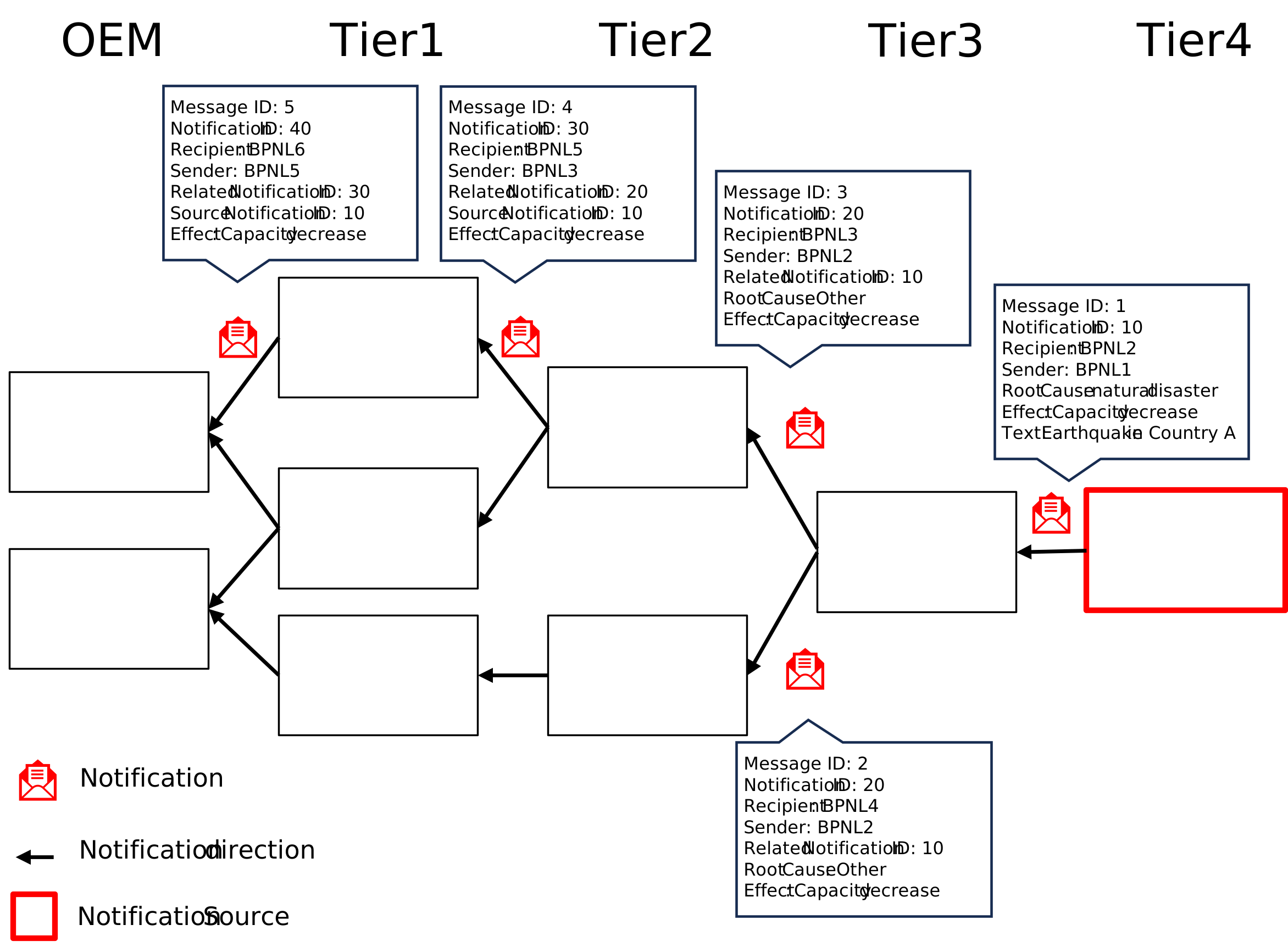 Figure 3: Visualization Notifications Process I
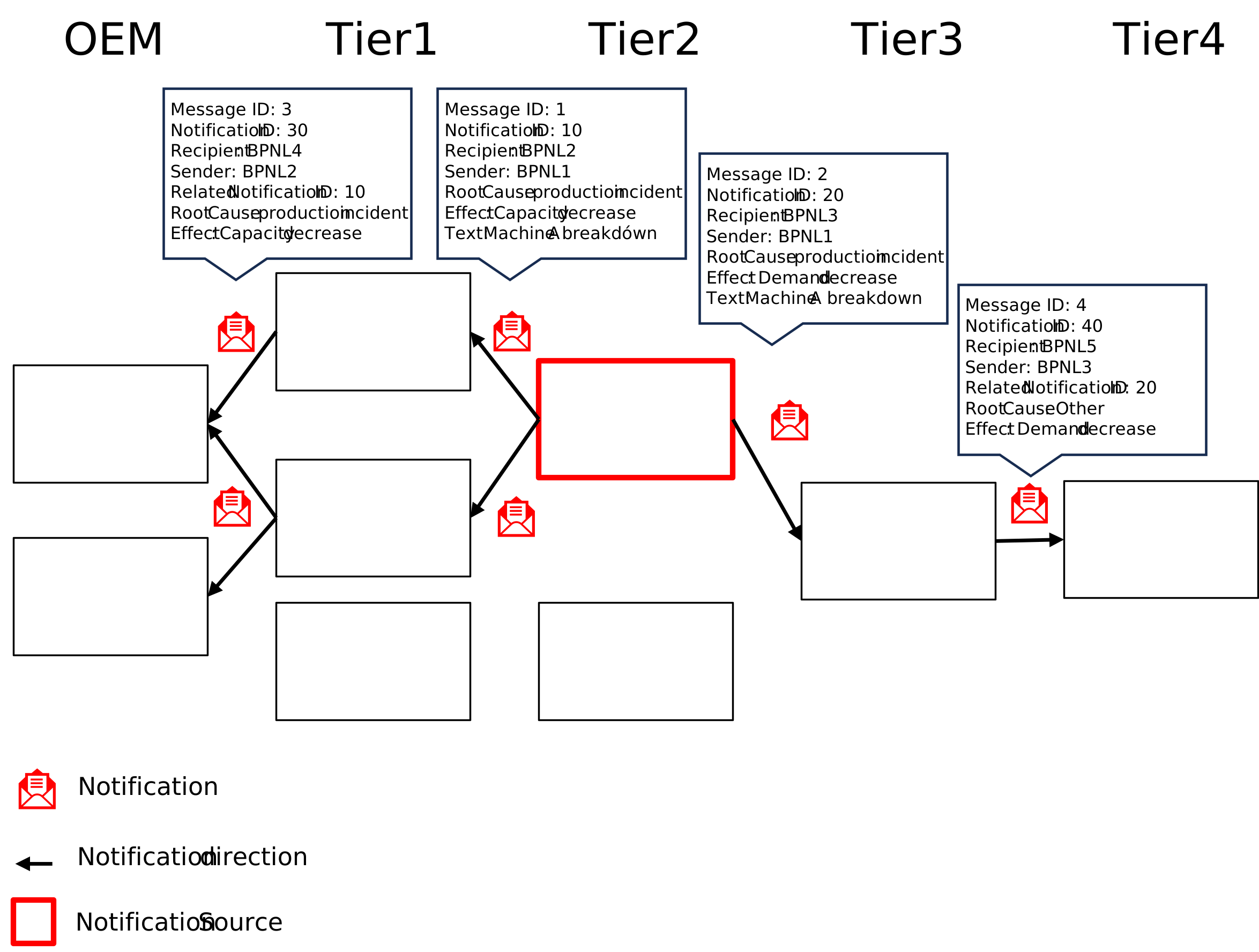 Figure 4: Visualization Notifications Process II
6 REFERENCES
6.1 NORMATIVE REFERENCES
This section is normative
| Number | Standard | Version |
|---|---|---|
| [CX-0001] | EDC Discovery APIAPI An API is a way for two or more computer programs to communicate with each other. | 1.0.2 |
| [CX-0003] | SAMM Aspect Meta Model | 1.1.0 |
| [CX-0006] | Registration and initial onboarding | 2.0.0 |
| [CX-0010] | Business Partner Number (BPNBPN A BPN is the unique identifier of a partner within Catena-X.) | 2.0.0 |
| [CX-0018] | Dataspace Connectivity | 3.0.0 |
| [CX-0126] | Industry Core Part Type | 2.0.0 |
6.2 NON-NORMATIVE REFERENCES
This section is non-normative
| Number | Standard | Version |
|---|---|---|
| [CX-0118] | Delivery Information Exchange | 2.0.0 |
| [CX-0120] | Short-term Material Demand Exchange | 2.0.0 |
| [CX-0121] | Planned Production Output Exchange | 2.0.0 |
| [CX-0122] | Item Stock Exchange | 2.0.0 |
| [CX-0128] | Demand and Capacity Management Data Exchange | 2.0.0 |
| [CX-0145] | Days of Supply Exchange | 1.0.0 |
| [ISO8601] | ISO 8601: Date and time format | |
| [RFC2119] | Bradner, S. Key words for use in RFCs to Indicate Requirement Levels. Available online: https://datatracker.ietf.org/doc/html/rfc2119 | |
| [RFC4122] | A Universally Unique Identifier (UUID) URN Namespace (https://www.rfc-editor.org/rfc/rfc4122) | |
| [RFC8174] | Leiba, B. Ambiguity of Uppercase vs Lowercase in RFC 2119 Key Words. Available online: https://datatracker.ietf.org/doc/html/rfc8174 | |
| [RFC9110] | HTTPHTTP HTTP is an application-layer protocol for transmitting hypermedia documents (such as HTML). It was designed for communication between web browsers and web servers, but can also be used for other purposes. Semantics (https://www.rfc-editor.org/rfc/rfc9110) | |
| [CX-ODRL] | Catena-X ODRL Profile repository: https://github.com/catenax-eV/cx-odrl-profile | |
| [SMT] | How to create a submodel template specification. Guideline. Download from: https://industrialdigitaltwin.org/wp-content/uploads/2022/12/I40-IDTA-WS-Process-How-to-write-a-SMT-FINAL-.pdf |
6.3 REFERENCE IMPLEMENTATIONS
This section is non-normative
Not applicable.
ANNEXES
FIGURES
This section is non-normative
| Figure | Name | Chapter |
|---|---|---|
| Figure 1 | Demand and Capacity Notification APIAPI An API is a way for two or more computer programs to communicate with each other. overview | 4.1 |
| Figure 2 | States of the Demand and Capacity Notifications | 4.1 |
| Figure 3 | Visualization Notifications Process I | 5.3 |
| Figure 4 | Visualization Notifications Process II | 5.3 |
Table 14: List of Figures
TABLES
This section is non-normative
| Table | Name | Chapter |
|---|---|---|
| Table 1 | List of terminology helpful for understanding the standard | 1.5 |
| Table 2 | List of mandatory standards | 2.1.1 |
| Table 3 | List of non-mandatory, but complementary standards | 2.1.1 |
| Table 4 | Endpoint in the data exchange process | 4.1.2.2 |
| Table 5 | Message header fields used in the Demand and Capacity Notification APIAPI An API is a way for two or more computer programs to communicate with each other. | 4.1.2.2 |
| Table 6 | Data assetsAsset On the Data Provider side, an Asset describes the data set which will be shared or can be consumed by a Data Consumer. | 4.1.3 |
| Table 7 | Data assetsAsset On the Data Provider side, an Asset describes the data set which will be shared or can be consumed by a Data Consumer. request properties | 4.1.3 |
| Table 8 | Data assetsAsset On the Data Provider side, an Asset describes the data set which will be shared or can be consumed by a Data Consumer. request properties values | 4.1.3 |
| Table 9 | Request error handling | 4.1.4 |
| Table 10 | Demand and Capacity Notification Payload Description | 5.1 |
| Table 11 | Overview of Actors & Roles | 5.2 |
| Table 12 | List of normative standards | 6.1 |
| Table 13 | List of non-normative standards | 6.2 |
| Table 14 | List if Figures | Annexes |
| Table 15 | List of Tables | Annexes |
Table 15: List of Tables
Legal
Copyright © 2025 Catena-X Automotive Network e.V. All rights reserved. For more information, please visit here.