CX-0030 Aspect Model BoM As Specified v2.0.0
FOR WHOM IS THE STANDARD DESIGNED
COMPARISON WITH THE PREVIOUS VERSION OF THE STANDARD
Relevant only for existing standards. At the new standard, please delete
ABSTRACT
A core problem of the circular economy is making the right decisions. These strategies include Rethink, Refuse, Reduce, Reuse, Refurbish, Redesign, Recycle, Recover and Rot. In particular, the end of life (EoL) decisions are a challenge. In order for a circular economy to scale, however, these must be supported in a standardized way. The present data model is used for this purpose. This supports the products R-Strategy Assistant & Circularity Dashboard to provide decision support for its users. In this first scope, the model should support the EoL decisions in particular. The data provided by the data provider allows relevant decisions to be derived. This leads to higher reuse and recycling rates, an economically and ecologically balanced decision-making process and a scaled circular economy.
1 INTRODUCTION
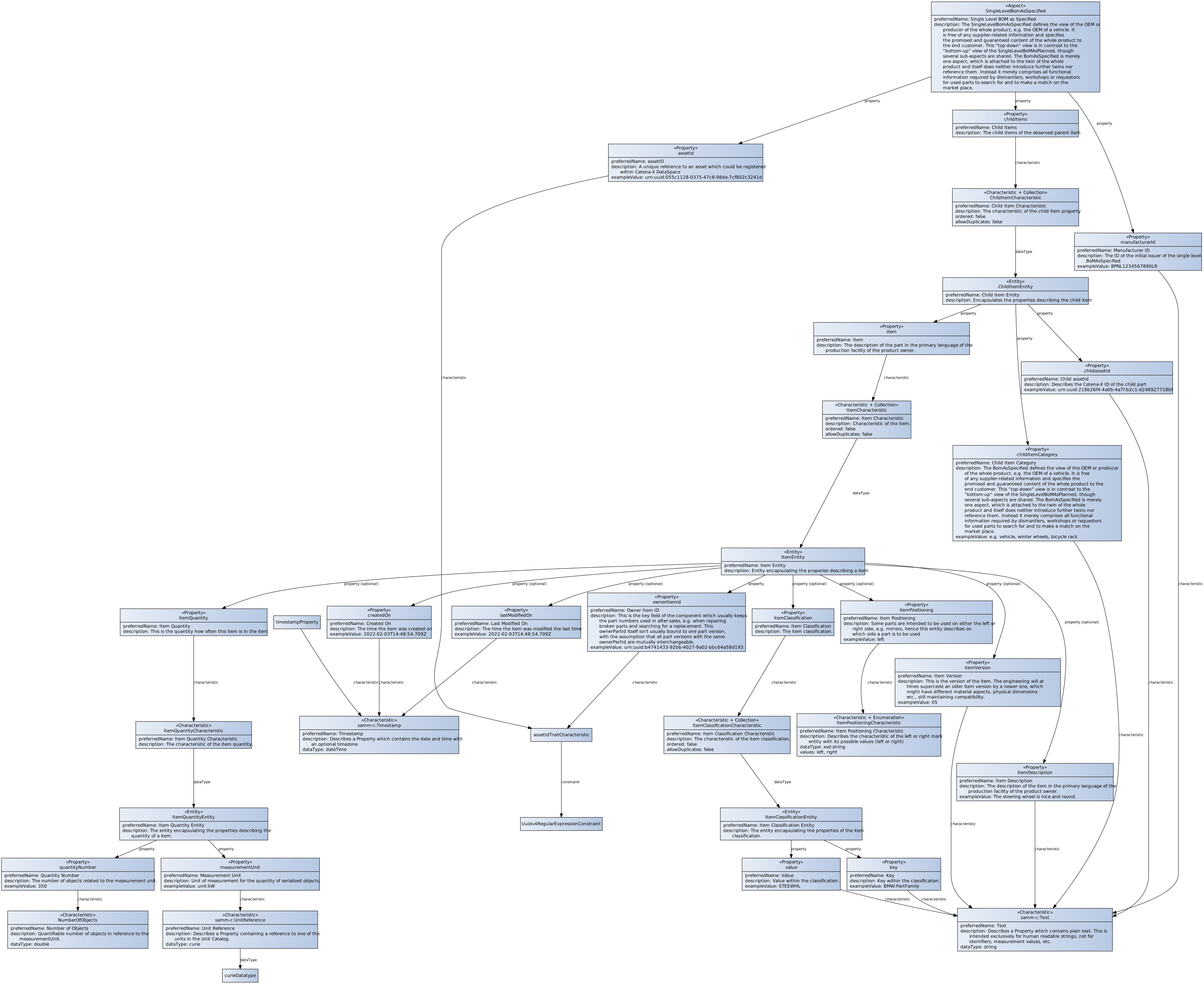
The SingleLevelBoMAsSpecified defines the view of the OEM or producer of the whole product, e.g. the OEM of a vehicle. It is free of any supplierSupplier In the context of OSim, the producer of goods.-related information and specifies the promised and guaranteed content of the whole product to the end customerCustomer In the context of OSim, the receiver of produced goods from a supplier.. This “top-down” view contrasts with the “bottom-up” view of the SingleLevelBoMAsPlanned, though several sub-aspects are shared. The SingleLevelBoMAsSpecified is merely one aspect, which is attached to the twin of the whole product and itself does neither introduce further twins nor reference them. Instead, it merely comprises all functional information required by dismantlers, workshops, or requestors for used parts to search for and to make a match on the marketplace.
1.1 AUDIENCE & SCOPE
This section is non-normative
- Data Provider / Consumer
The purpose of this document is the description of the Asset Administration ShellAsset Administration Shell The AAS is a digital representation of an asset; it is a form of a digital twin. submodel bill of materialBill of Material A Bill of Material (BoM) represents the structure of a product: a list of raw materials, sub-assemblies and sub-components needed to manufacture the end product. In Catena-X Traceability more than one BoM is considered, since the BoM can change during the lifecycle (different BoMs for different lifecycles). (BoM) as specified. It defines the view of the producing company of the produced product. The presented data model is described and illustrated in the following with the entities and properties and their interrelationships. This chapter serves to situate the given reference implementation, to outline its prerequisites and to point out its limitations.
1.2 CONTEXT AND ARCHITECTURE FIT
This section is non-normative
There are several parties needing information about the product, be it dismantlers, workshops or the owners. With the aspect modelAspect Model A formal, machine-readable semantic description (expressed with RDF/Turtle) of data accessible from an aspect. Note 1: An Aspect Model must adhere to the Semantic Aspect Meta Model (SAMM) and be compliant with its validity rules. Note 2: Aspect Models are logical data models that can be used to detail a conceptual model to describe the semantics of runtime data related to a concept; elements of an Aspect Model can/should refer to terms of a standardized Business Glossary (if existing). "as Planned" there is already a model which contains interesting information for these groups. However, this model also reveals sensitive information about the manufacturer, for example supplierSupplier In the context of OSim, the producer of goods. relationships. This creates a conflict between the need for information of the exploiting/using parties and the data sovereignty of the manufacturer. This conflict is solved by the given aspect modelAspect Model A formal, machine-readable semantic description (expressed with RDF/Turtle) of data accessible from an aspect. Note 1: An Aspect Model must adhere to the Semantic Aspect Meta Model (SAMM) and be compliant with its validity rules. Note 2: Aspect Models are logical data models that can be used to detail a conceptual model to describe the semantics of runtime data related to a concept; elements of an Aspect Model can/should refer to terms of a standardized Business Glossary (if existing). "BoMAsSpecified" by providing a top-down view of the product and its components. Together with the aspect modelAspect Model A formal, machine-readable semantic description (expressed with RDF/Turtle) of data accessible from an aspect. Note 1: An Aspect Model must adhere to the Semantic Aspect Meta Model (SAMM) and be compliant with its validity rules. Note 2: Aspect Models are logical data models that can be used to detail a conceptual model to describe the semantics of runtime data related to a concept; elements of an Aspect Model can/should refer to terms of a standardized Business Glossary (if existing). "PartAsSpecified", "BomAsSpecified" provides an abstraction layer for other Catena-X members to obtain relevant information about the product while protecting sensitive information of the manufacturer.
Standarts which are not required but may be interesting to the use case:
1.3 CONFORMANCE AND PROOF OF CONFORMITY
This section is non-normative
As well as sections marked as non-normative, all authoring guidelines, diagrams, examples, and notes in this specification are non-normative. Everything else in this specification is normative.
The key words MAY, MUST, MUST NOT, OPTIONAL, RECOMMENDED, REQUIRED, SHOULD and SHOULD NOT in this document document are to be interpreted as described in BCP 14 [RFC2119] [RFC8174] when, and only when, they appear in all capitals, as shown here.
1.4 EXAMPLES
{
  "manufacturerId": "BPNL1234567890LR",
  "assetId": "urn:uuid:055c1128-0375-47c8-98de-7cf802c3241d",
  "childItems": [
    {
      "childItemCategory": "e.g. vehicle, winter wheels, bicycle rack",
      "item": [
        {
          "itemClassification": [
            {
              "value": "STEEWHL",
              "key": "BMW:PartFamily"
            }
          ],
          "itemQuantity": {
            "quantityNumber": 350.0,
            "measurementUnit": "unit:kW"
          },
          "ownerItemId": "urn:uuid:b4741433-92bb-4027-9a02-bbc64a58d193",
          "itemVersion": "05",
          "itemDescription": "The steering wheel is nice and round",
          "createdOn": "2022-02-03T14:48:54.709Z",
          "itemPositioning": "left",
          "lastModifiedOn": "2022-02-03T14:48:54.709Z"
        }
      ],
      "childassetId": "urn:uuid:218b26f4-4a0b-4a7f-b2c1-d248927718bf "
    }
  ]
}
1.5 TERMINOLOGY
This section is non-normative
The following terms are especially relevant for the understanding of the standard:
Business Partner Number (BPNBPN A BPN is the unique identifier of a partner within Catena-X.) : A BPNBPN A BPN is the unique identifier of a partner within Catena-X. is the unique identifier of a partner within Catena-x
End of life vehicle (EoL vehicle) : 'End-of life vehicle' means a vehicle which is waste within the meaning of Article 1(a) of Directive 75/442/EEC on waste (waste means any substance or object which the holder disposes of or is required to dispose of pursuant to the provisions of national law in force).
Original Equipment Manufacturer (OEM) :An original equipment manufacturer (OEM) is generally perceived as a company that produces non-aftermarket parts and equipment that may be marketed by another manufacturer.
Bill of materialBill of Material A Bill of Material (BoM) represents the structure of a product: a list of raw materials, sub-assemblies and sub-components needed to manufacture the end product. In Catena-X Traceability more than one BoM is considered, since the BoM can change during the lifecycle (different BoMs for different lifecycles). (BOM) :A bill of materialBill of Material A Bill of Material (BoM) represents the structure of a product: a list of raw materials, sub-assemblies and sub-components needed to manufacture the end product. In Catena-X Traceability more than one BoM is considered, since the BoM can change during the lifecycle (different BoMs for different lifecycles). is a list of the raw materials, sub-assemblies, intermediate assemblies, sub-components, parts, and the quantities of each needed to manufacture an end product.
Eclipse Dataspace Connector (EDC) :The Eclipse Dataspace Connector provides a framework for sovereign, inter-organizational data exchange.
2 ASPECT MODEL "Single Level BoM As Specified"
This section is normative
2.1 INTRODUCTION
The purpose of this document is the description of the Asset Administration ShellAsset Administration Shell The AAS is a digital representation of an asset; it is a form of a digital twin. submodel SingleLevelBoMAsSpecified. It defines Bill of MaterialBill of Material A Bill of Material (BoM) represents the structure of a product: a list of raw materials, sub-assemblies and sub-components needed to manufacture the end product. In Catena-X Traceability more than one BoM is considered, since the BoM can change during the lifecycle (different BoMs for different lifecycles). and all relevant attributes. The presented data model is described and illustrated in the following with the entities and properties and their interrelationships.
Every data provider MUST provide the data conformant to the semantic model specified in this document.
The unique identifier of the semantic model specified in this document MUST be used by the data provider to define the semantics of the data being transferred.
Every certified business application using the Single Level BoM As Specified data MUST be able to consume data conformant to the semantic model specified in this document.
This semantic model MUST be made available in the central Semantic Hub.
Data consumers and data provider MUST comply with the license of the semantic model.
In the Catena-X data space Single Level BoM As Specified data MUST be requested and exchanged via Eclipse Dataspace Connector (EDC) conformant to CX-0018 and CX-0002.
The JSON Payload of data providers MUST be conformant to the JSON Schema as specified in this document.
2.2 SPECIFICATION ARTIFACTS
The modelling of the semantic model specified in this document was done in accordance to the "semantic driven workflow" to create a submodel template specification SMT.
This aspect modelAspect Model A formal, machine-readable semantic description (expressed with RDF/Turtle) of data accessible from an aspect. Note 1: An Aspect Model must adhere to the Semantic Aspect Meta Model (SAMM) and be compliant with its validity rules. Note 2: Aspect Models are logical data models that can be used to detail a conceptual model to describe the semantics of runtime data related to a concept; elements of an Aspect Model can/should refer to terms of a standardized Business Glossary (if existing). is written in BAMM 2.0.0 as a modeling language conformant to CX-0003 as input for the semantic deriven workflow.
Like all Catena-X data models, this model is available in a machine-readable format on GitHub2F2F conformant to CX-0003.
2.3 LICENSE
This Catena-X data model is an outcome of Catena-X use case group Digital Product Pass (DPP).This Catena-X data model is made available under the terms of the Creative Commons Attribution 4.0 International (CC-BY-4.0) license, which is available at Creative Commons4F4F.
2.4 IDENTIFER OF SEMANTIC MODEL
The semantic model has the unique identifier:
urn:samm:io.catenax.single_level_bom_as_specified:2.0.0##SingleLevelBomAsSpecified
This identifier MUST be used by the data provider to define the semantics of the data being transferred.
2.5 FORMATS OF SEMANTIC MODEL
All different formats of the semantic model can be found in the github repository.
2.5.1 RDF TURTLE
The rdf turtle file, an instance of the Semantic Aspect Meta Model, is the master for generating additional file formats and serializations.
The open source command line tool of the Eclipse Semantic Modeling Framework is used for generation of other file formats like for example a JSON Schema, aasx for Asset Administration ShellAsset Administration Shell The AAS is a digital representation of an asset; it is a form of a digital twin. Submodel Template or a HTML documentation.
2.5.2 JSON SCHEMA
A JSON Schema can be generated from the RDF Turtle file. The JSON Schema defines the Value-Only payload of the Asset Administration ShellAsset Administration Shell The AAS is a digital representation of an asset; it is a form of a digital twin. for the APIAPI An API is a way for two or more computer programs to communicate with each other. operation "GetSubmodel".
2.5.3 AASX
An AASX file can be generated from the RDF Turtle file. The AASX file defines one of the requested artifacts for a Submodel Template Specification conformant to [SMT].
Note: As soon as the specification V3.0 of the Asset Administration ShellAsset Administration Shell The AAS is a digital representation of an asset; it is a form of a digital twin. specfication is available an update will be provided.
2.6 SEMANTIC MODEL
The data model is described in SAMM . A html documentation can be generated from the rdf turtle file.
So far no .md documentation can be generated. So it is recommended to not
3 REFERENCES
3.1 NORMATIVE REFERENCES
- CX-0003 BAMM Aspect Meta Model v1.0.2
- CX-0002 Digital Twins in Catena - X v2.0.0
- CX-0018 Sovereign Data Exchange (EDC) v2.0.1
3.2 NON-NORMATIVE REFERENCES
This section is non-normative
    [Optional] – Links to further documentation that may help to understand the
    standard but isn’t relevant for conformity assessment
[SMT] How to create a submodel template specification. Guideline. Download from: https://industrialdigitaltwin.org/wp-content/uploads/2022/12/I40-IDTA-WS-Process-How-to-write-a-SMT-FINAL-.pdf
3.3 REFERENCE IMPLEMENTATIONS
This section is non-normative
ANNEXES
FIGURES
This section is non-normative
TABLES
This section is non-normative
Legal
Copyright © 2025 Catena-X Automotive Network e.V. All rights reserved. For more information, please visit here.