CX-0128 - Demand and Capacity Management Data Exchange v2.2.1
ABSTRACT
This section and all its subsections are non-normative
The Catena-X Demand and Capacity Management (DCM) standard is designed for all members of the automotive supply chain. Its goal is to help these members prevent or anticipate production issues that can arise from fluctuations in demand or capacity planning. This standard is particularly relevant for mid- to long-term planning, covering periods up to 24 months into the future. Effective collaboration between partners in a direct business relationship (also referred to as “one-up” and “one-down”) is a key element of success.
The Catena-X DCM standard is accessible to all supply chain participants, including suppliersSupplier In the context of OSim, the producer of goods. and Original Equipment Manufacturers (OEMs), regardless of their size and position in the supply chain. It is particularly useful for those involved in production and production planning. The standard prioritizes parts and materials that are critical to manufacturing, aiming to create mutually beneficial outcomes for all parties involved and to enhance the flexibility in meeting customerCustomer In the context of OSim, the receiver of produced goods from a supplier. needs.
This standard offers an alternative to proprietary systems or manual processes that are often resource-intensive and prone to errors. It provides a collaborative foundation for demand and capacity management within the automotive industry, ensuring compatibility with existing systems and maintaining data sovereignty for all users.
Recent global supply chain disruptions have highlighted the need for greater resilience. The automotive industry, with its complex and volatile environment, has multiple IT solutions and interfaces within a single company and across the supply chain. However, there is a lack of a unified process understanding among all partners.
Demand and Capacity Management (DCM) involves the exchange of demand and capacity data between customersCustomer In the context of OSim, the receiver of produced goods from a supplier. and suppliersSupplier In the context of OSim, the producer of goods. within their direct business relationships. CustomersCustomer In the context of OSim, the receiver of produced goods from a supplier. communicate their anticipated material needs for specific timeframes and suppliersSupplier In the context of OSim, the producer of goods. respond with their planned production capacities for those materials and timeframes.
For successful DCM, companies must share a common understanding that enables the exchange of data across different partners and systems while respecting each partner's data sovereignty.
This standard describes the data models, data exchange protocols and a core business logic for interpreting the data, ensuring a consistent approach for all DCM participants.
Cross-company interactions and common business logic required for DCM are standardized in Chapter 5, while the Application Programming Interfaces (APIsAPI An API is a way for two or more computer programs to communicate with each other.) are described in Chapter 4. The data models are presented in Chapter 3.
COMPARISON WITH PREVIOUS VERSIONS OF THIS STANDARD
This section and all its subsections are non-normative
1 INTRODUCTION
This section and all its subsections are non-normative
1.1 Audience and Scope
This standard is intended for the three roles below, who are involved in the Demand and Capacity Management (DCM) process within the automotive industry:
- Data provider
- Data consumer
- Business application provider
For clarity on the roles and responsibility of each actor, please see Chapter 5.2. The scope of this standard includes regulations for managing future demands and capacities. It does not cover the specific methods companies use to calculate their demand or capacity data, nor does it address internal company measures.
Illustrations and descriptions of roles are provided to help explain concepts and processes but are not mandatory. This standard requires that data consumers, providers and business application providers must adopt a uniform business logic, data models and data exchange protocols to ensure interoperable data exchange.
This standard focuses on direct one-to-one business relationships between customersCustomer In the context of OSim, the receiver of produced goods from a supplier. and suppliersSupplier In the context of OSim, the producer of goods.. Companies participating in Catena-X DCM must have agreed to the Data Exchange Governance framework agreement.
1.2 Context and Architecture Fit
This standard (CX-0128) defines the standard data models and APIsAPI An API is a way for two or more computer programs to communicate with each other. for the following objects, utilized by the DCM use case: WeekBasedMaterialDemand, WeekBasedCapacityGroup, IdBasedRequestForUpdate and IdBasedComment. Applying these standards ensures that:
- All actors participating in the DCM use case provide and consume demand-, capacity- and comment-information in an identical manner
- All actors participating in the DCM use case process data in an identical manner
- All actors participating in the DCM use case exchange data only via a connector conformant to [CX-0018] (e.g. Tractus-X EDCTractus-X EDC The Tractus-X Eclipse Dataspace Connector (Tractus-X EDC) is a reference implementation for a connector conformant to CX-0018 and acts as a de-facto standard/reference implementation within Catena-X; other CX-0018-conformant connectors are also valid options.)
- All actors participating in the DCM use case interpret the exchanged data in an identical manner
The APIsAPI An API is a way for two or more computer programs to communicate with each other. must only be used on the context of Catena-X and must only be accessible via a connector conformant to [CX-0018] (e.g. Tractus-X EDCTractus-X EDC The Tractus-X Eclipse Dataspace Connector (Tractus-X EDC) is a reference implementation for a connector conformant to CX-0018 and acts as a de-facto standard/reference implementation within Catena-X; other CX-0018-conformant connectors are also valid options.).
1.2.1 Architectural Overview
This standard covers the exchange of WeekBasedMaterialDemand, WeekBasedCapacityGroup, IdBasedRequestForUpdate and IdBasedComment data as JSON strings through a connector conformant to [CX-0018].
This standard also discusses the optional use of digital twin registries to support the transmission of WeekBasedMaterialDemand and WeekBasedCapacityGroup objects.
How to build an application that creates and handles these objects is not part of this standard.
1.3 Conformity and Proof of Conformity
Non-mandatory sections include authoring guidelines, diagrams, examples and notes. All other content is mandatory.
The capitalized key words such as MAY, MUST, MUST NOT, OPTIONAL, RECOMMENDED, REQUIRED, SHOULD and SHOULD NOT are to be interpreted as defined in BCP 14 [RFC2119] [RFC8174].
Participants must demonstrate conformity with Catena-X standards. Conformity Assessment Bodies (CABs) verify that standards are correctly applied.
If a participant or application only implements either the business role customerCustomer In the context of OSim, the receiver of produced goods from a supplier. or the business role supplierSupplier In the context of OSim, the producer of goods., then conformity must only be demonstrated along conformity assessment criteria (CACs) that apply to the specific business role.
Conformity assessment criteria are found only in the following chapters:
- 2.3 Policy Constraints for data exchange
- 3.1 Aspect Model WeekBasedMaterialDemand
- 3.2 Aspect Model WeekBasedCapacityGroup
- 3.3 Aspect Model IdBasedRequestForUpdate
- 3.4 Aspect Model IdBasedComment
- 4 APPLICATION PROGRAMMING INTERFACES
- 4.1 WeekBasedMaterialDemand API
- 4.2 WeekBasedCapacityGroup API
- 4.3 IdBasedRequestForUpdate API
- 4.4 IdBasedComment API
- 4.5 DCM Asset Administration Shell API (AAS API)
- 5 PROCESSES
- 6 FRAMEWORK AGREEMENT AND POLICIES
Proof of Conformity for Data Models
Participants must implement and conform to the standardized data models as described in Chapter 3. Depending on which business role a participant or application implements only parts of Chapter 3 are relevant for conformity.
| Data model | Business role | Relevant capability |
|---|---|---|
| WeekBasedMaterialDemand | CustomerCustomer In the context of OSim, the receiver of produced goods from a supplier. | Data provider |
| WeekBasedMaterialDemand | SupplierSupplier In the context of OSim, the producer of goods. | Data consumer |
| WeekBasedCapacityGroup | CustomerCustomer In the context of OSim, the receiver of produced goods from a supplier. | Data consumer |
| WeekBasedMaterialDemand | SupplierSupplier In the context of OSim, the producer of goods. | Data provider |
| IdBasedRequestForUpdate | CustomerCustomer In the context of OSim, the receiver of produced goods from a supplier. or supplierSupplier In the context of OSim, the producer of goods. | Data provider and data consumer |
| IdBasedComment | CustomerCustomer In the context of OSim, the receiver of produced goods from a supplier. or supplierSupplier In the context of OSim, the producer of goods. | Data provider and data consumer |
Proof of Conformity for APIsAPI An API is a way for two or more computer programs to communicate with each other.
Participants must implement and conform to the standardized APIsAPI An API is a way for two or more computer programs to communicate with each other. as described in Chapter 4. Depending on which business role a participant or application implements only parts of Chapter 4 are relevant for conformity.
| APIAPI An API is a way for two or more computer programs to communicate with each other. taxonomy | Business role | Relevant capability |
|---|---|---|
| DcmWeekBasedMaterialDemand | CustomerCustomer In the context of OSim, the receiver of produced goods from a supplier. | Call APIAPI An API is a way for two or more computer programs to communicate with each other. |
| DcmWeekBasedMaterialDemand | SupplierSupplier In the context of OSim, the producer of goods. | Offer APIAPI An API is a way for two or more computer programs to communicate with each other. |
| DcmWeekBasedCapacityGroup | CustomerCustomer In the context of OSim, the receiver of produced goods from a supplier. | Offer APIAPI An API is a way for two or more computer programs to communicate with each other. |
| DcmWeekBasedCapacityGroup | SupplierSupplier In the context of OSim, the producer of goods. | Call APIAPI An API is a way for two or more computer programs to communicate with each other. |
| DcmIdBasedRequestForUpdate | CustomerCustomer In the context of OSim, the receiver of produced goods from a supplier. or supplierSupplier In the context of OSim, the producer of goods. | Offer APIAPI An API is a way for two or more computer programs to communicate with each other. and call APIAPI An API is a way for two or more computer programs to communicate with each other. |
| DcmIdBasedComment | CustomerCustomer In the context of OSim, the receiver of produced goods from a supplier. or supplierSupplier In the context of OSim, the producer of goods. | Offer APIAPI An API is a way for two or more computer programs to communicate with each other. and call APIAPI An API is a way for two or more computer programs to communicate with each other. |
| Submodel | CustomerCustomer In the context of OSim, the receiver of produced goods from a supplier. or supplierSupplier In the context of OSim, the producer of goods. | Offer APIAPI An API is a way for two or more computer programs to communicate with each other. and call APIAPI An API is a way for two or more computer programs to communicate with each other. |
Proof of Conformity for Process and Core Business Logic
Participants must implement and conform to the DCM core business logic as described in Chapter 5. Depending on which business role a participant or application implements only parts of Chapter 5 are relevant for conformity.
| Relevant process step | Business role |
|---|---|
| Manage demands | CustomerCustomer In the context of OSim, the receiver of produced goods from a supplier. |
| Manage capacities | SupplierSupplier In the context of OSim, the producer of goods. |
| Bottleneck calculation | CustomerCustomer In the context of OSim, the receiver of produced goods from a supplier. and supplierSupplier In the context of OSim, the producer of goods. |
| Collaborate | CustomerCustomer In the context of OSim, the receiver of produced goods from a supplier. and supplierSupplier In the context of OSim, the producer of goods. |
| Align capacities and demands | CustomerCustomer In the context of OSim, the receiver of produced goods from a supplier. and supplierSupplier In the context of OSim, the producer of goods. |
| Update demands | CustomerCustomer In the context of OSim, the receiver of produced goods from a supplier. |
| Update capacities | SupplierSupplier In the context of OSim, the producer of goods. |
1.4 Examples
1.4.1 Examples for Process and Core Business Logic
CustomersCustomer In the context of OSim, the receiver of produced goods from a supplier. and suppliersSupplier In the context of OSim, the producer of goods. must have agreed to the Data Exchange Governance framework agreement, implement the core business logic from Chapter 5 and manage their access authorizations. They should ensure that material demand and capacity data are accurate, regularly updated and shared in a standardized format.
Business application providers must implement APIsAPI An API is a way for two or more computer programs to communicate with each other. as described in this standard and enforce requirements for a trusted usage environment, contractual agreements and antitrust requirements. Their applications must also enforce process traceability and data sovereignty.
1.4.2 Examples for Data Models
This section provides JSON examples for WeekBasedMaterialDemand, WeekBasedCapacityGroup, IdBasedRequestForUpdate and IdBasedComment payloads. Further property descriptions are available in Chapter 5.
1.4.2.1 WeekBasedMaterialDemand data model JSON structure
{
  "unitOfMeasureIsOmitted" : false,
  "unitOfMeasure" : "unit:piece",
  "materialDescriptionCustomer" : "Spark Plug",
  "materialGlobalAssetId" : "urn:uuid:48878d48-6f1d-47f5-8ded-a441d0d879df",
  "materialDemandId" : "0157ba42-d2a8-4e28-8565-7b07830c1110",
  "materialNumberSupplier" : "MNR-8101-ID146955.001",
  "supplier" : "BPNL000000000BXT",
  "changedAt" : "2023-11-05T08:15:30.123-05:00",
  "demandSeries" : [ {
    "expectedSupplierLocation" : "BPNS000000000PFA",
    "demands" : [ {
      "demand" : 1000,
      "pointInTime" : "2023-10-09"
    } ],
    "customerLocation" : "BPNS0000000000WN",
    "demandCategory" : {
      "demandCategoryCode" : "0001"
    }
  } ],
  "materialDemandIsInactive" : true,
  "materialNumberCustomer" : "MNR-7307-AU340474.002",
  "customer" : "BPNL00000000015G"
}
1.4.2.2 WeekBasedCapacityGroup data model JSON structure
{
  "unitOfMeasure" : "unit:piece",
  "linkedDemandSeries" : [ {
    "loadFactor" : 3.5,
    "materialNumberCustomer" : "MNR-7307-AU340474.002",
    "materialNumberSupplier" : "MNR-8101-ID146955.001",
    "customerLocation" : "BPNS0000000000WN",
    "demandCategory" : {
      "demandCategoryCode" : "0001"
    }
  } ],
  "linkedCapacityGroups" : [ "be4d8470-2de6-43d2-b5f8-2e5d3eebf3fd" ],
  "unitOfMeasureIsOmitted" : false,
  "capacityGroupIsInactive" : true,
  "demandVolatilityParameters" : {
    "rollingHorizonAlertThresholds" : [ {
      "sequenceNumber" : 1,
      "absoluteNegativeDeviation" : 100.0,
      "subhorizonLength" : 4,
      "relativeNegativeDeviation" : 0.3,
      "absolutePositiveDeviation" : 100.0,
      "relativePositiveDeviation" : 0.2
    } ],
    "measurementInterval" : 4,
    "startReferenceDateTime" : "2024-01-10T12:00:00.320Z"
  },
  "supplier" : "BPNL000000000BXT",
  "name" : "Spark Plugs on drilling machine for car model XYZ",
  "supplierLocations" : [ "BPNS000000000PFA" ],
  "capacities" : [ {
    "pointInTime" : "2022-08-01",
    "agreedCapacity" : 1800,
    "actualCapacity" : 1000,
    "maximumCapacity" : 2000,
    "deltaProductionResult" : 400
  } ],
  "changedAt" : "2023-03-10T12:27:11.320Z",
  "capacityGroupId" : "0157ba42-d2a8-4e28-8565-7b07830c1110",
  "customer" : "BPNL00000000015G"
}
1.4.2.3 IdBasedRequestForUpdate data model JSON structure
1.4.2.3.1 RfU: Provide Everything
{
}
1.4.2.3.2 RfU: Provide only Material Demands
{
    "weekBasedMaterialDemand": [
    ]
}
1.4.2.3.3 RfU: Provide only Capacity Groups
{
    "weekBasedCapacityGroup": [
    ]
}
1.4.2.3.4 RfU: Provide only certain Objects
{
  "weekBasedMaterialDemand": [
    {
      "materialDemandId": "0157ba42-d2a8-4e28-8565-7b07830c3456"
    }
  ],
  "weekBasedCapacityGroup": [
    {
      "capacityGroupId": "0157ba42-d2a8-4e28-8565-7b07830c1110"
    },
    {
      "capacityGroupId": "a2fc69ac-ede7-48d3-bee5-04de665d49f0"
    },
    {
      "capacityGroupId": "34238729-990a-4b61-b0c6-336da7b71675"
    }
  ]
}
1.4.2.3.5 RfU: Provide only certain Objects and only if my version is not up to date
{
  "weekBasedMaterialDemand" : [ {
    "materialDemandId" : "0157ba42-d2a8-4e28-8565-7b07830c3456",
    "changedAt" : "2023-03-10T12:27:11.320Z"
  } ],
  "weekBasedCapacityGroup" : [ {
    "capacityGroupId" : "0157ba42-d2a8-4e28-8565-7b07830c1110",
    "changedAt" : "2023-03-10T12:27:11.320Z"
  } ]
}
1.4.2.4 IdBasedComment data model JSON structure
{
  "postedAt" : "2023-03-10T12:27:11.320Z",
  "listOfReferenceDates" : [ "2023-11-05" ],
  "author" : "someone@company.com",
  "supplier" : "BPNL000000000BXT",
  "commentType" : "information",
  "commentId" : "f5c151e4-30b5-4456-94fd-2a7b559b6121",
  "changedAt" : "2023-03-10T12:27:11.320Z",
  "commentText" : "Hello, this is a comment!",
  "requestDelete" : true,
  "objectId" : "dfeb1334-497e-4dab-97c1-4e6f4e1c0320",
  "objectType" : "urn:samm:io.catenax.week_based_capacity_group",
  "customer" : "BPNL00000000015G"
}
1.4.3 Examples for Data Assets
This section provides JSON examples for registering APIAPI An API is a way for two or more computer programs to communicate with each other. endpoints as data assetsAsset On the Data Provider side, an Asset describes the data set which will be shared or can be consumed by a Data Consumer. with your own connector conformant to CX-0018.
1.4.3.1 WeekBasedMaterialDemand API endpoint data asset
{
  "@context": {
    "edc": "https://w3id.org/edc/v0.0.1/ns/",
    "cx-common": "https://w3id.org/catenax/ontology/common#",
    "cx-taxo": "https://w3id.org/catenax/taxonomy#",
    "dct": "http://purl.org/dc/terms/"
  },
  "@id": "catx-dcm-materialdemand-receive",
  "properties": {
    "dct:type": {
      "@id": "cx-taxo:DcmWeekBasedMaterialDemand"
    },
    "description": "Endpoint for providing Material Demands",
    "cx-common:version": "2.0"
  },
  "dataAddress": {
    "@type": "DataAddress",
    "type": "HttpData",
    "baseUrl": "https://myApplication.myCompany.com/catx/api/md",
    "method": "POST",
    "proxyBody": "true",
    "contentType": "application/json"
  }
}
1.4.3.2 WeekBasedCapacityGroup API endpoint data asset
{
  "@context": {
    "edc": "https://w3id.org/edc/v0.0.1/ns/",
    "cx-common": "https://w3id.org/catenax/ontology/common#",
    "cx-taxo": "https://w3id.org/catenax/taxonomy#",
    "dct": "http://purl.org/dc/terms/"
  },
  "@id": "catx-dcm-capacitygroup-receive",
  "properties": {
    "dct:type": {
      "@id": "cx-taxo:DcmWeekBasedCapacityGroup"
    },
    "description": "Endpoint for providing Week Based Capacity Groups",
    "cx-common:version": "2.0"
  },
  "dataAddress": {
    "@type": "DataAddress",
    "type": "HttpData",
    "baseUrl": "https://myApplication.myCompany.com/catx/api/cg",
    "method": "POST",
    "proxyBody": "true",
    "contentType": "application/json"
  }
}
1.4.3.3 IdBasedRequestForUpdate API endpoint data asset
{
  "@context": {
    "edc": "https://w3id.org/edc/v0.0.1/ns/",
    "cx-common": "https://w3id.org/catenax/ontology/common#",
    "cx-taxo": "https://w3id.org/catenax/taxonomy#",
    "dct": "http://purl.org/dc/terms/"
  },
  "@id": "catx-dcm-rfu-receive",
  "properties": {
    "dct:type": {
      "@id": "cx-taxo:DcmIdBasedRequestForUpdate"
    },
    "description": "Endpoint for requesting updates",
    "cx-common:version": "2.0"
  },
  "dataAddress": {
    "@type": "DataAddress",
    "type": "HttpData",
    "baseUrl": "https://myApplication.myCompany.com/catx/api/rfu",
    "method": "POST",
    "proxyBody": "true",
    "contentType": "application/json"
  }
}
1.4.3.4 IdBasedComment API endpoint data asset
{
  "@context": {
    "edc": "https://w3id.org/edc/v0.0.1/ns/",
    "cx-common": "https://w3id.org/catenax/ontology/common#",
    "cx-taxo": "https://w3id.org/catenax/taxonomy#",
    "dct": "http://purl.org/dc/terms/"
  },
  "@id": "catx-dcm-comment-receive",
  "properties": {
    "dct:type": {
      "@id": "cx-taxo:DcmIdBasedComment"
    },
    "description": "Endpoint for providing comments",
    "cx-common:version": "2.0"
  },
  "dataAddress": {
    "@type": "DataAddress",
    "type": "HttpData",
    "baseUrl": "https://myApplication.myCompany.com/catx/api/cmt",
    "method": "POST",
    "proxyBody": "true",
    "contentType": "application/json"
  }
}
1.4.4 Capabilities as data assets
This section provides JSON examples for data assetAsset On the Data Provider side, an Asset describes the data set which will be shared or can be consumed by a Data Consumer., policy and contract definition as utilized Chapter 4.6 Capabilities as Data Assets. A catalog request with response is shown as well.
1.4.4.1 Capability data asset
{
    "@context": {
        "edc": "https://w3id.org/edc/v0.0.1/ns/",
        "cx-common": "https://w3id.org/catenax/ontology/common#",
        "cx-taxo": "https://w3id.org/catenax/taxonomy#",
        "dct": "http://purl.org/dc/terms/"
    },
    "@id": "capability-load-factor",
    "properties": {
        "dct:type": {
            "@id": "cx-taxo:DcmLoadFactor"
        },
        "description": "I do support the optional capability load factors"
    },
  "dataAddress": {
  "@type": "DataAddress",
  "type": "HttpData",
  "baseUrl": "https://myCompany.com"

 }
}
1.4.4.2 Always True Policy
{
    "@id": "always-true",
    "@type": "PolicyDefinition",
    "createdAt": 1729522849169,
    "policy": {
        "@id": "f65bbd32-9674-4cd7-a3c3-280dab4653a6",
        "@type": "odrl:Set",
        "odrl:permission": [],
        "odrl:prohibition": [],
        "odrl:obligation": []
    },
    "@context": {
        "tx": "https://w3id.org/tractusx/v0.0.1/ns/",
        "tx-auth": "https://w3id.org/tractusx/auth/",
        "cx-policy": "https://w3id.org/catenax/2025/9/policy/context.jsonld",
        "@vocab": "https://w3id.org/edc/v0.0.1/ns/",
        "edc": "https://w3id.org/edc/v0.0.1/ns/",
        "odrl": "http://www.w3.org/ns/odrl/2/"
    }
}
1.4.4.3 Contract Definition
{
    "@context": {},
    "@id": "DcmLoadFactor",
    "@type": "ContractDefinition",
    "accessPolicyId": "always-true",
    "contractPolicyId": "always-true",
    "assetsSelector": {
        "@type": "CriterionDto",
        "operandLeft": "https://w3id.org/edc/v0.0.1/ns/id",
        "operator": "=",
        "operandRight": "capability-load-factor"
    }
}
1.4.4.4 Catalog request
{
 "@context": {},
 "protocol": "dataspace-protocol-http",
 "counterPartyAddress": "https://partnerEdc.com/api/v1/dsp",
 "counterPartyId": "BPNL000000000BXT",
 "querySpec": {
  "@type": "QuerySpecDto",
  "https://w3id.org/edc/v0.0.1/ns/offset": 0,
  "https://w3id.org/edc/v0.0.1/ns/limit": 2,
  "https://w3id.org/edc/v0.0.1/ns/filterExpression": [
   {
    "@type": "CriterionDto",
    "operandLeft": "'http://purl.org/dc/terms/type'.'@id'",
    "operator": "=",
    "operandRight": "https://w3id.org/catenax/taxonomy#DcmLoadFactor"
   }
  ]
 }
}
1.4.4.5 Response to catalog request
{
  "@id": "72d62115-d1f2-47ff-b522-f647f45dabdb",
  "@type": "dcat:Catalog",
  "dcat:dataset": {
    "@id": "capability-load-factor",
    "@type": "dcat:Dataset",
    "odrl:hasPolicy": {
      "@id": "RGNtTG9hZEZhY3Rvci00:Y2FwYWJpbGl0eS1sb2FkLWZhY3Rvcg==:NmIzZGVjMzgtZjllOS00NTljLTk4ZGQtOGY1MmVlMjhiMmVm",
      "@type": "odrl:Offer",
      "odrl:permission": [],
      "odrl:prohibition": [],
      "odrl:obligation": []
    },
    "dcat:distribution": [
      {
        "@type": "dcat:Distribution",
        "dct:format": {
          "@id": "AzureStorage-PUSH"
        },
        "dcat:accessService": {
          "@id": "743fc8be-e463-433b-80e4-640373dc4a66",
          "@type": "dcat:DataService",
          "dcat:endpointDescription": "dspace:connector",
          "dcat:endpointUrl": "https://myCompany.com/api/v1/dsp",
          "dcat:endpointURL": "https://myCompany.com/api/v1/dsp"
        }
      },
      {
        "@type": "dcat:Distribution",
        "dct:format": {
          "@id": "HttpData-PULL"
        },
        "dcat:accessService": {
          "@id": "743fc8be-e463-433b-80e4-640373dc4a66",
          "@type": "dcat:DataService",
          "dcat:endpointDescription": "dspace:connector",
          "dcat:endpointUrl": "https://myCompany.com/api/v1/dsp",
          "dcat:endpointURL": "https://myCompany.com/api/v1/dsp"
        }
      },
      {
        "@type": "dcat:Distribution",
        "dct:format": {
          "@id": "HttpData-PUSH"
        },
        "dcat:accessService": {
          "@id": "743fc8be-e463-433b-80e4-640373dc4a66",
          "@type": "dcat:DataService",
          "dcat:endpointDescription": "dspace:connector",
          "dcat:endpointUrl": "https://myCompany.com/api/v1/dsp",
          "dcat:endpointURL": "https://myCompany.com/api/v1/dsp"
        }
      },
      {
        "@type": "dcat:Distribution",
        "dct:format": {
          "@id": "AmazonS3-PUSH"
        },
        "dcat:accessService": {
          "@id": "743fc8be-e463-433b-80e4-640373dc4a66",
          "@type": "dcat:DataService",
          "dcat:endpointDescription": "dspace:connector",
          "dcat:endpointUrl": "https://myCompany.com/api/v1/dsp",
          "dcat:endpointURL": "https://myCompany.com/api/v1/dsp"
        }
      }
    ],
    "dct:type": {
      "@id": "https://w3id.org/catenax/taxonomy#DcmLoadFactor"
    },
    "description": "I do support the optional capability load factors",
    "id": "capability-load-factor"
  },
  "dcat:catalog": [],
  "dcat:distribution": [],
  "dcat:service": {
    "@id": "743fc8be-e463-433b-80e4-640373dc4a66",
    "@type": "dcat:DataService",
    "dcat:endpointDescription": "dspace:connector",
    "dcat:endpointUrl": "https://myCompany.com/api/v1/dsp",
    "dcat:endpointURL": "https://myCompany.com/api/v1/dsp"
  },
  "dspace:participantId": "BPNL000000000BXT",
  "@context": {
    "tx": "https://w3id.org/tractusx/v0.0.1/ns/",
    "tx-auth": "https://w3id.org/tractusx/auth/",
    "cx-policy": "https://w3id.org/catenax/2025/9/policy/context.jsonld",
    "dcat": "http://www.w3.org/ns/dcat#",
    "dct": "http://purl.org/dc/terms/",
    "odrl": "http://www.w3.org/ns/odrl/2/",
    "dspace": "https://w3id.org/dspace/v0.8/",
    "@vocab": "https://w3id.org/edc/v0.0.1/ns/",
    "edc": "https://w3id.org/edc/v0.0.1/ns/"
  }
}
1.4.5 AAS API Examples
1.4.5.1 Submodel registration
{
  "id": "{{id of the AAS}}",
  "idShort": "{{short name of your AAS}}",
  "specificAssetIds": [
    {
      "name": "creationEntityId",
      "value": "{{someUuidV4}}",
      "externalSubjectId": {
        "type": "ExternalReference",
        "keys": [
          {
            "type": "GlobalReference",
            "value": "*"
          }
        ]
      }
    }
  ],
  "submodelDescriptors": [
    {
      "id": "{{someSubmodelId}}",
      "semanticId": {
        "type": "ExternalReference",
        "keys": [
          {
            "type": "GlobalReference",
            "value": "urn:samm:io.catenax.week_based_capacity_group:2.0.0#WeekBasedCapacityGroup"
          }
        ]
      },
      "endpoints": [
        {
          "interface": "SUBMODEL-3.0",
          "protocolInformation": {
            "href": "{{dataplane baseurl extended with the appropriate path ending on /submodel}}",
            "endpointProtocol": "HTTP",
            "endpointProtocolVersion": [
              "1.1"
            ],
            "subprotocol": "DSP",
            "subprotocolBody": "id={{ID of the connector asset the submodel is living behind}};dspEndpoint={{controlPlaneEndpoint}}",
            "subprotocolBodyEncoding": "plain",
            "securityAttributes": [
              {
                "type": "NONE",
                "key": "NONE",
                "value": "NONE"
              }
            ]
          }
        }
      ]
    }
  ]
}
1.4.5.2 Data asset definition
{
  "@context": {
    "cx-common": "https://w3id.org/catenax/ontology/common#",
    "ctx": "https://w3id.org/catenax/taxonomy#",
    "aas-semantics": "https://admin-shell.io/aas/3/0/HasSemantics/"
  },
  "@id": "{{ID for the Asset}}",
  "properties": {
    "dct:type": {
      "@id": "ctx:Submodel"
    },
    "cx-common:version": "3.0",
    "aas-semantics:semanticId": "{{URN of WeekBasedMaterialDemand or WeekBasedCapacityGroup Submodel}}"
    },
    "dataAddress": {
      "@type": "DataAddress",
      "type": "HttpData",
      "proxyPath": "true",
      "proxyBody": "true",
      "proxyMethod": "true",
      "proxyQueryParams": "true",
      "baseUrl": "{{Submodel endpoint ending before /submodel}}"
    }
}
1.4.5.3 Policy definition
{
  "@context": {
    "@vocab": "https://w3id.org/edc/v0.0.1/ns/",
    "http://www.w3.org/ns/odrl/2/"
    "https://w3id.org/catenax/2025/9/policy/context.jsonld"
  },
  "@type": "Set",
  "@id": "{{POLICY-DEFINITION-ID}}",
  "policy": {
    "permission": [
      {
        "action": "access",
        "constraint": [
          {
            "and": [
              {
              "leftOperand": "BusinessPartnerNumber",
              "operator": "isAnyOf",
              "rightOperand": "{{hard-coded BPNLs of privileged consumer}}"
              }

             ]
          }
        ]
      }
    ]
  }
}
1.4.5.4 Contract definition
{
  "@context": {
    "@vocab": "https://w3id.org/edc/v0.0.1/ns/"
  },
  "@type": "ContractDefinition",
  "@id": "contract-definition-id",
  "accessPolicyId": "{{POLICY-DEFINITION-ID}}",
  "contractPolicyId": "{{POLICY-DEFINITION-ID}}",
  "assetsSelector": [
    {
      "operandLeft": "https://w3id.org/edc/v0.0.1/ns/id",
      "operator": "=",
      "operandRight": "{{ID for the Asset}}"
    }
  ]
}
1.5 Terminology
| Term | Description |
|---|---|
| Actual Capacity | This is the capacity a supplierSupplier In the context of OSim, the producer of goods. realistically plans to have available to produce a certain amount of material per week for a customerCustomer In the context of OSim, the receiver of produced goods from a supplier.. It takes into account the supplierSupplier In the context of OSim, the producer of goods.'s own assessment of their capabilities, inventory and existing commitments. |
| Agreed Capacity | May be coordinated between customerCustomer In the context of OSim, the receiver of produced goods from a supplier. and supplierSupplier In the context of OSim, the producer of goods.. The agreed capacity must not constitute a legal obligation to deliver. Using the agreed capacity is optional and has purely informative character. The agreed capacity may be greater than, less than or equal to the actual or maximum capacity of the supplierSupplier In the context of OSim, the producer of goods.. It may be used for a time frame shorter than the whole time series. |
| Aspect ModelAspect Model A formal, machine-readable semantic description (expressed with RDF/Turtle) of data accessible from an aspect. Note 1: An Aspect Model must adhere to the Semantic Aspect Meta Model (SAMM) and be compliant with its validity rules. Note 2: Aspect Models are logical data models that can be used to detail a conceptual model to describe the semantics of runtime data related to a concept; elements of an Aspect Model can/should refer to terms of a standardized Business Glossary (if existing). | An Aspect modelAspect Model A formal, machine-readable semantic description (expressed with RDF/Turtle) of data accessible from an aspect. Note 1: An Aspect Model must adhere to the Semantic Aspect Meta Model (SAMM) and be compliant with its validity rules. Note 2: Aspect Models are logical data models that can be used to detail a conceptual model to describe the semantics of runtime data related to a concept; elements of an Aspect Model can/should refer to terms of a standardized Business Glossary (if existing). is a structured, machine-readable description of data. It utilizes the Turtle file format to serialize a Resource Description Framework (RDF) graph, that relates to a specific aspect. It must follow the Semantic Aspect Meta Model (SAMM) guidelines, meaning it uses defined elements and rules from SAMM. Aspect modelsAspect Model A formal, machine-readable semantic description (expressed with RDF/Turtle) of data accessible from an aspect. Note 1: An Aspect Model must adhere to the Semantic Aspect Meta Model (SAMM) and be compliant with its validity rules. Note 2: Aspect Models are logical data models that can be used to detail a conceptual model to describe the semantics of runtime data related to a concept; elements of an Aspect Model can/should refer to terms of a standardized Business Glossary (if existing). help to clarify the meaning of data at runtime and should link to standardized business glossary terms, if available. |
| Bottleneck | A facility, function, department, or resource whose capacity is less than the demand placed upon it. For example, a bottleneck machine or work center exists where jobs are processed at a slower rate than they are demanded (Source: ASCM Supply Chain Dictionary, 17th edition). |
| Business application provider | Offers tools for demand and capacity management that conform to the core business logic, data models and APIsAPI An API is a way for two or more computer programs to communicate with each other. described in this standard. |
| Business Partner Number Legal Entity (BPNLBPNL The unique identifier of a legal entity of a partner within Catena-X (e.g., a company).) | A BPNLBPNL The unique identifier of a legal entity of a partner within Catena-X (e.g., a company). is an unique identifier for a company or partner within the Catena-X network. |
| Business Partner Number Site (BPNSBPNS The unique identifier of a partner site within Catena-X (e.g., a specific factory).) | A BPNSBPNS The unique identifier of a partner site within Catena-X (e.g., a specific factory). is an unique identifier for a specific location, such as a factory, within the Catena-X network. |
| Calendar Week | A week consisting of seven days, typically numbered according to the week containing the year's first Thursday. For example, if the first Thursday of the year is on January 1st, that week is considered Week 1. |
| Capacity | 1. The capability of a system to perform its expected function. 2. The capability of a worker, machine, work center, plant, or organization to produce output per time period. (Source: ASCM Supply Chain Dictionary, 17th edition). |
| Capacity Group | A Capacity Group is where material demand and capacity information are matched for collaborative planning. When written as WeekBasedCapacityGroup, it refers to a specific data model within this standard. |
| Comment | A feature that allows two business partners to exchange messages about material demand and capacity, facilitating direct collaboration and quick issue resolution. |
| Comments | These are purely text-based exchanges without the transfer of documents or attachments. |
| CreationEntity | Currently, a Creation Entity groups WeekBasedCapacityGroup objects to support digital twins in the planning process. It may represent a production plant and will be further defined in future revisions of this standard. |
| CustomerCustomer In the context of OSim, the receiver of produced goods from a supplier. | A role within the DCM use case. Receives goods from its suppliersSupplier In the context of OSim, the producer of goods.. Participating companies can have multiple roles at the same time. CustomersCustomer In the context of OSim, the receiver of produced goods from a supplier. provide consistent and up-to-date demand forecast and receive capacity data from suppliersSupplier In the context of OSim, the producer of goods.. |
| Delta-Production | This is an optional feature that allows suppliersSupplier In the context of OSim, the producer of goods. to manage capacity bottlenecks by shifting demand from one week to another in production without altering actual capacity, maximum capacity or the material demand. |
| Demand Deviation | This is an optional metric that allows suppliersSupplier In the context of OSim, the producer of goods. to monitor changes in customerCustomer In the context of OSim, the receiver of produced goods from a supplier. demands and to identify significant changes that can collaboratively be addressed by suppliersSupplier In the context of OSim, the producer of goods. and customersCustomer In the context of OSim, the receiver of produced goods from a supplier.. |
| Digital Twin | Based on [CX-0002] Standard a digital twin (DT) describes a digital representation of an assetAsset On the Data Provider side, an Asset describes the data set which will be shared or can be consumed by a Data Consumer. sufficient to meet the requirements of a set of use cases. For detailed information please refer to [CX-0002] Digital Twins in Catena-X. |
| Flexible Capacity | The difference between maximum and actual capacity, representing the potential to increase capacity without further agreements, such as extending the use of production resources within a week. In particular, it refers to measures to extend the weekly utilization of the available production resources. |
| Linking material demand | Material demands can be linked directly to a capacity group or indirectly through another capacity group, which is known as "Nesting." |
| Load Factor | Optional feature of a capacity group. ~ adds individual numerical material load factors to WeekBasedMaterialDemand linked by the WeekBasedCapacityGroup. ~ adds flexibility to the unit of measure of the capacity group. |
| Material | The elements, constituents, or substances of which something is composed or can be made. Usually referred to by a material number. |
| (Material) demand | A need for a particular product or component. The demand could come from any number of sources (e.g., a customerCustomer In the context of OSim, the receiver of produced goods from a supplier. order or forecast, an interplant requirement, a branch warehouse request for a service part, or the manufacturing of another product). At the finished goods level, demand data is usually different from sales data because demand does not necessarily result in sales (i.e., If there is no stock, there will be no sale (Source: ASCM Supply Chain Dictionary, 17th edition)). Material demand may comprise multiple demand series by location and demand categories. When the term is written as one word (WeekBasedMaterialDemand), the term refers specifically to the respective aspect modelAspect Model A formal, machine-readable semantic description (expressed with RDF/Turtle) of data accessible from an aspect. Note 1: An Aspect Model must adhere to the Semantic Aspect Meta Model (SAMM) and be compliant with its validity rules. Note 2: Aspect Models are logical data models that can be used to detail a conceptual model to describe the semantics of runtime data related to a concept; elements of an Aspect Model can/should refer to terms of a standardized Business Glossary (if existing).. |
| Maximum Capacity | Is the maximum releasable capacity of a supplierSupplier In the context of OSim, the producer of goods. which should be possible to achieve a material output per calendar week with a certain unit of measure for one customerCustomer In the context of OSim, the receiver of produced goods from a supplier.. The maximum capacity is based on capacity-increasing measures, agreed by the parties involved. Capacity-increasing measures can be, for example, a longer utilization of the available production resources, a shift extension or additional shifts. Secondarily, additional resources can also be activated. |
| Nesting | A method by which a capacity group links another capacity group, allowing for dynamic changes and centralized data management. |
| SupplierSupplier In the context of OSim, the producer of goods. | A role within the DCM use case. Supplies goods to its customersCustomer In the context of OSim, the receiver of produced goods from a supplier.. Participating companies can have multiple roles at the same time. SuppliersSupplier In the context of OSim, the producer of goods. provide consistent and up-to-date capacity data and receive demands from customersCustomer In the context of OSim, the receiver of produced goods from a supplier.. |
| Surplus | A surplus is a situation in which an oversupply exists. |
| WeekBasedCapacityGroup | This term refers to the specific WeekBasedCapacityGroup object defined in this standard. |
For additional terminology, please refer to the glossary on the association's homepage.
2 RELEVANT PARTS OF THIS STANDARD FOR SPECIFIC USE CASES
This section and all its subsections are normative
This chapter lists all aspects of this standard that directly impact other Catena-X use cases if modified.
2.1 Digital Twins
This standard utilizes digital twins of "part type" (BOM as planned). Digital twins of "part instancePart Instance A Part Instance is a physically produced instance (e.g., serialized part, batch, just-in-sequence part) of a Part Type." (BOM as built) are not utilized. Part type twins are also relevant to various other Catena-X standards. For additional details see [CX-0126] Industry Core: Part Type.
2.2 Supply Chain Disruption Notifications
This standard utilizes Supply Chain Disruption Notifications. Supply Chain Disruption Notifications are also relevant to other Catena-X standards. For additional details see [CX-0146] Supply Chain Disruption Notifications.
2.3 POLICY CONSTRAINTS FOR DATA EXCHANGE
In alignment with our commitment to data sovereignty, a specific framework governing the utilization of data within the Catena-X use cases has been outlined. As part of this data sovereignty framework, conventions for access policies, for usage policies and for the constraints contained in the policies have been specified in standard 'CX-0152 Policy Constraints for Data Exchange'. This standard document CX-0152 MUST be followed when providing services or apps for data sharing/consuming and when sharing or consuming data in the Catena-X ecosystem. What conventions are relevant for what roles named in 1.1 AUDIENCE and SCOPE is specified in the CX-0152 standard document as well. CX-0152 can be found in the standard library.
3 ASPECT MODELS
This section and all its subsections are normative
3.1 Aspect Model WeekBasedMaterialDemand
The unique identifier for the semantic model, as specified in this standard, MUST be used to define the meaning of the data being transferred.
The JSON payload provided by data providers MUST comply with the JSON schema as specified in this standard and MUST be validated against the same JSON schema by data consumers.
Within the Catena-X data space WeekBasedMaterialDemand data MUST be requested and exchanged using a connector, conforming to the standards [CX-0018] and [CX-0002]. It MUST be transferred using the WeekBasedMaterialDemand API
3.1.1 Introduction
For the exchange of material demand information, customersCustomer In the context of OSim, the receiver of produced goods from a supplier. must provide data to suppliersSupplier In the context of OSim, the producer of goods.. The data format specified in this standard must be conformed to.
CustomersCustomer In the context of OSim, the receiver of produced goods from a supplier. and suppliersSupplier In the context of OSim, the producer of goods. must implement the WeekBasedMaterialDemand data model.
SuppliersSupplier In the context of OSim, the producer of goods. must be able to consume and process material demand information.
CustomersCustomer In the context of OSim, the receiver of produced goods from a supplier. must be able to provide and process material demand information.
Data providers of WeekBasedMaterialDemand data must ensure that it aligns with the semantic model specified in this standard.
Business applications utilizing WeekBasedMaterialDemand data must consume this data, conforming to the semantic model specified in this standard.
This semantic model has been made available in the central Semantic Hub.
Data consumers and data providers must comply with the license of the semantic model specified in Section 3.1.3.
The characteristics BPNLBPNL The unique identifier of a legal entity of a partner within Catena-X (e.g., a company). and BPNSBPNS The unique identifier of a partner site within Catena-X (e.g., a specific factory). must be used, conforming with [CX-0010].
3.1.2 Specification Artifacts
The creation of the semantic model specified in this section followed a sematic driven workflow, conforming to [SMT]. Conforming with [CX-0003] the resulting aspect modelAspect Model A formal, machine-readable semantic description (expressed with RDF/Turtle) of data accessible from an aspect. Note 1: An Aspect Model must adhere to the Semantic Aspect Meta Model (SAMM) and be compliant with its validity rules. Note 2: Aspect Models are logical data models that can be used to detail a conceptual model to describe the semantics of runtime data related to a concept; elements of an Aspect Model can/should refer to terms of a standardized Business Glossary (if existing). was written in SAMM 2.0.0 and is available on GitHub.
3.1.3 License
This Catena-X data model is released under the CC-BY-4.0 license.
3.1.4 Identifier of Semantic Model
The semantic model has the unique identifier
urn:samm:io.catenax.week_based_material_demand:3.0.1
Data providers must use this identifier to clearly define the semantics of the data they are transferring.
3.1.5 Formats of Semantic Model
3.1.5.1 RDF turtle
All other file format and serializations are derived from a RDF turtle file. It is the source for the Semantic Aspect Meta Model. You can access the RDF turtle file at the following URL:
https://github.com/eclipse-tractusx/sldt-semantic-models/blob/main/io.catenax.week_based_material_demand/3.0.1/WeekBasedMaterialDemand.ttl
The open source command line tool of the Eclipse Semantic Modeling Framework is used to generate other file formats such as JSON schema, AASX for Asset Administration ShellAsset Administration Shell The AAS is a digital representation of an asset; it is a form of a digital twin. Submodel template or HTML documentation.
3.1.5.2 JSON schema
A JSON schema, which describes the structure of the data payload, can be created from the RDF turtle file. This schema specifically describes the data format for the GetSubmodel APIAPI An API is a way for two or more computer programs to communicate with each other. operation within the Asset Administration ShellAsset Administration Shell The AAS is a digital representation of an asset; it is a form of a digital twin., focusing on the values without including semantic information. This allows for a clear and structured way to retrieve data from the APIAPI An API is a way for two or more computer programs to communicate with each other..
https://github.com/eclipse-tractusx/sldt-semantic-models/blob/main/io.catenax.week_based_material_demand/3.0.1/gen/WeekBasedMaterialDemand-schema.json
3.1.5.3 AASX
An AASX file can be generated from the RDF turtle file. The AASX file defines one of the requested artifacts for a Submodel template specification conformant to [SMT].
https://github.com/eclipse-tractusx/sldt-semantic-models/blob/main/io.catenax.week_based_material_demand/3.0.1/gen/WeekBasedMaterialDemand.aasx
3.1.6 Semantic Model
Not applicable.
3.2 Aspect Model WeekBasedCapacityGroup
The unique identifier for the semantic model, as specified in this standard, MUST be used to define the meaning of the data being transferred.
The JSON payload provided by data providers MUST comply with the JSON schema as specified in this standard and MUST be validated against the same JSON schema by data consumers.
Within the Catena-X data space WeekBasedMaterialCapacityGroup data MUST be requested and exchanged using a connector, conforming to the standards [CX-0018] and [CX-0002]. It MUST be transferred using the WeekBasedCapacityGroup API
3.2.1 Introduction
For the exchange of capacity group information, suppliersSupplier In the context of OSim, the producer of goods. must provide data to customersCustomer In the context of OSim, the receiver of produced goods from a supplier.. The data format specified in this standard must be conformed to.
CustomersCustomer In the context of OSim, the receiver of produced goods from a supplier. and suppliersSupplier In the context of OSim, the producer of goods. must implement the WeekBasedCapacityGroup data model.
SuppliersSupplier In the context of OSim, the producer of goods. must be able to provide and process capacity group information.
CustomersCustomer In the context of OSim, the receiver of produced goods from a supplier. must be able to consume and process capacity group information.
Data providers of WeekBasedCapacityGroup data must ensure that it aligns with the semantic model specified in this standard.
Business applications utilizing WeekBasedCapacityGroup data must consume this data, conforming to the semantic model specified in this standard.
This semantic model has been made available in the central Semantic Hub.
Data consumers and data providers must comply with the license of the semantic model specified in Section 3.2.3.
The characteristics BPNLBPNL The unique identifier of a legal entity of a partner within Catena-X (e.g., a company). and BPNSBPNS The unique identifier of a partner site within Catena-X (e.g., a specific factory). must be used, conforming with [CX-0010].
3.2.2 Specification Artifacts
The creation of the semantic model specified in this section followed a sematic driven workflow, conforming to [SMT]. Conforming with [CX-0003] the resulting aspect modelAspect Model A formal, machine-readable semantic description (expressed with RDF/Turtle) of data accessible from an aspect. Note 1: An Aspect Model must adhere to the Semantic Aspect Meta Model (SAMM) and be compliant with its validity rules. Note 2: Aspect Models are logical data models that can be used to detail a conceptual model to describe the semantics of runtime data related to a concept; elements of an Aspect Model can/should refer to terms of a standardized Business Glossary (if existing). was written in SAMM 2.0.0 and is available on GitHub.
3.2.3 License
This Catena-X data model is released under the (CC-BY-4.0) license.
3.2.4 Identifier of Semantic Model
The semantic model has the unique identifier
urn:samm:io.catenax.week_based_capacity_group:3.0.1
Data providers must use this identifier to clearly define the semantics of the data they are transferring.
3.2.5 Formats of Semantic Model
3.2.5.1 RDF turtle
All other file format and serializations are derived from a RDF turtle file. It is the source for the Semantic Aspect Meta Model. You can access the RDF turtle file at the following URL:
https://github.com/eclipse-tractusx/sldt-semantic-models/blob/main/io.catenax.week_based_capacity_group/3.0.1/WeekBasedCapacityGroup.ttl
The open source command line tool of the Eclipse Semantic Modeling Framework is used to generate other file formats such as JSON schema, AASX for Asset Administration ShellAsset Administration Shell The AAS is a digital representation of an asset; it is a form of a digital twin. Submodel template or HTML documentation.
3.2.5.2 JSON schema
A JSON schema, which describes the structure of the data payload, can be created from the RDF turtle file. This schema specifically describes the data format for the GetSubmodel APIAPI An API is a way for two or more computer programs to communicate with each other. operation within the Asset Administration ShellAsset Administration Shell The AAS is a digital representation of an asset; it is a form of a digital twin., focusing on the values without including semantic information. This allows for a clear and structured way to retrieve data from the APIAPI An API is a way for two or more computer programs to communicate with each other..
https://github.com/eclipse-tractusx/sldt-semantic-models/blob/main/io.catenax.week_based_capacity_group/3.0.1/gen/WeekBasedCapacityGroup-schema.json
3.2.5.3 AASX
An AASX file can be generated from the RDF turtle file. The AASX file defines one of the requested artifacts for a Submodel template specification conformant to [SMT].
https://github.com/eclipse-tractusx/sldt-semantic-models/blob/main/io.catenax.week_based_capacity_group/3.0.1/gen/WeekBasedCapacityGroup.aasx
3.2.6 Semantic Model
Not applicable.
3.3 Aspect Model IdBasedRequestForUpdate
The unique identifier for the semantic model, as specified in this standard, MUST be used to define the meaning of the data being transferred.
The JSON payload provided by data providers MUST comply with the JSON schema as specified in this standard and MUST be validated against the same JSON schema by data consumers.
Within the Catena-X data space IdBasedRequestForUpdate data MUST be requested and exchanged using a connector, conforming to the standards [CX-0018] and [CX-0002]. It MUST be transferred using the IdBasedRequestForUpdate API.
3.3.1 Introduction
IdBasedRequestForUpdate can be exchanged between customerCustomer In the context of OSim, the receiver of produced goods from a supplier. and supplierSupplier In the context of OSim, the producer of goods. conforming to the APIAPI An API is a way for two or more computer programs to communicate with each other. standard described in Capter 4.3. The data format specified in this standard must be conformed to.
CustomersCustomer In the context of OSim, the receiver of produced goods from a supplier. and suppliersSupplier In the context of OSim, the producer of goods. must implement the IdBasedRequestForUpdate data model.
CustomersCustomer In the context of OSim, the receiver of produced goods from a supplier. and suppliersSupplier In the context of OSim, the producer of goods. must be able to consume and process a request for update.
Providing an IdBasedRequestForUpdate is optional. It is recommended to be both capable of providing and consuming a request for update.
Data providers of an IdBasedRequestForUpdate must ensure that it aligns with the semantic model specified in this standard.
Business applications utilizing IdBasedRequestForUpdate data must consume this data, conforming to the semantic model specified in this standard.
This semantic model has been made available in the central Semantic Hub.
Data consumers and data providers must comply with the license of the semantic model specified in Section 3.3.3.
3.3.2 Specification Artifacts
The creation of the semantic model specified in this section followed a sematic driven workflow, conforming to [SMT]. Conforming with [CX-0003] the resulting aspect modelAspect Model A formal, machine-readable semantic description (expressed with RDF/Turtle) of data accessible from an aspect. Note 1: An Aspect Model must adhere to the Semantic Aspect Meta Model (SAMM) and be compliant with its validity rules. Note 2: Aspect Models are logical data models that can be used to detail a conceptual model to describe the semantics of runtime data related to a concept; elements of an Aspect Model can/should refer to terms of a standardized Business Glossary (if existing). was written in SAMM 2.0.0 and is available on GitHub.
3.3.3 License
This Catena-X data model is released under the (CC-BY-4.0) license.
3.3.4 Identifier of Semantic Model
The semantic model has the unique identifier
urn:samm:io.catenax.id_based_request_for_update:3.0.0
Data providers must use this identifier to clearly define the semantics of the data they are transferring.
3.3.5 Formats of Semantic Model
3.3.5.1 RDF turtle
All other file format and serializations are derived from a RDF turtle file. It is the source for the Semantic Aspect Meta Model. You can access the RDF turtle file at the following URL:
https://github.com/eclipse-tractusx/sldt-semantic-models/blob/main/io.catenax.id_based_request_for_update/3.0.0/IdBasedRequestForUpdate.ttl
The open source command line tool of the Eclipse Semantic Modeling Framework is used to generate other file formats such as JSON schema, AASX for Asset Administration ShellAsset Administration Shell The AAS is a digital representation of an asset; it is a form of a digital twin. Submodel template or HTML documentation.
3.3.5.2 JSON schema
A JSON schema, which describes the structure of the data payload, can be created from the RDF turtle file. This schema specifically describes the data format for the GetSubmodel APIAPI An API is a way for two or more computer programs to communicate with each other. operation within the Asset Administration ShellAsset Administration Shell The AAS is a digital representation of an asset; it is a form of a digital twin., focusing on the values without including semantic information. This allows for a clear and structured way to retrieve data from the APIAPI An API is a way for two or more computer programs to communicate with each other..
https://github.com/eclipse-tractusx/sldt-semantic-models/blob/main/io.catenax.id_based_request_for_update/3.0.0/gen/IdBasedRequestForUpdate-schema.json
3.3.5.3 AASX
An AASX file can be generated from the RDF turtle file. The AASX file defines one of the requested artifacts for a Submodel template specification conformant to [SMT].
https://github.com/eclipse-tractusx/sldt-semantic-models/blob/main/io.catenax.id_based_request_for_update/3.0.0/gen/IdBasedRequestForUpdate.aasx
3.3.6 Semantic Model
Not applicable.
3.4 Aspect Model IdBasedComment
The unique identifier for the semantic model, as specified in this standard, MUST be used to define the meaning of the data being transferred.
The JSON Payload provided by data providers MUST comply with the JSON schema as specified in this standard and MUST be validated against the same JSON schema by data consumers.
Within the Catena-X data space IdBasedComment data MUST be requested and exchanged using a connector, conforming to the standards [CX-0018] and [CX-0002]. It MUST be transferred using the IdBasedComment API.
3.4.1 Introduction
An IdBasedComment can refer to a WeekBasedCapacityGroup, its weekly capacities, a WeekBasedMaterialDemand, or its weekly demand series. This comment can be exchanged between customerCustomer In the context of OSim, the receiver of produced goods from a supplier. and supplierSupplier In the context of OSim, the producer of goods. conforming to the APIAPI An API is a way for two or more computer programs to communicate with each other. standard described in Chapter 4.4. The data format specified in this standard must be conformed to.
CustomersCustomer In the context of OSim, the receiver of produced goods from a supplier. and suppliersSupplier In the context of OSim, the producer of goods. must implement the IdBasedComment data model.
CustomersCustomer In the context of OSim, the receiver of produced goods from a supplier. and suppliersSupplier In the context of OSim, the producer of goods. must be able to provide and process an IdBasedComment.
CustomersCustomer In the context of OSim, the receiver of produced goods from a supplier. and suppliersSupplier In the context of OSim, the producer of goods. must be able to consume and process an IdBasedComment.
Data providers of IdBasedComment data must ensure that it aligns with the semantic model specified in this standard.
Business applications utilizing IdBasedComment data must consume this data, conforming to the semantic model specified in this standard.
This semantic model has been made available in the central Semantic Hub.
Data consumers and data providers must comply with the license of the semantic model specified in Section 3.4.3.
The characteristics BPNLBPNL The unique identifier of a legal entity of a partner within Catena-X (e.g., a company). and BPNSBPNS The unique identifier of a partner site within Catena-X (e.g., a specific factory). must be used, conforming with [CX-0010].
3.4.2 Specification Artifacts
The creation of the semantic model specified in this section followed a sematic driven workflow, conforming to [SMT]. Conforming with [CX-0003] the resulting aspect modelAspect Model A formal, machine-readable semantic description (expressed with RDF/Turtle) of data accessible from an aspect. Note 1: An Aspect Model must adhere to the Semantic Aspect Meta Model (SAMM) and be compliant with its validity rules. Note 2: Aspect Models are logical data models that can be used to detail a conceptual model to describe the semantics of runtime data related to a concept; elements of an Aspect Model can/should refer to terms of a standardized Business Glossary (if existing). was written in SAMM 2.0.0 and is available on GitHub.
3.4.3 License
This Catena-X data model is released under the (CC-BY-4.0) license.
3.4.4 Identifier of Semantic Model
The semantic model has the unique identifier
urn:samm:io.catenax.id_based_comment:1.0.0
Data providers must use this identifier to clearly define the semantics of the data they are transferring.
3.4.5 Formats of Semantic Model
3.4.5.1 RDF turtle
All other file format and serializations are derived from a RDF turtle file. It is the source for the Semantic Aspect Meta Model. You can access the RDF turtle file at the following URL:
https://github.com/eclipse-tractusx/sldt-semantic-models/blob/main/io.catenax.id_based_comment/1.0.0/IdBasedComment.ttl
The open source command line tool of the Eclipse Semantic Modeling Framework is used to generate other file formats such as JSON schema, AASX for Asset Administration ShellAsset Administration Shell The AAS is a digital representation of an asset; it is a form of a digital twin. Submodel template or HTML documentation.
3.4.5.2 JSON schema
A JSON schema, which describes the structure of the data payload, can be created from the RDF turtle file. This schema specifically describes the data format for the GetSubmodel APIAPI An API is a way for two or more computer programs to communicate with each other. operation within the Asset Administration ShellAsset Administration Shell The AAS is a digital representation of an asset; it is a form of a digital twin., focusing on the values without including semantic information. This allows for a clear and structured way to retrieve data from the APIAPI An API is a way for two or more computer programs to communicate with each other..
https://github.com/eclipse-tractusx/sldt-semantic-models/blob/main/io.catenax.id_based_comment/1.0.0/gen/IdBasedComment-schema.json
3.4.5.3 AASX
An AASX file can be generated from the RDF turtle file. The AASX file defines one of the requested artifacts for a Submodel template specification conformant to [SMT].
https://github.com/eclipse-tractusx/sldt-semantic-models/blob/main/io.catenax.id_based_comment/1.0.0/gen/IdBasedComment.aasx
3.4.6 Semantic Model
Not applicable.
4 APPLICATION PROGRAMMING INTERFACES
This section and all its subsections are normative
HEADER
When exchanging data with a DCM partner, the POST request payload MUST be structured as follows:
{
  "messageHeader":
      <messageHeaderObject>,

  "content":{
      "informationObject":[
        <informationObject>,
        <informationObject>
      ]
  }
}
This format ensures that the header, which contains metadata about the message, is kept separate from the content, which includes the actual data being exchanged. The content section can hold multiple informationObject entries. These objects can be one of the following types: WeekBasedMaterialDemand, WeekBasedCapacityGroup, IdBasedComment, or IdBasedRequestForUpdate.
The master reference for generating additional file formats and serializations is the RDF turtle file, which is an instance of the Semantic Aspect Meta Model. The RDF turtle file for the messageHeaderObject is defined in a centralized shared aspect modelAspect Model A formal, machine-readable semantic description (expressed with RDF/Turtle) of data accessible from an aspect. Note 1: An Aspect Model must adhere to the Semantic Aspect Meta Model (SAMM) and be compliant with its validity rules. Note 2: Aspect Models are logical data models that can be used to detail a conceptual model to describe the semantics of runtime data related to a concept; elements of an Aspect Model can/should refer to terms of a standardized Business Glossary (if existing). and can be accessed at the following URL:
https://github.com/eclipse-tractusx/sldt-semantic-models/blob/main/io.catenax.shared.message_header/3.0.0/MessageHeaderAspect.ttl
Within the RDF turtle file, you will find detailed descriptions for how to use the message header.
4.1 WeekBasedMaterialDemand API
Within the Catena-X data space APIsAPI An API is a way for two or more computer programs to communicate with each other. MUST only be accessible via a connector, conforming to the standard [CX-0018].
The APIAPI An API is a way for two or more computer programs to communicate with each other. MUST be registered as a data assetAsset On the Data Provider side, an Asset describes the data set which will be shared or can be consumed by a Data Consumer. as defined in Section 4.1.2.5.
The APIAPI An API is a way for two or more computer programs to communicate with each other. MUST be implemented as defined in Section 4.1.2.
The WeekBasedMaterialDemand object is used to provide material demand information from customerCustomer In the context of OSim, the receiver of produced goods from a supplier. to supplierSupplier In the context of OSim, the producer of goods..
CustomersCustomer In the context of OSim, the receiver of produced goods from a supplier. must be able to provide WeekBasedMaterialDemand.
SuppliersSupplier In the context of OSim, the producer of goods. must be able to consume and process WeekBasedMaterialDemand.
4.1.1 Preconditions and Dependencies
The WeekBasedMaterialDemand APIAPI An API is a way for two or more computer programs to communicate with each other. must be published towards the network using a data assetAsset On the Data Provider side, an Asset describes the data set which will be shared or can be consumed by a Data Consumer. and contract offer, which is in line with the dataspace protocol as specified by the International Data Spaces Association (IDSAIDSA The IDSA is an organization working to create the future of the global digital economy with International Data Spaces (IDS): a secure, sovereign system of data sharing where participants can realize the full value of their data.) and must conform with the Catena-X standard [CX-0001].
4.1.2 API Specification
https://catenax-ev.github.io/assets/files/catena-x-dcm-week-based-material-demand-3_0_0-cdbb230355f36a0dd6e4a387fb604c31.yaml
4.1.2.1 API endpoints and resources
The APIAPI An API is a way for two or more computer programs to communicate with each other. requires a single endpoint that accepts HTTPHTTP HTTP is an application-layer protocol for transmitting hypermedia documents (such as HTML). It was designed for communication between web browsers and web servers, but can also be used for other purposes. POST requests as described in [RFC9110]. The specific structure of the endpoint may vary, but its address must be included in the data assetAsset On the Data Provider side, an Asset describes the data set which will be shared or can be consumed by a Data Consumer. as defined in Section 4.1.2.5.
4.1.2.2 Data exchange
CustomersCustomer In the context of OSim, the receiver of produced goods from a supplier. must provide suppliersSupplier In the context of OSim, the producer of goods. with WeekBasedMaterialDemand data via HTTPHTTP HTTP is an application-layer protocol for transmitting hypermedia documents (such as HTML). It was designed for communication between web browsers and web servers, but can also be used for other purposes. POST request. The data must conform to the format specified in this standard and it must not exceed 15 MiB in size. It must be a valid JSON string and must include all mandatory properties. The data model with all its properties must conform to the respective aspect modelAspect Model A formal, machine-readable semantic description (expressed with RDF/Turtle) of data accessible from an aspect. Note 1: An Aspect Model must adhere to the Semantic Aspect Meta Model (SAMM) and be compliant with its validity rules. Note 2: Aspect Models are logical data models that can be used to detail a conceptual model to describe the semantics of runtime data related to a concept; elements of an Aspect Model can/should refer to terms of a standardized Business Glossary (if existing). and the definitions in Chapter 3.1 as well as Units of measure used in DCM. Properties marked as "optional" may be included in the data.
When consuming a payload, that contains unknown properties not described within the data model but is otherwise correct, those properties must be ignored.
Attributes that are strings must be formatted correctly. For example, expectedSupplierLocation must be formatted as a BPNSBPNS The unique identifier of a partner site within Catena-X (e.g., a specific factory).. The pointInTime property must represent the week's Monday in the format YYYY-MM-DD as described in [ISO8601].
The demandCategory property must be set to one of the predefined values from Section 5.5.1.
The unitOfMeasure property must be set to one of the predefined values from Units of measure used in DCM. If no unit of measure is to be provided, the customerCustomer In the context of OSim, the receiver of produced goods from a supplier. must omit the property and set the unitOfMeasureIsOmitted flag to true.
Multiple WeekBasedMaterialDemand aspects may be provided in one transfer as a JSON list. If only one WeekBasedMaterialDemand aspect is provided, it must be as list with one entry.
The current week is denominated as N=0, the next week as N=1, the week after the next week as N=2 and so on.
The data series in the WeekBasedMaterialDemand should start from week N=2. The dataset must include at least one week, where N>1 and must not contain duplicate weeks. Weeks N=0 and N=1 may be included. If demand changes, the entire dataset must be provided again, avoiding inconsistent or incomplete data. The new dataset might contain additional data or less data than the previous version of the same dataset. This includes the possibility that a demandSeries might have been removed entirely. Each WeekBasedMaterialDemand object must be unique for a given supplier, customer and materialNumberCustomer combination. This means that customersCustomer In the context of OSim, the receiver of produced goods from a supplier. need to aggregate demands from all their factories before providing them to suppliersSupplier In the context of OSim, the producer of goods. as a single WeekBasedMaterialDemand.
If a week's demand is zero (value = 0), it must be explicitly stated and included in the WeekBasedMaterialDemand, unknown demands (value = null) should be omitted.
The customerCustomer In the context of OSim, the receiver of produced goods from a supplier. may define a WeekBasedMaterialDemand as inactive by setting and transferring the materialDemandIsInactive flag to the supplierSupplier In the context of OSim, the producer of goods.. The inactive WeekBasedMaterialDemand and their related demandSeries data must be ignored during the demand-capacity matching over the whole horizon, i.e. must be considered in the same way as not existing data for the demand-capacity matching. Inactivating a WeekBasedMaterialDemand may trigger their archiving or deletion in the local DCM application of the business partner.
Once a WeekBasedMaterialDemand has been set as inactive, this may be undone by the customerCustomer In the context of OSim, the receiver of produced goods from a supplier. by reverting the materialDemandIsInactive flag. In this case, the WeekBasedMaterialDemand must again be considered during the demand-capacity matching. The reverting of the inactive flag of a WeekBasedMaterialDemand may correspond to a newly created and initially transferred or to an updated WeekBasedMaterialDemand.
4.1.2.3 UUID generation and handling
UUIDv4 is required for exchanging demand data to ensure uniqueness and security. The UUID must be generated conforming to [RFC4122] and must be treated as unique within the supplierSupplier In the context of OSim, the producer of goods.-customerCustomer In the context of OSim, the receiver of produced goods from a supplier. relationship.
See Section 4.1.2.7 for further handling information.
4.1.2.4 Available data types
The APIAPI An API is a way for two or more computer programs to communicate with each other. must use JSON formatted data transmitted over HTTPSHTTP HTTP is an application-layer protocol for transmitting hypermedia documents (such as HTML). It was designed for communication between web browsers and web servers, but can also be used for other purposes..
4.1.2.5 Data asset structure
The HTTPHTTP HTTP is an application-layer protocol for transmitting hypermedia documents (such as HTML). It was designed for communication between web browsers and web servers, but can also be used for other purposes. POST endpoint introduced in Section 4.1.2.1 must not be called from a supply chain partner directly. Rather, it must be called via connector conformant to [CX-0018]. Therefore, the endpoint must be offered as a data assetAsset On the Data Provider side, an Asset describes the data set which will be shared or can be consumed by a Data Consumer.. The latter must have a property http://purl.org/dc/terms/type with the ID https://w3id.org/catenax/taxonomy#DcmWeekBasedMaterialDemand. It can be abbreviated if the namespaces of key and value are part of the json-ld @context object (see example below). This property should be used to identify the assetAsset On the Data Provider side, an Asset describes the data set which will be shared or can be consumed by a Data Consumer. when searching the assetsAsset On the Data Provider side, an Asset describes the data set which will be shared or can be consumed by a Data Consumer. catalog of a supplierSupplier In the context of OSim, the producer of goods.. Because the assetAsset On the Data Provider side, an Asset describes the data set which will be shared or can be consumed by a Data Consumer. reflects the contractual relationship between a supplierSupplier In the context of OSim, the producer of goods. and its customersCustomer In the context of OSim, the receiver of produced goods from a supplier., only one assetAsset On the Data Provider side, an Asset describes the data set which will be shared or can be consumed by a Data Consumer. with the aforementioned property for one version must be visible to the customerCustomer In the context of OSim, the receiver of produced goods from a supplier. at any time to avoid ambiguity.
The APIAPI An API is a way for two or more computer programs to communicate with each other. version described in this standard must be published in the property https://w3id.org/catenax/ontology/common#version as version 2.0 in the assetAsset On the Data Provider side, an Asset describes the data set which will be shared or can be consumed by a Data Consumer.. The requester of an assetAsset On the Data Provider side, an Asset describes the data set which will be shared or can be consumed by a Data Consumer. must be able to handle multiple assetsAsset On the Data Provider side, an Asset describes the data set which will be shared or can be consumed by a Data Consumer. for this endpoint, being differentiated only by the version. The requester should choose the assetAsset On the Data Provider side, an Asset describes the data set which will be shared or can be consumed by a Data Consumer. with the highest compatible version number implemented by themselves. If the requester cannot find a compatible version with their own, the requester must terminate the data transfer.
Each supplierSupplier In the context of OSim, the producer of goods. must ensure that only their customersCustomer In the context of OSim, the receiver of produced goods from a supplier. have access to the assetAsset On the Data Provider side, an Asset describes the data set which will be shared or can be consumed by a Data Consumer. by using access and usage policies and respective contract definitions.
An example data assetAsset On the Data Provider side, an Asset describes the data set which will be shared or can be consumed by a Data Consumer. definition can be found in Section 1.4.3.
4.1.2.6 Error handling
Every APIAPI An API is a way for two or more computer programs to communicate with each other. endpoint defined in Section 4.1.2.1 must respond to incoming requests with HTTPHTTP HTTP is an application-layer protocol for transmitting hypermedia documents (such as HTML). It was designed for communication between web browsers and web servers, but can also be used for other purposes. status codes as described in [RFC9110]. All of the following HTTPHTTP HTTP is an application-layer protocol for transmitting hypermedia documents (such as HTML). It was designed for communication between web browsers and web servers, but can also be used for other purposes. status codes, except for codes 200 and 201, must be interpreted as failures. Therefore, it may be sufficient for a business application to simply check if the status code is 200 or 201 or not. If not, the request failed.
| HTTPHTTP HTTP is an application-layer protocol for transmitting hypermedia documents (such as HTML). It was designed for communication between web browsers and web servers, but can also be used for other purposes. Status Code | HTTPHTTP HTTP is an application-layer protocol for transmitting hypermedia documents (such as HTML). It was designed for communication between web browsers and web servers, but can also be used for other purposes. Status Message | Description |
|---|---|---|
| 200 | OK | The request has succeeded. The WeekBasedMaterialDemand has been successfully processed in the backend system. |
| 201 | Created | The request has succeeded and has led to the creation of a new WeekBasedMaterialDemand in the backend system. |
| 400 | Bad request | The server cannot or will not process the request due to something that is perceived to be a client error (e.g. malformed request syntax, invalid request message framing, or deceptive request routing). |
| 401 | Unauthorized | The client request has not been completed because it lacks valid authentication credentials for the requested resource. |
| 403 | Forbidden | The WeekBasedMaterialDemand in question is not available for the client (e.g. it belongs to a different company). |
| 405 | Method not allowed | The method used to request the data was not POST. |
| 422 | Unprocessable Entity | The request was well-formed but was unable to be followed due to semantic errors, e.g. the JSON payload could not be parsed. |
| 503 | Service Unavailable | The server is not ready to handle the request. |
If one WeekBasedMaterialDemand aspect is provided in one HTTPHTTP HTTP is an application-layer protocol for transmitting hypermedia documents (such as HTML). It was designed for communication between web browsers and web servers, but can also be used for other purposes. request, the return codes must be used as stated in the table above.
If a list of multiple WeekBasedMaterialDemand aspects is provided in one HTTPHTTP HTTP is an application-layer protocol for transmitting hypermedia documents (such as HTML). It was designed for communication between web browsers and web servers, but can also be used for other purposes. request, the status code 400 must be used if at least one WeekBasedMaterialDemand in the list cannot be processed. Applications may choose to process valid entries from a list which also contains invalid entries. If a list of multiple WeekBasedMaterialDemand aspects is provided in one HTTPHTTP HTTP is an application-layer protocol for transmitting hypermedia documents (such as HTML). It was designed for communication between web browsers and web servers, but can also be used for other purposes. request and all of them can be processed successfully, the status code 200 must be used.
The return codes 401, 405, 422 and 503 in the table above may also be applicable to a list of multiple WeekBasedMaterialDemand aspects.
4.1.2.7 Validating payload
The following tables are supposed to answer questions regarding what business logic must be executed when consuming a WeekBasedMaterialDemand which has been formed in a specific way.
The order of rules is indicated by the 'Number' row. The rules must be executed in exactly this order, starting from the lowest number.
The first rule that matches must be executed. All other rules must be ignored.
'value' indicates the actual value written in quotation marks and without any specific formatting (e.g. italic).
Valid value indicates that the value is valid according to aspect modelAspect Model A formal, machine-readable semantic description (expressed with RDF/Turtle) of data accessible from an aspect. Note 1: An Aspect Model must adhere to the Semantic Aspect Meta Model (SAMM) and be compliant with its validity rules. Note 2: Aspect Models are logical data models that can be used to detail a conceptual model to describe the semantics of runtime data related to a concept; elements of an Aspect Model can/should refer to terms of a standardized Business Glossary (if existing)., APIAPI An API is a way for two or more computer programs to communicate with each other. and process.
Invalid value indicates that the value is invalid according to aspect modelAspect Model A formal, machine-readable semantic description (expressed with RDF/Turtle) of data accessible from an aspect. Note 1: An Aspect Model must adhere to the Semantic Aspect Meta Model (SAMM) and be compliant with its validity rules. Note 2: Aspect Models are logical data models that can be used to detail a conceptual model to describe the semantics of runtime data related to a concept; elements of an Aspect Model can/should refer to terms of a standardized Business Glossary (if existing)., APIAPI An API is a way for two or more computer programs to communicate with each other. and process.
Any value indicates that the value can be anything, valid or not.
A whitespace or an empty cell indicates that for this specific rule that row is not applicable.
| Number | 1 | |
|---|---|---|
| Properties | ||
| Meta Properties | Any property | Invalid value |
| All other properties | Any value | |
| Actions | Business Logic | Ignore consumed values |
| Return Code | 400 - Bad Request |
| Number | 2 | |
|---|---|---|
| Properties | customerCustomer In the context of OSim, the receiver of produced goods from a supplier. | CustomerCustomer In the context of OSim, the receiver of produced goods from a supplier. BPNLBPNL The unique identifier of a legal entity of a partner within Catena-X (e.g., a company). does not match the providing connectors registered BPNLBPNL The unique identifier of a legal entity of a partner within Catena-X (e.g., a company). |
| Meta Properties | Any property | |
| All other properties | Valid value | |
| Actions | Business Logic | Ignore consumed values |
| Return Code | 400 - Bad Request |
| Number | 3 | |
|---|---|---|
| Properties | customerCustomer In the context of OSim, the receiver of produced goods from a supplier. | SupplierSupplier In the context of OSim, the producer of goods. does not match any SupplierSupplier In the context of OSim, the producer of goods. BPNLBPNL The unique identifier of a legal entity of a partner within Catena-X (e.g., a company). that I am responsible for |
| Meta Properties | Any property | |
| All other properties | Valid value | |
| Actions | Business Logic | Ignore consumed values |
| Return Code | 400 - Bad Request |
| Number | 4 | |
|---|---|---|
| Properties | materialDemandID | Known value |
| changedAt | More recent than all previously consumed WeekBasedMaterialDemand with the same materialDemandID | |
| Meta Properties | Any property | |
| All other properties | Valid value | |
| Actions | Business Logic | Overwrite all existing values |
| Return Code | 200 - OK |
| Number | 5 | |
|---|---|---|
| Properties | materialDemandID | Unknown value, but there exists another UUID for the exact same combination of supplierSupplier In the context of OSim, the producer of goods., customerCustomer In the context of OSim, the receiver of produced goods from a supplier. and materialNumberCustomer |
| customerCustomer In the context of OSim, the receiver of produced goods from a supplier. | Known value | |
| supplierSupplier In the context of OSim, the producer of goods. | Known value | |
| materialNumberCustomer | Known value | |
| Meta Properties | Any property | |
| All other properties | Valid value | |
| Actions | Business Logic | Ignore consumed values |
| Return Code | 400 - Bad Request |
| Number | 6 | |
|---|---|---|
| Properties | materialDemandID | Unknown value |
| Meta Properties | Any property | |
| All other properties | Valid value | |
| Actions | Business Logic | Save as new material demand with consumed values |
| Return Code | 201 - Created |
| Number | 7 | |
|---|---|---|
| Properties | materialDemandID | Known value |
| changedAt | Older than any previously consumed WeekBasedMaterialDemand with the same materialDemandID | |
| Meta Properties | Any property | |
| All other properties | Any value | |
| Actions | Business Logic | Ignore consumed values |
| Return Code | 400 - Bad Request |
| Number | 8 | |
|---|---|---|
| Properties | materialDemandID | Known value |
| changedAt | Identical to the most recent of all previously consumed WeekBasedMaterialDemand with the same materialDemandID | |
| Meta Properties | Any property | |
| All other properties | Any value | |
| Actions | Business Logic | Overwrite all existing values with consumed values |
| Return Code | 200 - OK |
4.2 WeekBasedCapacityGroup API
Within the Catena-X data space APIsAPI An API is a way for two or more computer programs to communicate with each other. MUST only be accessible via a connector, conforming to the standard [CX-0018].
The APIAPI An API is a way for two or more computer programs to communicate with each other. MUST be registered as a data assetAsset On the Data Provider side, an Asset describes the data set which will be shared or can be consumed by a Data Consumer. as defined in Section 4.2.2.5.
The APIAPI An API is a way for two or more computer programs to communicate with each other. MUST be implemented as defined in Section 4.2.2.
The WeekBasedCapacityGroup object is used to provide capacity group information from supplierSupplier In the context of OSim, the producer of goods. to customerCustomer In the context of OSim, the receiver of produced goods from a supplier..
SuppliersSupplier In the context of OSim, the producer of goods. must be able to provide WeekBasedCapacityGroup
CustomersCustomer In the context of OSim, the receiver of produced goods from a supplier. must be able to consume and process WeekBasedCapacityGroup
4.2.1 Preconditions and Dependencies
The WeekBasedCapacityGroup APIAPI An API is a way for two or more computer programs to communicate with each other. must be published towards the network using a data AssetAsset On the Data Provider side, an Asset describes the data set which will be shared or can be consumed by a Data Consumer. and contract offer, which is in line with the dataspace protocol as specified by IDSAIDSA The IDSA is an organization working to create the future of the global digital economy with International Data Spaces (IDS): a secure, sovereign system of data sharing where participants can realize the full value of their data. and must conform with the Catena-X standard [CX-0001].
4.2.2 API Specification
https://catenax-ev.github.io/assets/files/catena-x-dcm-week-based-capacity-group-3_0_0-e8effbe4304a0b6a40b3878667f5b984.yaml
4.2.2.1 API endpoints and resources
The APIAPI An API is a way for two or more computer programs to communicate with each other. requires a single endpoint that accepts HTTPHTTP HTTP is an application-layer protocol for transmitting hypermedia documents (such as HTML). It was designed for communication between web browsers and web servers, but can also be used for other purposes. POST requests as described in [RFC9110]. The specific structure of the endpoint may vary, but its address must be included in the data assetAsset On the Data Provider side, an Asset describes the data set which will be shared or can be consumed by a Data Consumer. as defined in Section 4.1.2.5.
4.2.2.2 Data exchange
SuppliersSupplier In the context of OSim, the producer of goods. must provide customersCustomer In the context of OSim, the receiver of produced goods from a supplier. with WeekBasedCapacityGroup data via HTTPHTTP HTTP is an application-layer protocol for transmitting hypermedia documents (such as HTML). It was designed for communication between web browsers and web servers, but can also be used for other purposes. POST request. The data must conform to the format specified in this standard and it must not exceed 15 MiB in size. It must be a valid JSON string and must include all mandatory properties. The data model with all its properties must conform to the respective aspect modelAspect Model A formal, machine-readable semantic description (expressed with RDF/Turtle) of data accessible from an aspect. Note 1: An Aspect Model must adhere to the Semantic Aspect Meta Model (SAMM) and be compliant with its validity rules. Note 2: Aspect Models are logical data models that can be used to detail a conceptual model to describe the semantics of runtime data related to a concept; elements of an Aspect Model can/should refer to terms of a standardized Business Glossary (if existing). and the definitions in Chapter 3.2 as well as in Units of measure used in DCM. Properties marked as "optional" may be included in the data.
When consuming a payload, that contains unknown properties not described within the data model but is otherwise correct, those properties must be ignored.
Attributes that are strings must be formatted correctly. For example, customer must be formatted as a BPNLBPNL The unique identifier of a legal entity of a partner within Catena-X (e.g., a company).. The pointInTime property must represent the week's Monday in the format YYYY-MM-DD as described in [ISO8601].
The demandCategory property must be set to one of the predefined values from Section 5.5.1.
The unitOfMeasure property must be set to one of the predefined values from Units of measure used in DCM. If no unit of measure is to be provided, the supplierSupplier In the context of OSim, the producer of goods. must omit the property and set the unitOfMeasureIsOmitted flag to true.
Multiple WeekBasedCapacityGroup aspects may be provided in one transfer as a JSON list. If only one WeekBasedCapacityGroup aspect is provided, it must be as a list with one entry.
The current week is denominated as N=0, the next week as N=1, the week after the next week as N=2 and so on.
The data series in the WeekBasedCapacityGroup should start from N=2. The dataset must include at least one week, where N>1 and must not contain duplicate weeks. Weeks N=0 and N=1 may be included. If capacity changes, the entire dataset must be provided again, avoiding inconsistent or incomplete data. A single combination of demandCategory, customerLocation and materialNumberCustomer may be referenced across multiple WeekBasedCapacityGroup objects. This means that one materialNumberCustomer may appear in the linkedDemandSeries of several distinct WeekBasedCapacityGroup objects.
If a week's demand is zero (value = 0), it must be explicitly stated and included in the WeekBasedMaterialDemand, unknown demands (value = null) should be omitted.
The linkedDemandSeries property specifies which particular WeekBasedMaterialDemand a WeekBasedCapacityGroup is referencing. To clarify the linkedDemandSeries points to a demand with a specific trio: demandCategory, customerLocation and materialNumberCustomer.
The supplierSupplier In the context of OSim, the producer of goods. may define a WeekBasedCapacityGroup as inactive by setting and transferring the capacityGroupIsInactive flag to the customerCustomer In the context of OSim, the receiver of produced goods from a supplier.. The inactive WeekBasedCapacityGroup must be ignored during the demand-capacity matching over the whole horizon, i.e. must be considered in the same way as not existing data for the demand-capacity matching. Inactivating data may trigger their archiving or deletion in the local DCM application of the business partner. The inactive flag of a WeekBasedCapacityGroup must not affect linked WeekBasedMaterialDemand objects or other linked WeekBasedCapacityGroup. The inactivation of a WeekBasedCapacityGroup may result in the situation that its linked active WeekBasedMaterialDemand objects have to be newly linked to other active WeekBasedCapacityGroup. Once a WeekBasedCapacityGroup has been set as inactive, this may be undone by reverting the capacityGroupIsInactive flag. In this case, the WeekBasedCapacityGroup must again be considered during the demand-capacity matching. The reverting of the inactive flag of a WeekBasedCapacityGroup may correspond to a newly created and initially transferred or to an updated WeekBasedCapacityGroup.
SuppliersSupplier In the context of OSim, the producer of goods. may use demand volatility metrics, including the optional entity demandVolatilityParameters within the JSON payload.
The following properties are used by demand volatility metrics:
- demandVolatilityParameters
- startReferenceDateTime
- measurementInterval
- rollingHorizonAlertThresholds
- sequenceNumber
- subhorizonLength
- absolutePositiveDeviation
- absoluteNegativeDeviation
- relativePositiveDeviation
- relativeNegativeDeviation
SuppliersSupplier In the context of OSim, the producer of goods. use startReferenceDateTime to define the start of the demand volatility metric calculation, it is also marks the start of the first measurement interval. Its value must be chosen, so that transfer times are considered, allowing the customerCustomer In the context of OSim, the receiver of produced goods from a supplier. to consume the data while startReferenceDateTime is still larger than the customerCustomer In the context of OSim, the receiver of produced goods from a supplier.´s system time. It is recommended to allow for a grace period of at least 24 hours.
In order to get the start of any subsequent measurement intervals the value of measurementInterval needs to be converted from integer to weeks and added to startReferenceDateTime.
Once demand volatility metric calculation has been initialized startReferenceDateTime must maintain its value.
If the value of startReferenceDateTime or measurementInterval changes this is considered another initialization.
For details, see Chapter 3.2.
The sequence of entries within the linkedDemandSeries of a WeekBasedCapacityGroup does not follow any particular order and must be treated as non-sequential or random.
4.2.2.3 UUID generation and handling
UUIDv4 is required for exchanging capacity data to ensure uniqueness and security. The UUID must be generated conforming to [RFC4122] and must be treated as unique within the supplierSupplier In the context of OSim, the producer of goods.-customerCustomer In the context of OSim, the receiver of produced goods from a supplier. relationship.
See Section 4.1.2.7 for further handling information.
4.2.2.4 Available data types
The APIAPI An API is a way for two or more computer programs to communicate with each other. must use JSON formatted data transmitted over HTTPSHTTP HTTP is an application-layer protocol for transmitting hypermedia documents (such as HTML). It was designed for communication between web browsers and web servers, but can also be used for other purposes..
4.2.2.5 Data asset structure
The HTTPHTTP HTTP is an application-layer protocol for transmitting hypermedia documents (such as HTML). It was designed for communication between web browsers and web servers, but can also be used for other purposes. POST endpoint introduced in Section 4.2.2.1 must not be called from a supply chain partner directly. Rather, it must be called via a connector conformant to [CX-0018]. Therefore, the endpoint must be offered as a data assetAsset On the Data Provider side, an Asset describes the data set which will be shared or can be consumed by a Data Consumer.. The latter must have a property http://purl.org/dc/terms/type with the ID https://w3id.org/catenax/taxonomy#DcmWeekBasedCapacityGroup. It can be abbreviated if the namespaces of key and value are part of the json-ld @context object (see example below). This property should be used to identify the assetAsset On the Data Provider side, an Asset describes the data set which will be shared or can be consumed by a Data Consumer. when searching the assetsAsset On the Data Provider side, an Asset describes the data set which will be shared or can be consumed by a Data Consumer. catalog of a customerCustomer In the context of OSim, the receiver of produced goods from a supplier.. Because the assetAsset On the Data Provider side, an Asset describes the data set which will be shared or can be consumed by a Data Consumer. reflects the contractual relationship between a customerCustomer In the context of OSim, the receiver of produced goods from a supplier. and its suppliersSupplier In the context of OSim, the producer of goods., only one assetAsset On the Data Provider side, an Asset describes the data set which will be shared or can be consumed by a Data Consumer. with the aforementioned property for one version must be visible to the supplierSupplier In the context of OSim, the producer of goods. at any time to avoid ambiguity.
The APIAPI An API is a way for two or more computer programs to communicate with each other. version described in this standard must be published in the property https://w3id.org/catenax/ontology/common#version as version 2.0 in the assetAsset On the Data Provider side, an Asset describes the data set which will be shared or can be consumed by a Data Consumer.. The requester of an assetAsset On the Data Provider side, an Asset describes the data set which will be shared or can be consumed by a Data Consumer. must be able to handle multiple assetsAsset On the Data Provider side, an Asset describes the data set which will be shared or can be consumed by a Data Consumer. for this endpoint, being differentiated only by the version. The requester should choose the assetAsset On the Data Provider side, an Asset describes the data set which will be shared or can be consumed by a Data Consumer. with the highest compatible version number implemented by themselves. If the requester cannot find a compatible version with their own, the requester must terminate the data transfer.
Each customerCustomer In the context of OSim, the receiver of produced goods from a supplier. must ensure that only their suppliersSupplier In the context of OSim, the producer of goods. have access to the assetAsset On the Data Provider side, an Asset describes the data set which will be shared or can be consumed by a Data Consumer. by using access and usage policies and respective contract definitions.
An example data assetAsset On the Data Provider side, an Asset describes the data set which will be shared or can be consumed by a Data Consumer. definition can be found in Section 1.4.3.
4.2.2.6 Error handling
Every APIAPI An API is a way for two or more computer programs to communicate with each other. endpoint defined in Section 4.2.2.1 must respond to incoming requests with HTTPHTTP HTTP is an application-layer protocol for transmitting hypermedia documents (such as HTML). It was designed for communication between web browsers and web servers, but can also be used for other purposes. status codes as described in [RFC9110]. All of the following HTTPHTTP HTTP is an application-layer protocol for transmitting hypermedia documents (such as HTML). It was designed for communication between web browsers and web servers, but can also be used for other purposes. status codes, except for codes 200 and 201, must be interpreted as failures. Therefore, it may be sufficient for a business application to simply check if the status code is 200 or 201 or not. If not, the request failed.
| HTTPHTTP HTTP is an application-layer protocol for transmitting hypermedia documents (such as HTML). It was designed for communication between web browsers and web servers, but can also be used for other purposes. Status Code | HTTPHTTP HTTP is an application-layer protocol for transmitting hypermedia documents (such as HTML). It was designed for communication between web browsers and web servers, but can also be used for other purposes. Status Message | Description |
|---|---|---|
| 200 | OK | The request has succeeded. The WeekBasedCapacityGroup has been successfully processed in the backend system. |
| 201 | Created | The request has succeeded and has led to the creation of a new WeekBasedCapacityGroup in the backend system. |
| 400 | Bad request | The server cannot or will not process the request due to something that is perceived to be a client error (e.g., malformed request syntax, invalid request message framing, or deceptive request routing). |
| 401 | Unauthorized | The client request has not been completed because it lacks valid authentication credentials for the requested resource. |
| 403 | Forbidden | The WeekBasedCapacityGroup in question is not available for the client (e.g. it belongs to a different company). |
| 405 | Method not allowed | The method used to request the data was not POST. |
| 422 | Unprocessable Entity | The request was well-formed but was unable to be followed due to semantic errors, e.g. the JSON payload could not be parsed. |
| 503 | Service Unavailable | The client request has not been completed because it lacks valid authentication credentials for the requested resource. |
If one WeekBasedCapacityGroup aspect is provided in one HTTPHTTP HTTP is an application-layer protocol for transmitting hypermedia documents (such as HTML). It was designed for communication between web browsers and web servers, but can also be used for other purposes. request, the return codes must be used as stated in the table above.
If a list of multiple WeekBasedCapacityGroup aspects is provided in one HTTPHTTP HTTP is an application-layer protocol for transmitting hypermedia documents (such as HTML). It was designed for communication between web browsers and web servers, but can also be used for other purposes. request, the status code 400 must be used if at least one WeekBasedCapacityGroup in the list cannot be processed. Applications may choose to process valid entries from a list which also contains invalid entries. If a list of multiple WeekBasedCapacityGroup aspects is provided in one HTTPHTTP HTTP is an application-layer protocol for transmitting hypermedia documents (such as HTML). It was designed for communication between web browsers and web servers, but can also be used for other purposes. request and all of them can be processed successfully, the status code 200 must be used.
The return codes 401, 405, 422 and 503 in the table above may also be applicable to a list of multiple WeekBasedCapacityGroup aspects.
4.2.2.7 Validating payload
The following tables are supposed to answer questions regarding what business logic must be executed when consuming a WeekBasedCapacityGroup which has been formed in a specific way.
The order of rules is indicated by the 'Number' row.
The first rule that matches must be executed. All other rules must be ignored.
'value' indicates the actual value written in quotation marks and without any specific formatting (e.g. italic).
Valid value indicates that the value is valid according to aspect modelAspect Model A formal, machine-readable semantic description (expressed with RDF/Turtle) of data accessible from an aspect. Note 1: An Aspect Model must adhere to the Semantic Aspect Meta Model (SAMM) and be compliant with its validity rules. Note 2: Aspect Models are logical data models that can be used to detail a conceptual model to describe the semantics of runtime data related to a concept; elements of an Aspect Model can/should refer to terms of a standardized Business Glossary (if existing)., APIAPI An API is a way for two or more computer programs to communicate with each other. and process.
Invalid value indicates that the value is invalid according to to aspect modelAspect Model A formal, machine-readable semantic description (expressed with RDF/Turtle) of data accessible from an aspect. Note 1: An Aspect Model must adhere to the Semantic Aspect Meta Model (SAMM) and be compliant with its validity rules. Note 2: Aspect Models are logical data models that can be used to detail a conceptual model to describe the semantics of runtime data related to a concept; elements of an Aspect Model can/should refer to terms of a standardized Business Glossary (if existing)., APIAPI An API is a way for two or more computer programs to communicate with each other. and process.
Any value indicates that the value can by anything, valid or not.
A whitespace or an empty cell indicates that for this specific rule that row is not applicable.
| Number | 1 | |
|---|---|---|
| Properties | ||
| Meta Properties | Any property | Invalid value |
| All other properties | Any value | |
| Actions | Business Logic | Ignore consumed values |
| Return Code | 400 - Bad Request |
| Number | 2 | |
|---|---|---|
| Properties | customerCustomer In the context of OSim, the receiver of produced goods from a supplier. | SupplierSupplier In the context of OSim, the producer of goods. BPNLBPNL The unique identifier of a legal entity of a partner within Catena-X (e.g., a company). does not match the providing connectors registered BPNLBPNL The unique identifier of a legal entity of a partner within Catena-X (e.g., a company). |
| Meta Properties | Any property | |
| All other properties | Valid value | |
| Actions | Business Logic | Ignore consumed values |
| Return Code | 400 - Bad Request |
| Number | 3 | |
|---|---|---|
| Properties | customerCustomer In the context of OSim, the receiver of produced goods from a supplier. | CustomerCustomer In the context of OSim, the receiver of produced goods from a supplier. does not match any SupplierSupplier In the context of OSim, the producer of goods. BPNLBPNL The unique identifier of a legal entity of a partner within Catena-X (e.g., a company). that I am responsible for |
| Meta Properties | Any property | |
| All other properties | Valid value | |
| Actions | Business Logic | Ignore consumed values |
| Return Code | 400 - Bad Request |
| Number | 4 | |
|---|---|---|
| Properties | linkedCapacityGroups | Either both linkedCapacityGroups and linkedDemandSeries contain Any value or do not contain a value. |
| linkedDemandSeries | Either both linkedCapacityGroups and linkedDemandSeries contain Any value or do not contain a value. | |
| Meta Properties | Any property | |
| All other properties | Valid value | |
| Actions | Business Logic | Ignore consumed values |
| Return Code | 400 - Bad Request |
| Number | 5 | |
|---|---|---|
| Properties | startReferenceDateTime | value < system time AND value <> current value of startReferenceDateTime |
| Meta Properties | Any property | |
| All other properties | Valid value | |
| Actions | Business Logic | Ignore consumed values. |
| Return Code | 400 - Bad Request |
| Number | 6 | |
|---|---|---|
| Properties | capacityGroupID | Known value |
| changedAt | More recent than all previously consumed WeekBasedCapacityGroup with the same capacityGroupID | |
| Meta Properties | Any property | |
| All other properties | Valid value | |
| Actions | Business Logic | Overwrite all existing values |
| Return Code | 200 - OK |
| Number | 7 | |
|---|---|---|
| Properties | capacityGroupID | Unknown value |
| Meta Properties | Any property | |
| All other properties | Valid value | |
| Actions | Business Logic | Save as new capacity group with consumed values |
| Return Code | 201 - Created |
| Number | 8 | |
|---|---|---|
| Properties | capacityGroupID | Known value |
| changedAt | Older than any previously consumed WeekBasedCapacityGroup with the same capacityGroupID | |
| Meta Properties | Any property | |
| All other properties | Any value | |
| Actions | Business Logic | Ignore consumed values |
| Return Code | 400 - Bad Request |
| Number | 9 | |
|---|---|---|
| Properties | capacityGroupID | Known value |
| changedAt | Identical to the most recent of all previously consumed WeekBasedCapacityGroup with the same capacityGroupID | |
| Meta Properties | Any property | |
| All other properties | Any value | |
| Actions | Business Logic | Overwrite all existing values with consumed values |
| Return Code | 200 - OK |
4.3 IdBasedRequestForUpdate API
Within the Catena-X data space APIsAPI An API is a way for two or more computer programs to communicate with each other. MUST only be accessible via a connector, conforming to the standard [CX-0018].
The APIAPI An API is a way for two or more computer programs to communicate with each other. MUST be registered as a data assetAsset On the Data Provider side, an Asset describes the data set which will be shared or can be consumed by a Data Consumer. as defined in Section 4.3.2.4.
The APIAPI An API is a way for two or more computer programs to communicate with each other. MUST be implemented as defined in Section 4.3.2.
The IdBasedRequestForUpdate object (RfU) is used to request updates of some or even all WeekBasedMaterialDemand or WeekBasedCapacityGroup objects.
CustomersCustomer In the context of OSim, the receiver of produced goods from a supplier. and SupplierSupplier In the context of OSim, the producer of goods. must be able to consume and process a RfU. Being able to provide a RfU is recommended.
To properly proccess a RfU, the following steps must be executed:
- Response: Answering with the appropriate HTTPHTTP HTTP is an application-layer protocol for transmitting hypermedia documents (such as HTML). It was designed for communication between web browsers and web servers, but can also be used for other purposes. status code
- Action: If that status code is
200 OK: Providing the requested material demands and capacity groups viaWeekBasedMaterialDemandAPIAPI An API is a way for two or more computer programs to communicate with each other. orWeekBasedCapacityGroupAPIAPI An API is a way for two or more computer programs to communicate with each other. respectively.
It is recommended that this functionality should not be an end-user functionality which can be executed in an user interface.
4.3.1 Preconditions and Dependencies
The IdBasedRequestForUpdate APIAPI An API is a way for two or more computer programs to communicate with each other. must be published towards the network using a data assetAsset On the Data Provider side, an Asset describes the data set which will be shared or can be consumed by a Data Consumer. and contract offer, which is in line with the dataspace protocol as specified by IDSAIDSA The IDSA is an organization working to create the future of the global digital economy with International Data Spaces (IDS): a secure, sovereign system of data sharing where participants can realize the full value of their data. and must conform with the Catena-X standard [CX-0001].
4.3.2 API Specification
https://catenax-ev.github.io/assets/files/catena-x-dcm-id-based-request-for-update-3_0_0-731c6a202b533e7416113b4a207ca959.yaml
4.3.2.1 API endpoints and resources
The APIAPI An API is a way for two or more computer programs to communicate with each other. requires a single endpoint that accepts HTTPHTTP HTTP is an application-layer protocol for transmitting hypermedia documents (such as HTML). It was designed for communication between web browsers and web servers, but can also be used for other purposes. POST requests as described in [RFC9110]. The specific structure of the endpoint May vary, but its address must be included in the data assetAsset On the Data Provider side, an Asset describes the data set which will be shared or can be consumed by a Data Consumer. as defined in Section 4.3.2.4.
4.3.2.2 Data exchange
The IdBasedRequestForUpdate data must be provided by the customerCustomer In the context of OSim, the receiver of produced goods from a supplier. to the supplierSupplier In the context of OSim, the producer of goods. or vice versa via HTTPHTTP HTTP is an application-layer protocol for transmitting hypermedia documents (such as HTML). It was designed for communication between web browsers and web servers, but can also be used for other purposes. POST request. The data must conform to the format specified in this standard and it must not exceed 15 MiB in size.
When consuming a payload, that contains unknown properties not described within this standard but is otherwise correct, those properties must be ignored.
An empty RfU payload requests all data within the specific customerCustomer In the context of OSim, the receiver of produced goods from a supplier.-supplierSupplier In the context of OSim, the producer of goods. relationship.
A RfU payload may specify that only WeekBasedMaterialDemand or WeekBasedCapacityGroup objects are requested within the specific customerCustomer In the context of OSim, the receiver of produced goods from a supplier.-supplierSupplier In the context of OSim, the producer of goods. relationship.
A RfU payload may specify that only certain data objects, identified by their respective UUID, are requested within the specific customerCustomer In the context of OSim, the receiver of produced goods from a supplier.-supplierSupplier In the context of OSim, the producer of goods. relationship.
A RfU payload may specify that only certain data objects, that have been updated, identified by their respective UUID and changedAt value, are requested within the specific customerCustomer In the context of OSim, the receiver of produced goods from a supplier.-supplierSupplier In the context of OSim, the producer of goods. relationship.
Payload examples can be found in Section 1.4.2.3.
4.3.2.3 Available data types
The APIAPI An API is a way for two or more computer programs to communicate with each other. must use JSON formatted data transmitted over HTTPSHTTP HTTP is an application-layer protocol for transmitting hypermedia documents (such as HTML). It was designed for communication between web browsers and web servers, but can also be used for other purposes..
4.3.2.4 Data asset structure
The HTTPHTTP HTTP is an application-layer protocol for transmitting hypermedia documents (such as HTML). It was designed for communication between web browsers and web servers, but can also be used for other purposes. POST endpoint introduced in Section 4.3.2.1 must not be called from a supply chain partner directly. Rather, it must be called via a connector conformant to [CX-0018]. Therefore, the endpoint must be offered as a data assetAsset On the Data Provider side, an Asset describes the data set which will be shared or can be consumed by a Data Consumer.. The latter must have a property http://purl.org/dc/terms/type with the ID https://w3id.org/catenax/taxonomy#DcmIdBasedRequestForUpdate. It can be abbreviated if the namespaces of key and value are part of the json-ld @context object (see example below). This property should be used to identify the assetAsset On the Data Provider side, an Asset describes the data set which will be shared or can be consumed by a Data Consumer. when searching the assetsAsset On the Data Provider side, an Asset describes the data set which will be shared or can be consumed by a Data Consumer. catalog of a partner. Because the assetAsset On the Data Provider side, an Asset describes the data set which will be shared or can be consumed by a Data Consumer. reflects the contractual relationship between two DCM partners, only one assetAsset On the Data Provider side, an Asset describes the data set which will be shared or can be consumed by a Data Consumer. with the aforementioned property for one version must be visible to the partner at any time to avoid ambiguity.
The APIAPI An API is a way for two or more computer programs to communicate with each other. version described in this standard must be published in the property https://w3id.org/catenax/ontology/common#version as version 2.0 in the assetAsset On the Data Provider side, an Asset describes the data set which will be shared or can be consumed by a Data Consumer.. The requester of an assetAsset On the Data Provider side, an Asset describes the data set which will be shared or can be consumed by a Data Consumer. must be able to handle multiple assetsAsset On the Data Provider side, an Asset describes the data set which will be shared or can be consumed by a Data Consumer. for this endpoint, being differentiated only by the version. The requester should choose the assetAsset On the Data Provider side, an Asset describes the data set which will be shared or can be consumed by a Data Consumer. with the highest compatible version number implemented by themselves. If the requester cannot find a compatible version with their own, the requester must terminate the data transfer.
Each DCM participant must ensure that only their business partners have access to the assetAsset On the Data Provider side, an Asset describes the data set which will be shared or can be consumed by a Data Consumer. by using access and usage policies and respective contract definitions.
An example data assetAsset On the Data Provider side, an Asset describes the data set which will be shared or can be consumed by a Data Consumer. definition can be found in Section 1.4.3.
4.3.2.5 Error handling
Every APIAPI An API is a way for two or more computer programs to communicate with each other. endpoint defined in Section 4.3.2.1 must respond to incoming requests with HTTPHTTP HTTP is an application-layer protocol for transmitting hypermedia documents (such as HTML). It was designed for communication between web browsers and web servers, but can also be used for other purposes. status codes as described in [RFC9110]. All of the following HTTPHTTP HTTP is an application-layer protocol for transmitting hypermedia documents (such as HTML). It was designed for communication between web browsers and web servers, but can also be used for other purposes. status codes, except for code 200 , must be interpreted as failures. Therefore, it may be sufficient for a business application to simply check if the status code is 200 or not. If not, the request failed.
| HTTPHTTP HTTP is an application-layer protocol for transmitting hypermedia documents (such as HTML). It was designed for communication between web browsers and web servers, but can also be used for other purposes. Status Code | HTTPHTTP HTTP is an application-layer protocol for transmitting hypermedia documents (such as HTML). It was designed for communication between web browsers and web servers, but can also be used for other purposes. Status Message | Description |
|---|---|---|
| 200 | OK | The request has succeeded. The IdBasedRequestForUpdate has been successfully processed in the backend system. |
| 400 | Bad request | The server cannot or will not process the request due to something that is perceived to be a client error (e.g., malformed request syntax, invalid request message framing, or deceptive request routing). |
| 401 | Unauthorized | The client request has not been completed because it lacks valid authentication credentials for the requested resource. |
| 403 | Forbidden | The IdBasedRequestForUpdate functionality is not available for the client. |
| 405 | Method not allowed | The method used to request the data was not POST. |
| 422 | Unprocessable Entity | The request was well-formed but was unable to be followed due to semantic errors, e.g. the JSON payload could not be parsed. |
| 503 | Service Unavailable | The client request has not been completed because it lacks valid authentication credentials for the requested resource. |
Because multiple material demands and capacity groups can be requested at the same time HTTPHTTP HTTP is an application-layer protocol for transmitting hypermedia documents (such as HTML). It was designed for communication between web browsers and web servers, but can also be used for other purposes. status code 200 only means that the IdBasedRequestForUpdate was processed successfully and that the data objects will be provided in due time.
The requested data objects should be provided within five minutes, but definitely they must be provided within 24 hours.
If only a single data object is requested it must be provided within 10 seconds.
4.3.2.6 Validating payload
Payload validation only applies to the formal layer. If a payload is correctly formed and thusly can be processed HTTPHTTP HTTP is an application-layer protocol for transmitting hypermedia documents (such as HTML). It was designed for communication between web browsers and web servers, but can also be used for other purposes. 200 is the correct response code. Even if a material demand (identified by its UUID) has been requested that does not exist within that supplierSupplier In the context of OSim, the producer of goods.-customerCustomer In the context of OSim, the receiver of produced goods from a supplier. relationship, HTTPHTTP HTTP is an application-layer protocol for transmitting hypermedia documents (such as HTML). It was designed for communication between web browsers and web servers, but can also be used for other purposes. 200 is the correct response code.
4.4 IdBasedComment API
Within the Catena-X data space APIsAPI An API is a way for two or more computer programs to communicate with each other. MUST only be accessible via a connector, conforming to the standard [CX-0018].
The APIAPI An API is a way for two or more computer programs to communicate with each other. MUST be registered as a data assetAsset On the Data Provider side, an Asset describes the data set which will be shared or can be consumed by a Data Consumer. as defined in Section 4.4.2.5.
The APIAPI An API is a way for two or more computer programs to communicate with each other. MUST be implemented as defined in Section 4.4.2.
The IdBasedComment object is used to exchange comments, referencing a WeekBasedCapacityGroup or a WeekBasedMaterialDemand between customerCustomer In the context of OSim, the receiver of produced goods from a supplier. and supplierSupplier In the context of OSim, the producer of goods..
CustomersCustomer In the context of OSim, the receiver of produced goods from a supplier. and suppliersSupplier In the context of OSim, the producer of goods. must be able to provide, consume and process IdBasedComment.
4.4.1 Preconditions and Dependencies
The IdBasedComment APIAPI An API is a way for two or more computer programs to communicate with each other. must be published towards the network using a data assetAsset On the Data Provider side, an Asset describes the data set which will be shared or can be consumed by a Data Consumer. and contract offer, which is in line with the dataspace protocol as specified by IDSAIDSA The IDSA is an organization working to create the future of the global digital economy with International Data Spaces (IDS): a secure, sovereign system of data sharing where participants can realize the full value of their data. and must conform with the Catena-X standard [CX-0001].
4.4.2 API Specification
https://catenax-ev.github.io/assets/files/catena-x-dcm-id-based-comment-1_0_0-106418e3be839d6e0556543e717691be.yaml
4.4.2.1 API endpoints and resources
The APIAPI An API is a way for two or more computer programs to communicate with each other. requires a single endpoint that accepts HTTPHTTP HTTP is an application-layer protocol for transmitting hypermedia documents (such as HTML). It was designed for communication between web browsers and web servers, but can also be used for other purposes. POST requests as described in [RFC9110]. The specific structure of the endpoint may vary, but its address must be included in the data assetAsset On the Data Provider side, an Asset describes the data set which will be shared or can be consumed by a Data Consumer. as defined in Section 4.4.2.5.
4.4.2.2 Data exchange
The IdBasedComment data must be provided by the customerCustomer In the context of OSim, the receiver of produced goods from a supplier. to the supplierSupplier In the context of OSim, the producer of goods. or vice versa via HTTPHTTP HTTP is an application-layer protocol for transmitting hypermedia documents (such as HTML). It was designed for communication between web browsers and web servers, but can also be used for other purposes. POST request. The data must conform to the format specified in this standard and it must not exceed 15 MiB in size. It must be a valid JSON string and must include all mandatory properties. The data model with all its properties must conform to the respective aspect modelAspect Model A formal, machine-readable semantic description (expressed with RDF/Turtle) of data accessible from an aspect. Note 1: An Aspect Model must adhere to the Semantic Aspect Meta Model (SAMM) and be compliant with its validity rules. Note 2: Aspect Models are logical data models that can be used to detail a conceptual model to describe the semantics of runtime data related to a concept; elements of an Aspect Model can/should refer to terms of a standardized Business Glossary (if existing). and the definitions in Chapter 3.4.
When consuming a payload, that contains unknown properties not described within the data model but is otherwise correct, those properties must be ignored.
Attributes that are strings must be formatted correctly. For example, expectedSupplierLocation must be formatted as a BPNSBPNS The unique identifier of a partner site within Catena-X (e.g., a specific factory).. The listOfReferenceDates collection must represent the calendar week's Mondays in the format YYYY-MM-DD as described in [ISO8601].
Certain properties, such as author, objectId, listOfReferenceDates and objectType, have specific requirements for their values. author must contain a valid email address or BPNLBPNL The unique identifier of a legal entity of a partner within Catena-X (e.g., a company). if anonymity is preferred. objectId, must be the UUID of either the WeekBasedMaterialDemand or WeekBasedCapacityGroup the comments is referencing. objectType must be as a Catena-X aspect modelAspect Model A formal, machine-readable semantic description (expressed with RDF/Turtle) of data accessible from an aspect. Note 1: An Aspect Model must adhere to the Semantic Aspect Meta Model (SAMM) and be compliant with its validity rules. Note 2: Aspect Models are logical data models that can be used to detail a conceptual model to describe the semantics of runtime data related to a concept; elements of an Aspect Model can/should refer to terms of a standardized Business Glossary (if existing). unique identifier without a version. See Section 3.1.4 and Section 3.2.4.
Multiple IdBasedComment aspects may be provided in one transfer as a JSON list. If only one IdBasedComment aspect is provided, it must be as a list with one entry.
A comment may reference more than one calendar week utilizing the listOfReferenceDates property. Every entry in listOfReferenceDates must be set to a Monday, must conform to [ISO8601] and must use the format YYYY-MM-DD (for example 2023-02-13).
Applications that consume a IdBasedComment with the property requestDelete set to true must delete the comment in compliance with General Data Protection Regulation (GDPR). Deletion is final and must not be reversed.
Applications should remember which comments they originated in order to prevent unauthorized deletion.
An IdBasedComment should always be provided with as much information as is available, so that the consuming application can better decide how to process the comment.
The table below must be considered in addition to the data model itself and describes which properties must be treated as mandatory so that applications can execute certain actions on an IdBasedComment.
| Property \ Action | Create | Update | Delete |
|---|---|---|---|
| commentId | mandatory | mandatory | mandatory |
| objectId | mandatory | mandatory | mandatory |
| objectType | mandatory | mandatory | mandatory |
| supplierSupplier In the context of OSim, the producer of goods. | mandatory | mandatory | mandatory |
| customerCustomer In the context of OSim, the receiver of produced goods from a supplier. | mandatory | mandatory | mandatory |
| commentType | recommended - if desired, consumer can use value default | recommended - if desired, consumer can use value default | optional |
| author | recommended - if desired, consumer can use sender BPNLBPNL The unique identifier of a legal entity of a partner within Catena-X (e.g., a company). from connector | recommended - if desired, consumer can use sender BPNLBPNL The unique identifier of a legal entity of a partner within Catena-X (e.g., a company). from connector | optional |
| postedAt | recommended - if desired, consumer can set timestamp of receipt | recommended - must not differ from time of creation | optional |
| listOfReferenceDates | optional | optional | optional |
| changedAt | optional | recommended - if not consumer can set timestamp of receipt | optional |
| commentText | recommended | recommended | optional |
| requestDelete | not allowed | not allowed | mandatory |
4.4.2.3 UUID generation and handling
UUIDv4 is required for exchanging comment data to ensure uniqueness and security. The UUID must be generated conforming to [RFC4122] and must be treated as unique within the supplierSupplier In the context of OSim, the producer of goods.-customerCustomer In the context of OSim, the receiver of produced goods from a supplier. relationship.
See Section 4.1.2.7 for further handling information.
4.4.2.4 Available data types
The APIAPI An API is a way for two or more computer programs to communicate with each other. must use JSON formatted data transmitted over HTTPSHTTP HTTP is an application-layer protocol for transmitting hypermedia documents (such as HTML). It was designed for communication between web browsers and web servers, but can also be used for other purposes..
4.4.2.5 Data asset structure
The HTTPHTTP HTTP is an application-layer protocol for transmitting hypermedia documents (such as HTML). It was designed for communication between web browsers and web servers, but can also be used for other purposes. POST endpoint introduced in Section 4.4.2.1 must not be called from a supply chain partner directly. Rather, it must be called via a connector conformant to [CX-0018]. Therefore, the endpoint must be offered as a data assetAsset On the Data Provider side, an Asset describes the data set which will be shared or can be consumed by a Data Consumer.. The latter must have a property http://purl.org/dc/terms/type with the ID https://w3id.org/catenax/taxonomy#DcmIdBasedComment. It can be abbreviated if the namespaces of key and value are part of the json-ld @context object (see example below). This property should be used to identify the assetAsset On the Data Provider side, an Asset describes the data set which will be shared or can be consumed by a Data Consumer. when searching the assetsAsset On the Data Provider side, an Asset describes the data set which will be shared or can be consumed by a Data Consumer. catalog of a partner. Because the assetAsset On the Data Provider side, an Asset describes the data set which will be shared or can be consumed by a Data Consumer. reflects the contractual relationship between two DCM partners, only one assetAsset On the Data Provider side, an Asset describes the data set which will be shared or can be consumed by a Data Consumer. with the aforementioned property for one version must be visible to the partner at any time to avoid ambiguity.
The APIAPI An API is a way for two or more computer programs to communicate with each other. version described in this standard must be published in the property https://w3id.org/catenax/ontology/common#version as version 2.0 in the assetAsset On the Data Provider side, an Asset describes the data set which will be shared or can be consumed by a Data Consumer.. The requester of an assetAsset On the Data Provider side, an Asset describes the data set which will be shared or can be consumed by a Data Consumer. must be able to handle multiple assetsAsset On the Data Provider side, an Asset describes the data set which will be shared or can be consumed by a Data Consumer. for this endpoint, being differentiated only by the version. The requester should choose the assetAsset On the Data Provider side, an Asset describes the data set which will be shared or can be consumed by a Data Consumer. with the highest compatible version number implemented by themselves. If the requester cannot find a compatible version with their own, the requester must terminate the data transfer.
Each DCM participant must ensure that only their business partners have access to the assetAsset On the Data Provider side, an Asset describes the data set which will be shared or can be consumed by a Data Consumer. by using access and usage policies and respective contract definitions.
An example data assetAsset On the Data Provider side, an Asset describes the data set which will be shared or can be consumed by a Data Consumer. definition can be found in Section 1.4.3.
4.4.2.6 Error handling
Every APIAPI An API is a way for two or more computer programs to communicate with each other. endpoint defined in Section 4.4.2.1 must respond to incoming requests with HTTPHTTP HTTP is an application-layer protocol for transmitting hypermedia documents (such as HTML). It was designed for communication between web browsers and web servers, but can also be used for other purposes. status codes as described in [RFC9110]. All of the following HTTPHTTP HTTP is an application-layer protocol for transmitting hypermedia documents (such as HTML). It was designed for communication between web browsers and web servers, but can also be used for other purposes. status codes, except for codes 200 and 201, must be interpreted as failures. Therefore, it may be sufficient for a business application to simply check if the status code is 200 or 201 or not. If not, the request failed.
| HTTPHTTP HTTP is an application-layer protocol for transmitting hypermedia documents (such as HTML). It was designed for communication between web browsers and web servers, but can also be used for other purposes. Status Code | HTTPHTTP HTTP is an application-layer protocol for transmitting hypermedia documents (such as HTML). It was designed for communication between web browsers and web servers, but can also be used for other purposes. Status Message | Description |
|---|---|---|
| 200 | OK | The request has succeeded. The IdBasedComment has been successfully processed in the backend system. |
| 201 | Created | The request has succeeded and has led to the creation of a new IdBasedComment in the backend system. |
| 400 | Bad request | The server cannot or will not process the request due to something that is perceived to be a client error (e.g., malformed request syntax, invalid request message framing, or deceptive request routing). |
| 401 | Unauthorized | The client request has not been completed because it lacks valid authentication credentials for the requested resource. |
| 403 | Forbidden | The IdBasedComment in question is not available for the client (e.g. it belongs to a different company). |
| 405 | Method not allowed | The method used to request the data was not POST. |
| 422 | Unprocessable Entity | The request was well-formed but was unable to be followed due to semantic errors, e.g. the JSON payload could not be parsed. |
| 501 | Not Implemented | The IdBasedComment is not accepted since the feature is not implemented. |
| 503 | Service Unavailable | The client request has not been completed because it lacks valid authentication credentials for the requested resource. |
If one IdBasedComment aspect is provided in one HTTPHTTP HTTP is an application-layer protocol for transmitting hypermedia documents (such as HTML). It was designed for communication between web browsers and web servers, but can also be used for other purposes. request, the return codes must be used as stated in the table above.
If a list of multiple IdBasedComment aspects is provided in one HTTPHTTP HTTP is an application-layer protocol for transmitting hypermedia documents (such as HTML). It was designed for communication between web browsers and web servers, but can also be used for other purposes. request, the status code 400 must be used if at least one IdBasedComment in the list cannot be processed. Applications may choose to process valid entries from a list which also contains invalid entries. If a list of multiple IdBasedComment aspects is provided in one HTTPHTTP HTTP is an application-layer protocol for transmitting hypermedia documents (such as HTML). It was designed for communication between web browsers and web servers, but can also be used for other purposes. request and all of them can be processed successfully, the status code 200 must be used.
The return codes 401, 405, 422 and 503 in the table above may also be applicable to a list of multiple IdBasedComment aspects.
4.4.2.7 Validating payload
The following tables are supposed to answer questions regarding what business logic must be executed when consuming a IdBasedComment which has been formed in a specific way.
The order of rules is indicated by the 'Number' row.
The first rule that matches must be executed. All other rules must be ignored.
'value' indicates the actual value written in quotation marks and without any specific formatting (e.g. italic).
Valid value indicates that the value is valid according to data model, APIAPI An API is a way for two or more computer programs to communicate with each other. and process.
Invalid value indicates that the value is invalid according to data model, APIAPI An API is a way for two or more computer programs to communicate with each other. and process.
Any value indicates that the value can by anything, valid or not.
A whitespace or an empty cell indicates that for this specific rule that row is not applicable.
| Number | 1 | |
|---|---|---|
| Properties | ||
| Meta Properties | Any property | Invalid value |
| All other properties | Any value | |
| Actions | Business Logic | Ignore consumed values |
| Return Code | 400 - Bad Request |
| Number | 2 | |
|---|---|---|
| Properties | messageHeader.header.senderBpn | SupplierSupplier In the context of OSim, the producer of goods. BPNLBPNL The unique identifier of a legal entity of a partner within Catena-X (e.g., a company). does not match the sending connectors registered BPNLBPNL The unique identifier of a legal entity of a partner within Catena-X (e.g., a company). |
| Meta Properties | Any property | |
| All other properties | Valid value | |
| Actions | Business Logic | Ignore consumed values |
| Return Code | 400 - Bad Request |
| Number | 3 | |
|---|---|---|
| Properties | messageHeader.header.senderBpn | Consumer does not match any Partners BPNLBPNL The unique identifier of a legal entity of a partner within Catena-X (e.g., a company). that I am in a relation with |
| Meta Properties | Any property | |
| All other properties | Valid value | |
| Actions | Business Logic | Ignore consumed values |
| Return Code | 400 - Bad Request |
| Number | 4 | |
|---|---|---|
| Properties | objectId | Does not match a UUID (WeekBasedMaterialDemand or WeekBasedCapacityGroup) the consumer exchanged with the provider before |
| Meta Properties | Any property | |
| All other properties | Valid value | |
| Actions | Business Logic | Ignore consumed values |
| Return Code | 403 - Forbidden |
| Number | 5 | |
|---|---|---|
| Properties | objectType | Matches the identifier of the WeekBasedMaterialDemand (urn:samm:io.catenax.week_based_material_demand), but the endpoint does not process an IdBasedComment linked to a WeekBasedMaterialDemand (compare Section 5.9.1) |
| Meta Properties | Any property | |
| All other properties | Any value | |
| Actions | Business Logic | Ignore consumed values |
| Return Code | 501 - Not Implemented |
| Number | 6 | |
|---|---|---|
| Properties | commentId | Known value |
| requestDelete | true | |
| Meta Properties | Any property | |
| All other properties | Any value | |
| Actions | Business Logic | Delete comment incl. all of its history from consumers application(s) |
| Return Code | 200 - OK |
| Number | 7 | |
|---|---|---|
| Properties | commentId | Known value |
| changedAt | More recent than all previously consumed IdBasedComment with the same commentId | |
| Meta Properties | Any property | |
| All other properties | Valid value | |
| Actions | Business Logic | Overwrite all existing values |
| Return Code | 200 - OK |
| Number | 8 | |
|---|---|---|
| Properties | commentId | Unknown value |
| Meta Properties | Any property | |
| All other properties | Valid value | |
| Actions | Business Logic | Save as new comment with consumed values |
| Return Code | 201 - Created |
| Number | 9 | |
|---|---|---|
| Properties | commentId | Known value |
| changedAt | Older than any previously consumed IdBasedComment with the same commentId | |
| Meta Properties | Any property | |
| All other properties | Any value | |
| Actions | Business Logic | Ignore consumed values |
| Return Code | 400 - Bad Request |
4.5 DCM Asset Administration Shell API (AAS API)
Data providers MAY adopt the DCM AAS APIAPI An API is a way for two or more computer programs to communicate with each other.. If they choose otherwise, none of the obligations of this section apply.
Within the Catena-X data space APIsAPI An API is a way for two or more computer programs to communicate with each other. MUST only be accessible via a connector, conforming to the standard [CX-0018].
The APIAPI An API is a way for two or more computer programs to communicate with each other. MUST be implemented as defined in Section 4.5.2.
The WeekBasedMaterialDemand contains the demand information which is provided from the customerCustomer In the context of OSim, the receiver of produced goods from a supplier. to the supplierSupplier In the context of OSim, the producer of goods.. The supplierSupplier In the context of OSim, the producer of goods. maintains a set of submodels (one for each WeekBasedMaterialDemand) and registers them in their digital twin registry. Both conform to the definitions of [CX-0002].
The WeekBasedCapacityGroup contains the capacity information which is provided from the supplierSupplier In the context of OSim, the producer of goods. to the customerCustomer In the context of OSim, the receiver of produced goods from a supplier.. The customerCustomer In the context of OSim, the receiver of produced goods from a supplier. maintains a set of submodels (one for each WeekBasedCapacityGroup) and registers them in their digital twin registry. Both conform to the definitions of [CX-0002].
SuppliersSupplier In the context of OSim, the producer of goods. must be able to host and correctly expose the WeekBasedMaterialDemand-submodel and update the customerCustomer In the context of OSim, the receiver of produced goods from a supplier.-hosted WeekBasedCapacityGroup-submodel.
CustomersCustomer In the context of OSim, the receiver of produced goods from a supplier. must be able to host and correctly expose the WeekBasedCapacityGroup-submodel and update the supplierSupplier In the context of OSim, the producer of goods.-hosted WeekBasedMaterialDemand-submodel.
4.5.1 Preconditions and Dependencies
Not applicable.
4.5.2 API Specification
4.5.2.1 API endpoints and resources
Exchanging data via the DCM AAS APIAPI An API is a way for two or more computer programs to communicate with each other. requires customersCustomer In the context of OSim, the receiver of produced goods from a supplier. and suppliersSupplier In the context of OSim, the producer of goods. to both act in the roles of data provider and data consumer. The APIAPI An API is a way for two or more computer programs to communicate with each other. is a superset of [CX-0002] with the following specializations:
- A supplierSupplier In the context of OSim, the producer of goods. must host and expose a submodel
WeekBasedMaterialDemandvia the submodel APIAPI An API is a way for two or more computer programs to communicate with each other. as defined in [CX-0002] - A customerCustomer In the context of OSim, the receiver of produced goods from a supplier. must host and expose a submodel
WeekBasedCapacityGroupvia the submodel APIAPI An API is a way for two or more computer programs to communicate with each other. as defined in [CX-0002] - Additionally, suppliersSupplier In the context of OSim, the producer of goods. and customersCustomer In the context of OSim, the receiver of produced goods from a supplier. must offer the PatchSubmodel-Operation with the content-modifier
$valueon all submodels as defined in [AAS Pt.2]- A supplierSupplier In the context of OSim, the producer of goods. must client-side be capable to update the
WeekBasedCapacityGroup-submodel hosted by the customerCustomer In the context of OSim, the receiver of produced goods from a supplier. - A customerCustomer In the context of OSim, the receiver of produced goods from a supplier. must client-side be capable to update the
WeekBasedMaterialDemand-submodel hosted by the supplierSupplier In the context of OSim, the producer of goods.
- A supplierSupplier In the context of OSim, the producer of goods. must client-side be capable to update the
4.5.2.2 Data exchange
Restrictions on the exchanged data can be retrieved from the data models. Additionally, the definitions of Section 4.1.2.2 and Section 4.2.2.2 apply.
4.5.2.3 UUID generation and handling
UUIDv4 is required for exchanging demand and capacity data to ensure uniqueness and security. The UUID must be generated conforming to [RFC4122] and must be treated as unique within the supplierSupplier In the context of OSim, the producer of goods.-customerCustomer In the context of OSim, the receiver of produced goods from a supplier. relationship.
See Section 4.1.2.7 for further handling information.
4.5.2.4 Available data types
The APIAPI An API is a way for two or more computer programs to communicate with each other. must use JSON formatted data transmitted over HTTPSHTTP HTTP is an application-layer protocol for transmitting hypermedia documents (such as HTML). It was designed for communication between web browsers and web servers, but can also be used for other purposes..
4.5.2.5 DTR registration
As mandated by [CX-0002], all data providers must provide a digital twin registry and use it to link their submodels to identified assetsAsset On the Data Provider side, an Asset describes the data set which will be shared or can be consumed by a Data Consumer.. AssetsAsset On the Data Provider side, an Asset describes the data set which will be shared or can be consumed by a Data Consumer. in the DTR are identified via specificAssetIds.
When registering submodels with semanticId WeekBasedMaterialDemand, the data provider (supplierSupplier In the context of OSim, the producer of goods.) must reuse the IDsIDS The International Data Space enables 'smart services' and business processes across companies and industries while ensuring data sovereignty and self-determined control of data use. mandated in [CX-0126], section 2.1.4.
When registering submodels with semanticId WeekBasedCapacityGroup, the data provider (customerCustomer In the context of OSim, the receiver of produced goods from a supplier.) must create a single specificAssetId with name creationEntityId and a UUIDv4 as value.
All other properties are standardized in [CX-0002] or [AAS Pt.2] respectively.
An example submodel registration can be found in Chapter 1.4.
4.5.2.6 Registration
Obligations for the assetAsset On the Data Provider side, an Asset describes the data set which will be shared or can be consumed by a Data Consumer. definition of the digital twin registry are adopted from [CX-0002].
Obligations for the assetAsset On the Data Provider side, an Asset describes the data set which will be shared or can be consumed by a Data Consumer. definition of a submodel are adopted from [CX-0002]. Of the example below, only the "properties"- section is defined as normative there. Please note that the example below only signifies a single registered submodel. While bundling several submodels into a single assetAsset On the Data Provider side, an Asset describes the data set which will be shared or can be consumed by a Data Consumer., there are no normative requirements for assetAsset On the Data Provider side, an Asset describes the data set which will be shared or can be consumed by a Data Consumer. properties.
4.5.2.6.1 Data asset
There are no normative statements on the section dataAddress for the assetAsset On the Data Provider side, an Asset describes the data set which will be shared or can be consumed by a Data Consumer..
An example data assetAsset On the Data Provider side, an Asset describes the data set which will be shared or can be consumed by a Data Consumer. definition can be found in Chapter 1.4.
4.5.2.6.2 Policy definition
An example policy definition can be found in Chapter 1.4.
The example shown in Section 1.4.5.3 lets a single business partner pass. It could be used as (part of) either an access policy or usage policy.
4.5.2.6.3 Contract definition
The contract definition connects the defined policy to the defined assetAsset On the Data Provider side, an Asset describes the data set which will be shared or can be consumed by a Data Consumer..
An example contract definition can be found in Chapter 1.4.
4.5.2.7 Error handling
Error handling is specified by [CX-0002] and [AAS Pt.2].
4.6 Capabilities as Data Assets
CustomerCustomer In the context of OSim, the receiver of produced goods from a supplier. and supplierSupplier In the context of OSim, the producer of goods. must indicate which capabilities they support by registering a corresponding data assetAsset On the Data Provider side, an Asset describes the data set which will be shared or can be consumed by a Data Consumer. with their connector conformant to [CX-0018] (e.g. Tractus-X EDCTractus-X EDC The Tractus-X Eclipse Dataspace Connector (Tractus-X EDC) is a reference implementation for a connector conformant to CX-0018 and acts as a de-facto standard/reference implementation within Catena-X; other CX-0018-conformant connectors are also valid options.). This allows customersCustomer In the context of OSim, the receiver of produced goods from a supplier. to see, whether the data, they intend to provide their supplierSupplier In the context of OSim, the producer of goods., can be interpreted correctly by the supplierSupplier In the context of OSim, the producer of goods. or not and vice versa. Every data assetsAsset On the Data Provider side, an Asset describes the data set which will be shared or can be consumed by a Data Consumer. must use a unique taxonomy to allow for easy identification of the corresponding capability.
The data assetAsset On the Data Provider side, an Asset describes the data set which will be shared or can be consumed by a Data Consumer. must have a property http://purl.org/dc/terms/type with an assetAsset On the Data Provider side, an Asset describes the data set which will be shared or can be consumed by a Data Consumer. specific ID. The value for the ID can be found in the following table. It can be abbreviated if the namespaces of key and value are part of the json-ld @context object . This property should be used to identify the assetAsset On the Data Provider side, an Asset describes the data set which will be shared or can be consumed by a Data Consumer. when searching the assetsAsset On the Data Provider side, an Asset describes the data set which will be shared or can be consumed by a Data Consumer. catalog of a customerCustomer In the context of OSim, the receiver of produced goods from a supplier. or supplierSupplier In the context of OSim, the producer of goods..
Examples for data assetAsset On the Data Provider side, an Asset describes the data set which will be shared or can be consumed by a Data Consumer., policy and contract definition as well as catalog request and response to a catalog request can be found in Chapter 1.4.
5 PROCESSES
This section and all its subsections are normative
Companies adopting demand and capacity management in Catena-X MUST conform to the processes and guidelies defined in Chapter 5 and all its subsections.
The following sections describe capabilities, that are REQUIRED (except for subsections that are defined as optional):
- 5.5 Providing Demand Data to Supplier
- 5.6 Providing Capacity Data to Customer
- 5.7 Comparison of Demand and Capacity Data within a Capacity Group
- 5.8 Request for Update (RfU)
- 5.9 Collaboration Functionalities for Demand and Capacity Management
The following sections describe capabilities, that are OPTIONAL:
- 5.6.4 Load Factors for WeekBasedCapacityGroup
- 5.7.2 Delta-Production (Pre-/Post-production)
- 5.10 Supply Chain Disruption Notifications
- 5.11 Demand Volatility Metrics
Software solutions implementing demand and capacity management in Catena-X MUST conform to the data formats and processes defined in the following sections, for every capability they intend to offer:
- 5.5 Providing Demand Data to Supplier
- 5.6 Providing Capacity Data to Customer
- 5.7 Comparison of Demand and Capacity Data within a Capacity Group
- 5.8 Request for Update (RfU)
- 5.9 Collaboration Functionalities for Demand and Capacity Management
- 5.10 Supply Chain Disruption Notifications
- 5.11 Demand Volatility Metrics
5.1 Contextual Description
The DCM process requires the following steps:
- CustomersCustomer In the context of OSim, the receiver of produced goods from a supplier. provide their material demands
- SuppliersSupplier In the context of OSim, the producer of goods. provide their capacities
- Creation of capacity groups which serve as a platform for matching and comparing material demands with supplierSupplier In the context of OSim, the producer of goods. capacities
In addition the following step is optional:
- CustomersCustomer In the context of OSim, the receiver of produced goods from a supplier. and suppliersSupplier In the context of OSim, the producer of goods. may collaborate by sharing comments
To facilitate these steps and enable effective collaboration, customersCustomer In the context of OSim, the receiver of produced goods from a supplier. and suppliersSupplier In the context of OSim, the producer of goods. in a direct business relationship must share data and must ensure that shared data is up-to-date.
All companies participating in Catena-X DCM must adopt the common core business logic, data models and data exchange structure described in this standard.
5.2 Actors and Roles
The DCM core business logic considers three general actors: the customerCustomer In the context of OSim, the receiver of produced goods from a supplier., the supplierSupplier In the context of OSim, the producer of goods. and the business application provider. Note that a single company may have different roles in various business relationships. In fact most companies will have to act as customerCustomer In the context of OSim, the receiver of produced goods from a supplier. and a supplierSupplier In the context of OSim, the producer of goods. when considering the whole supply chain network. Regardless of the specific titles within their organizations, all actors have defined responsibilities which are described in Chapter 1.5.
Typical job titles of personnel on the customerCustomer In the context of OSim, the receiver of produced goods from a supplier. side:
- Demand Planner
- SupplierSupplier In the context of OSim, the producer of goods. Capacity Manager
- Logistic Planner/Manager
- Buyer
Typical job titles of personnel on the supplierSupplier In the context of OSim, the producer of goods. side:
- Production/Supply Planner
- Demand Planner
- Product Manager
- Sales Manager/CustomerCustomer In the context of OSim, the receiver of produced goods from a supplier. Service
Typical job titles of personnel on the business application provider side:
- Solution/Product Manager
- Developer
- System Architect
- Operations Manager/Responsible
- Support Engineer
5.3 Process Representation
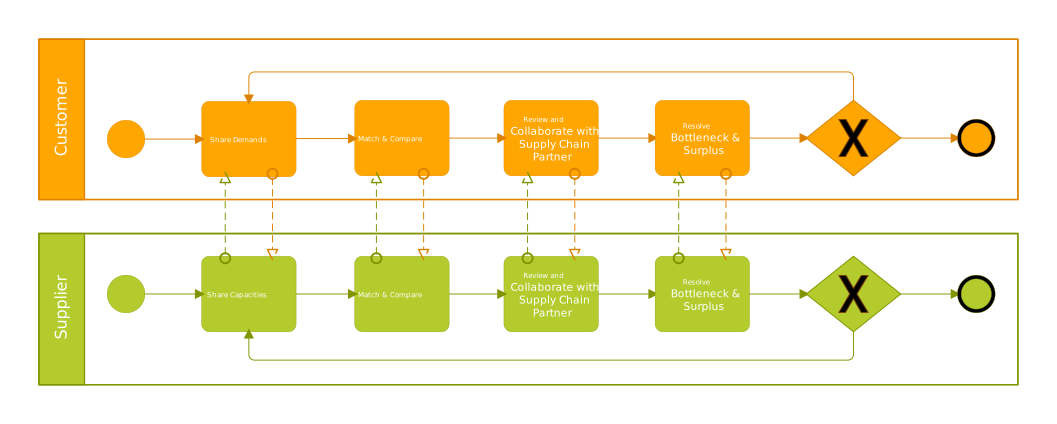
Figure 1: Process chart DCM
For more detailed information, please refer to the Annex Figures.
5.4 Prerequisites for a Collaborative Demand and Capacity Management
Before beginning data exchange, the following conditions must be met:
-
CustomerCustomer In the context of OSim, the receiver of produced goods from a supplier. and supplierSupplier In the context of OSim, the producer of goods. must have registered with a Catena-X operational company and conform to the Catena-X guidelines
-
CustomerCustomer In the context of OSim, the receiver of produced goods from a supplier. and supplierSupplier In the context of OSim, the producer of goods. must have entered into a contract with each other
-
CustomerCustomer In the context of OSim, the receiver of produced goods from a supplier. and supplierSupplier In the context of OSim, the producer of goods. must have agreed to the Data Exchange Governance framework agreement
-
CustomerCustomer In the context of OSim, the receiver of produced goods from a supplier. and supplierSupplier In the context of OSim, the producer of goods. must agree on a common unit of measure (see Units of measure used in DCM) for product-level data exchange (
WeekBasedMaterialDemandandWeekBasedCapacityGroup) -
CustomerCustomer In the context of OSim, the receiver of produced goods from a supplier. and supplierSupplier In the context of OSim, the producer of goods. must have the technical capability to engage in the DCM process with their business applications
Once these conditions are satisfied, the exchange of demand data and capacity data and fundamental collaboration are enabled.
5.5 Providing Demand Data to Supplier
5.5.1 Detailed Description of Demand Data
CustomersCustomer In the context of OSim, the receiver of produced goods from a supplier. provide WeekBasedMaterialDemand data and any updates to their supplierSupplier In the context of OSim, the producer of goods..
The supplierSupplier In the context of OSim, the producer of goods. must be able to consume the WeekBasedMaterialDemand from the customerCustomer In the context of OSim, the receiver of produced goods from a supplier..
A WeekBasedMaterialDemand indicates the need for a specific product or component over a certain time frame and quantity.
CustomersCustomer In the context of OSim, the receiver of produced goods from a supplier. must regularly provide their suppliersSupplier In the context of OSim, the producer of goods. with WeekBasedMaterialDemand data. It is recommended to provide the dataset without any gaps, extending at least nine months into the future.
CustomersCustomer In the context of OSim, the receiver of produced goods from a supplier. may provide data that extends up to 24 months (or even longer) into the future, as this is considered ideal.
The WeekBasedMaterialDemand data series may start from week n+2 (where n is the current week), although the focus is on mid- to long-term planning (typically 4 to 24 months).
The customerCustomer In the context of OSim, the receiver of produced goods from a supplier. has the option to mark a WeekBasedMaterialDemand as inactive (i.e. the demand is obsolete), in this case the demand will not be considered in the demand-capacity matching. However, the WeekBasedMaterialDemand can be reactivated again.
For technical details see Section 4.1.2.2.
CustomersCustomer In the context of OSim, the receiver of produced goods from a supplier. must conform to the following guidelines for qualitative demand data and enable an efficient demand and capacity matching:
- Demand quantities must be organized into weekly buckets
- The difference between forecasted demand and actual single-orders should be minimal
- Demands quantities should include product phase-ins and/or phase-outs where necessary
For a detailed process description, see Figures. Below is an example of how a WeekBasedMaterialDemand might be visualized.

Figure 2: Example of demand data visualization
WeekBasedMaterialDemanddata must be categorized as follows:
| Demand Category | Description | Demand Category Code (based on data model) |
|---|---|---|
| Default | No Assignment | 0001 |
| After-Sales | After sales demand of spare parts | A1S1 |
| Series | Dependent demand e.g. production, assembly, raw material | SR99 |
| Phase-In-period | Ramp up of a new product or new material introduction | PI01 |
| Single-Order | Demand outside the normal spectrum of supply | OS01 |
| Small series | Short time frame for demand and pose to higher volatility | OI01 |
| Extraordinary demand | Demand on top of standard demand | ED01 |
| Phase-Out-period | Ramp down of a retiring product or material from the market | PO01 |
- Demand data must be consistent with other data exchanged, such as call-offs and updated whenever changes occur
For implementation details, see Chapter 3.1.
Additional guidelines:
- CustomersCustomer In the context of OSim, the receiver of produced goods from a supplier. should update demand data at least monthly
- CustomersCustomer In the context of OSim, the receiver of produced goods from a supplier. should avoid or minimize unnecessary fluctuations in demands to allow a better capacity planning, because a stable demand plan enables better capacity planning
5.5.2 WeekBasedMaterialDemand Structure
A WeekBasedMaterialDemand dataset includes information about the material, the customerCustomer In the context of OSim, the receiver of produced goods from a supplier.-supplierSupplier In the context of OSim, the producer of goods. relationship and the requested quantities per week.
For more information, see Chapter 3.1 and Chapter 4.1.
If the DCM Asset Administration ShellAsset Administration Shell The AAS is a digital representation of an asset; it is a form of a digital twin. is used, see Chapter 4.5.
5.5.3 Example of a Visualization of a WeekBasedMaterialDemand
The following image shows how WeekBasedMaterialDemand information could be visualized, differentiating between header data and time series data:
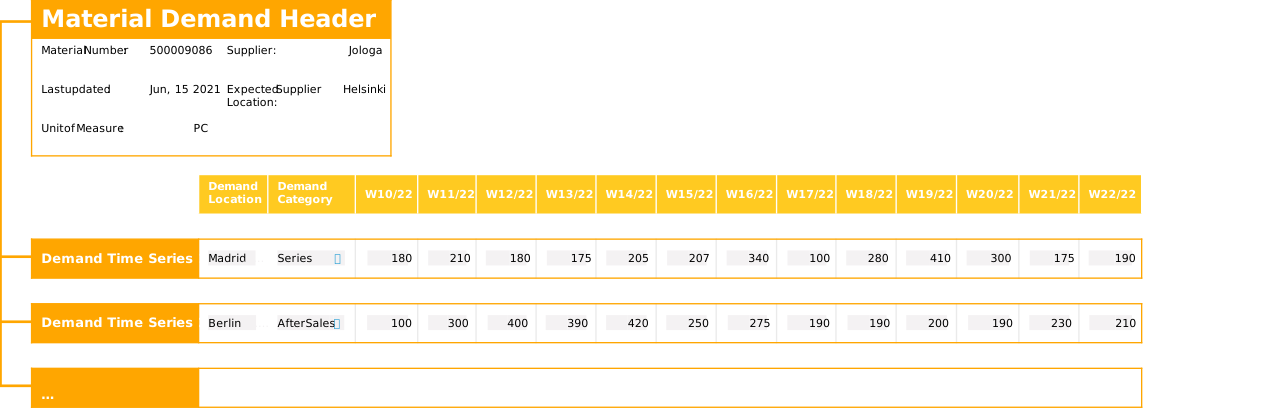
Figure 3: Visualized example of a material demand structure
5.6 Providing Capacity Data to Customer
5.6.1 Detailed Description of Capacity Data
SuppliersSupplier In the context of OSim, the producer of goods. provide WeekBasedCapacityGroup data and any updates to their customersCustomer In the context of OSim, the receiver of produced goods from a supplier.. This data must refer to the WeekBasedMaterialDemand data they previously consumed from their customersCustomer In the context of OSim, the receiver of produced goods from a supplier..
The customerCustomer In the context of OSim, the receiver of produced goods from a supplier. must be able to consume the WeekBasedCapacityGroup from the supplierSupplier In the context of OSim, the producer of goods..
SuppliersSupplier In the context of OSim, the producer of goods. must conform to the following guidelines for qualitative capacity data:
- Actual capacity represents the supplierSupplier In the context of OSim, the producer of goods.'s planned available capacity
- Maximum capacity is the highest possible capacity that the supplierSupplier In the context of OSim, the producer of goods. can offer, which may be equal to or greater than the actual capacity but must not be less
- Flexible capacity is the difference between maximum capacity and actual capacity
In addition suppliersSupplier In the context of OSim, the producer of goods. may conform to the following:
- Agreed capacity represents the agreed capacity of a supplierSupplier In the context of OSim, the producer of goods. for a specific customerCustomer In the context of OSim, the receiver of produced goods from a supplier. material(s) within a capacity group. It must not constitute a legal obligation to deliver. Using the agreed capacity is optional and has purely informative character. The agreed capacity may be greater than, less than or equal to the actual or maximum capacity of the supplierSupplier In the context of OSim, the producer of goods.. It may be used for a time frame shorter than the whole time series.
For detailed capacity definitions, see Chapter 1.5.
For a visual process description, see Figures.
5.6.2 WeekBasedCapacityGroup Structure
A WeekBasedCapacityGroup dataset includes information about which material demands it links to, the customerCustomer In the context of OSim, the receiver of produced goods from a supplier.-supplierSupplier In the context of OSim, the producer of goods. relationship and how much capacity is available. Thereby providing a shared perspective for both customerCustomer In the context of OSim, the receiver of produced goods from a supplier. and supplierSupplier In the context of OSim, the producer of goods. on the matching of demand and capacity information, enables collaborative DCM.
The WeekBasedCapacityGroup can represent combined capacities from machines, facilities, or entire plants. For additional details, especially if using the DCM Asset Administration ShellAsset Administration Shell The AAS is a digital representation of an asset; it is a form of a digital twin., see Chapter 4.5.
For a functional WeekBasedCapacityGroup, the supplierSupplier In the context of OSim, the producer of goods. must link it directly or indirectly to a WeekBasedMaterialDemand.
- Direct linking involves connecting at least one
WeekBasedMaterialDemandto theWeekBasedCapacityGroup - Indirect linking (or "nesting") involves connecting the
WeekBasedCapacityGroupto anotherWeekBasedCapacityGroupthat is already linked to aWeekBasedMaterialDemand
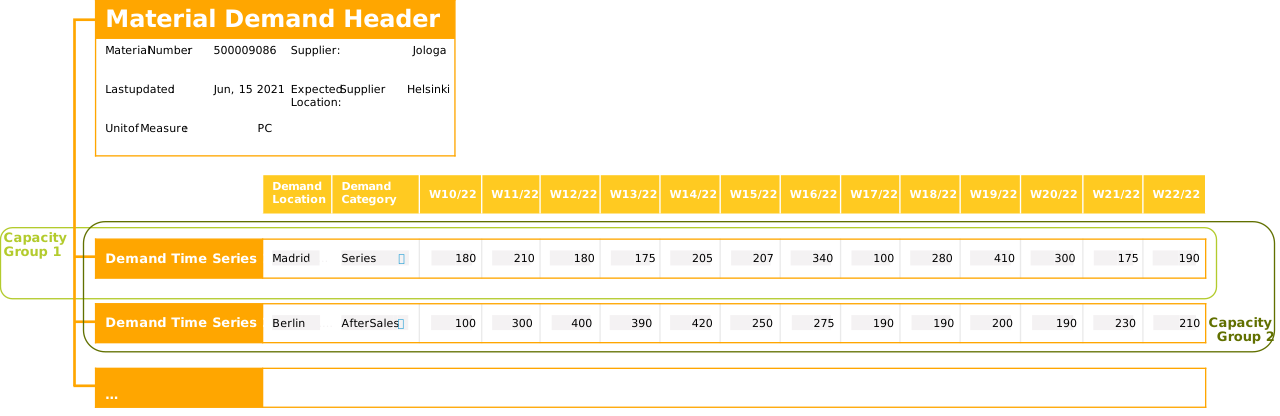
Figure 4: Example of linking WeekBasedMaterialDemand to WeekBasedCapacityGroup
When a supplierSupplier In the context of OSim, the producer of goods. provides a WeekBasedCapacityGroup to a customerCustomer In the context of OSim, the receiver of produced goods from a supplier., the following properties must have a value so that WeekBasedCapacityGroup and WeekBasedMaterialDemand can be linked:
suppliercustomermaterialNumberCustomercustomerLocationdemandCategory
If there's no complete match between supplierSupplier In the context of OSim, the producer of goods. and customerCustomer In the context of OSim, the receiver of produced goods from a supplier. data, it's recommended to initiate collaboration, as described in Chapter 5.9.
The supplierSupplier In the context of OSim, the producer of goods. has the option to mark a WeekBasedCapacityGroup as inactive (i.e. the capacity is obsolete), in this case the capacity will not be considered in the demand-capacity matching. However, the WeekBasedCapacityGroup can be reactivated again.
For more details, see the semantic model in Chapter 3.2 and the APIsAPI An API is a way for two or more computer programs to communicate with each other. in Chapter 4.2.
5.6.3 Example of a Visualization of Capacity Data
The figure below demonstrates:
- The solid line represents actual capacity
- The dotted line represents maximum capacity
- The dashed line represents agreed capacity
- The area between the solid and the dotted lines represents flexible capacity

Figure 5: Example of capacity data visualization
5.6.4 Load Factors for WeekBasedCapacityGroup
The feature “load factors” allows suppliersSupplier In the context of OSim, the producer of goods. to model and represent otherwise impossible capacity occurrences, by introducing a numerical multiplication factor, that changes the interpretation of a capacity group.
SuppliersSupplier In the context of OSim, the producer of goods. may apply load factors within a WeekBasedCapacityGroup. If they choose to do so, a load factor must be applied to every WeekBasedMaterialDemand linked by the WeekBasedCapacityGroup.
If a WeekBasedCapacityGroup links several WeekBasedMaterialDemand, which contain the same material, load factors applied to those WeekBasedMaterialDemand should be identical.
Load factors should be used to solve the following two problems:
- Usage of non-homogeneous material variants within a capacity group, resulting in diverging capacity utilization.
- Requirement for having a different unit of measure within a
WeekBasedCapacityGroup, as opposed to its linkedWeekBasedMaterialDemand.
Load factors solve these problems by:
- Scaling the weekly demand linearly if a material variant causes higher or lower than normal load within the capacity group. Load factors can for example express a reduction to 90% or an increase to 150%.
- Acting as conversion factors, converting the unit of measure of a
WeekBasedMaterialDemandinto the unit of measure of theWeekBasedCapacityGroup. This leads to a conversion into either “time” (unit:secondUnitOfTime) or “cycle” (unit:cycle), expressing that, for example, a piece of material takes 12 seconds or a set of material takes half a cycle to manufacture.
A load factor of 1 is neutral and leaves the linked WeekBasedMaterialDemand unchanged. Because load factors are applied via the WeekBasedCapacityGroup a WeekBasedMaterialDemand can have multiple load factors applied to it, that differ from each other. Without load factors applied the unit of measure of a WeekBasedCapacityGroup and its linked WeekBasedMaterialDemand should be identical. With load factors applied they may differ. Lot size restrictions, especially lot size = 1, are not considered when using load factors. Rounding any fractional conversion results should be avoided to keep demand-capacity comparison consistent.
5.7 Comparison of Demand and Capacity Data within a Capacity Group
The comparison of aggregated demands and capacities helps to identify imbalances, such as when demand exceeds or falls short of capacity. For visuals, see Figures.
If a WeekBasedCapacityGroup provides both load factor and delta production, then load factor must be applied first and delta production applied last.

5.7.1 Matching Results and Resolution
Both customersCustomer In the context of OSim, the receiver of produced goods from a supplier. and suppliersSupplier In the context of OSim, the producer of goods. must use the same logic when comparing demand and capacity, based on the WeekBasedCapacityGroup and WeekBasedMaterialDemand models.
Inactive WeekBasedMaterialDemand data and its related demandSeries data as well as inactive WeekBasedCapacityGroup data must not be considered when comparing the demand with the corresponding capacity values.
The table below describes potential scenarios and their outcomes:
| Scenario and Week | Matching situation (MUST) | Matching result (MUST) | Color (MAY) | Hex Code (MAY) |
|---|---|---|---|---|
| 1 | Demand = actual capacity = maximum capacity | Zero deviation | Green | #809500 |
| 2 | Demand = actual capacity < maximum capacity | Zero deviation | Green | #809500 |
| 3 | Demand < actual capacity = maximum capacity | Surplus | Green | #809500 |
| 4 | Demand < actual capacity < maximum capacity | Surplus | Green | #809500 |
| 5 | Demand > actual capacity = maximum capacity | Bottleneck | Red | #D91E18 |
| 6 | Actual capacity < demand = maximum capacity | Bottleneck | Orange | #FFA600 |
| 7 | Actual capacity < demand < maximum capacity | Bottleneck | Orange | #FFA600 |
| 8 | Actual capacity < maximum capacity < demand | Bottleneck | Red | #D91E18 |
An example visualization is provided below.

Figure 6: Visualized example of demand and capacity data matching and comparison
When a bottleneck or surplus is identified, collaboration between customerCustomer In the context of OSim, the receiver of produced goods from a supplier. and supplierSupplier In the context of OSim, the producer of goods. is strongly recommended. For more details, see Figures.
The exchange of comments is a key collaborative feature, enabling a dialogue between customersCustomer In the context of OSim, the receiver of produced goods from a supplier. and suppliersSupplier In the context of OSim, the producer of goods.. For more information, refer to Chapter 5.9.
5.7.2 Delta-Production (Pre-/Post-production)
5.7.2.1 Business value
Delta-Production is a feature that helps suppliersSupplier In the context of OSim, the producer of goods. to manage their production capacity more effectively. It allows them to address and balance capacity shortages without having to increase their actual or maximum capacity. SuppliersSupplier In the context of OSim, the producer of goods. can choose to use this feature, but it is not mandatory. Delta-Production, which covers both pre-production and post-production activities.
The main advantage of using Delta-Production is that it gives suppliersSupplier In the context of OSim, the producer of goods. a way to manage small capacity shortfalls. This can be done manually or automatically, which saves time and effort that would otherwise be spent on frequent capacity adjustments, particularly when demand is unpredictable.
Delta-Production enables suppliersSupplier In the context of OSim, the producer of goods. to add extra detail to their capacity information. This helps illustrate solutions for capacity issues or times when production resources might be offline. Only the end results of Delta-Production are shared with the customerCustomer In the context of OSim, the receiver of produced goods from a supplier.. SuppliersSupplier In the context of OSim, the producer of goods. may input a Delta-Production value for each week as needed (see Fig. 7 and 8), which shows an increase or decrease in planned demand without actually changing the real figures.
5.7.2.2 Definition of delta-production (Pre-/post-production) in the context of capacity groups
Delta-Production may be used within a Capacity Group to indicate how production can be adjusted to meet demand. It helps cover potential shortfalls by showing where goods could be produced earlier or later than currently demanded. SuppliersSupplier In the context of OSim, the producer of goods. can provide these values on a weekly basis alongside their regular capacity data. There's no need to give details about the duration of these adjustments, as this can be inferred from the number of weeks for which the data is provided.
When comparing demand and capacity data, the values are considered without altering the actual data. If a Delta-Production value is provided, it must be included in the weekly demand and capacity comparison. A positive value indicates a virtual increase in planned demand, while a negative value indicates a virtual decrease.
Delta-Production must not change the WeekBasedMaterialDemand itself. It is only applied downstream when visualizing materials demands or doing calculations with demand data.
SuppliersSupplier In the context of OSim, the producer of goods. can use comments to provide customersCustomer In the context of OSim, the receiver of produced goods from a supplier. with additional information about the Delta-Production. For more details on this communication feature, see Chapter 5.9.
Below are two examples of how Delta-Production might be represented visually.
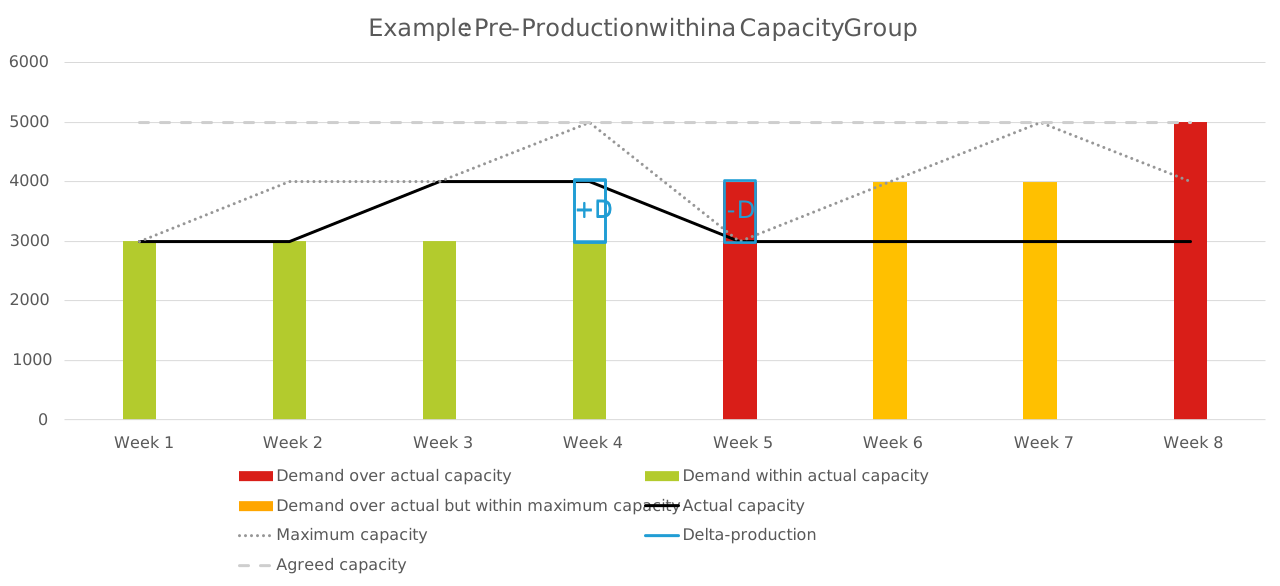 Figure 7: Visualized example of results of Delta-Production (with pre-production)
 Figure 8: Visualized example of results of Delta-Production (with post-production)
5.8 Request for Update (RfU)
The Request for Update (RfU) enables customersCustomer In the context of OSim, the receiver of produced goods from a supplier. and suppliersSupplier In the context of OSim, the producer of goods. to ask for updates on WeekBasedMaterialDemand and WeekBasedCapacityGroup. This can be particularly useful to check for and avoid data inconsistency.
CustomerCustomer In the context of OSim, the receiver of produced goods from a supplier. and SupplierSupplier In the context of OSim, the producer of goods. must be capable of consuming and correctly responding to a RfU. Being able to provide a RfU is recommended.
It is recommended that this feature is inaccessible to the end-user.
For further technical information please see Chapter 3.3 and Chapter 4.3.
5.9 Collaboration Functionalities for Demand and Capacity Management
Collaboration is key in DCM. By exchanging comments, customersCustomer In the context of OSim, the receiver of produced goods from a supplier. and suppliersSupplier In the context of OSim, the producer of goods. can communicate effectively within their direct business relationships. Comments can be linked to specific data objects, such as material demands or capacity groups and are identified by an unique CommentID.
This feature benefits users by having all data - even the communication with their business partners - embedded into the core process. This establishes a common point of truth within the DCM process and enables efficient decision making.
This standard only covers the exchange of textual comments without attachments. It does not describe the visualization, creation, deletion, or internal visibility of comments within an application.
5.9.1 Detailed Description of Comments
CustomersCustomer In the context of OSim, the receiver of produced goods from a supplier. and suppliersSupplier In the context of OSim, the producer of goods. must be able to process, provide and consume comments linked to specific objects identified by an ObjectID. These objects must be a WeekBasedMaterialDemand or a WeekBasedCapacityGroup. Comments may also reference specific time periods to enhance clarity. The exchange of comments must conform to standardized data formats and APIAPI An API is a way for two or more computer programs to communicate with each other. processing as described in Chapter 3.4 and Chapter 4.4.
CustomersCustomer In the context of OSim, the receiver of produced goods from a supplier. and suppliersSupplier In the context of OSim, the producer of goods. must be able to provide and consume comments linked to WeekBasedCapacityGroup.
CustomersCustomer In the context of OSim, the receiver of produced goods from a supplier. and suppliersSupplier In the context of OSim, the producer of goods. must be able to consume comments linked to WeekBasedMaterialDemand. CustomersCustomer In the context of OSim, the receiver of produced goods from a supplier. and suppliersSupplier In the context of OSim, the producer of goods. should also be able to process comments linked to WeekBasedMaterialDemand. If comments for WeekBasedMaterialDemand are not processed by the business logic behind the APIAPI An API is a way for two or more computer programs to communicate with each other. a HTTPHTTP HTTP is an application-layer protocol for transmitting hypermedia documents (such as HTML). It was designed for communication between web browsers and web servers, but can also be used for other purposes. status code must be sent, conforming to Chapter 4.4.
CustomersCustomer In the context of OSim, the receiver of produced goods from a supplier. and suppliersSupplier In the context of OSim, the producer of goods. should be able to provide comments linked to WeekBasedMaterialDemand.
CustomersCustomer In the context of OSim, the receiver of produced goods from a supplier. and supplierSupplier In the context of OSim, the producer of goods. must be able to provide and consume a comment deletion. Only the business partner that created the comment must be able to update or delete it. If a comment is updated, the changedAt timestamp must reflect the change. If a comment deletion is being processed successfully the IdBasedComment itself, as well as data derived from it, must be deleted.
The table below describes the types of comments that must be used:
| Comment Type | Description | Comment Type Code (based on data model) |
|---|---|---|
| Information comment | Comment purely provides additional information to the exchanged data | information |
| Warning comment | Comment provides additional information, which should be considered by the consumer, who might initiate follow up activities | warning |
| Action required comment | Consumer of the comment should react on provided information | actionRequired |
| Default | Default comment type without special classification | default |
The creator of a comment is responsible for its content and must comply with antitrust and information privacy laws.
5.10 Supply Chain Disruption Notifications
To enable a quick information flow outside a capacity group and the DCM process with regards to upcoming disruptions in the supply chain and potential effect beyond the one-to-one business relationship, a notifications functionality may be used. If a business partner decides to use this feature it must be used conforming to [CX–0146].
5.11 Demand Volatility Metrics
5.11.1 Business Value
Demand volatility metric is a feature that helps suppliersSupplier In the context of OSim, the producer of goods. to identify and measure demand volatility. It allows them to address demand volatility directly to their customersCustomer In the context of OSim, the receiver of produced goods from a supplier., increasing transparency for a more effective collaborative capacity planning.
This standard supports the following volatility metrics:
- Demand deviation
5.11.2 Demand Deviation Process
CustomersCustomer In the context of OSim, the receiver of produced goods from a supplier. must be able to consume WeekBasedCapacityGroup.
CustomersCustomer In the context of OSim, the receiver of produced goods from a supplier. should be able to fully process WeekBasedCapacityGroup that include properties related to demand volatility and calculate the demand deviation metric. If they choose otherwise, none of the obligations of Chapter 5.11 apply.
SuppliersSupplier In the context of OSim, the producer of goods. must process and provide WeekBasedCapacityGroup.
SuppliersSupplier In the context of OSim, the producer of goods. should process and provide WeekBasedCapacityGroup that include properties related to demand volatility and calculate the demand deviation metric. If they choose to use this feature at least startReferenceDateTime and measurementInterval must be provided. If they choose otherwise, none of the obligations of Chapter 5.11 apply.
After suppliersSupplier In the context of OSim, the producer of goods. identify critical WeekBasedCapacityGroup and apply demand deviation metrics to them the following applies:
- SuppliersSupplier In the context of OSim, the producer of goods. and customersCustomer In the context of OSim, the receiver of produced goods from a supplier. must calculate the demand deviation metric exactly as described in Section 5.11.3. Other calculation methods must not be used for the calculation of the metric.
- SuppliersSupplier In the context of OSim, the producer of goods. must calculate the demand deviation metric on
WeekBasedCapacityGrouplevel. - SuppliersSupplier In the context of OSim, the producer of goods. must activate each of the
WeekBasedCapacityGroupsfor which the metric has to be calculated, see Chapter 4.2. - SuppliersSupplier In the context of OSim, the producer of goods. must specify the start date of calculations at a future date and time. The first calculation will then be completed at the end of the first measurement interval, see Chapter 4.2.
- If suppliersSupplier In the context of OSim, the producer of goods. change the measurement interval, they must specify a new start date of calculations at a future date and time.
- SuppliersSupplier In the context of OSim, the producer of goods. should not calculate the demand deviation based on any data measured before the start date of calculations.
- SuppliersSupplier In the context of OSim, the producer of goods. must provide the parameters of the calculation of the demand deviation metric to their customersCustomer In the context of OSim, the receiver of produced goods from a supplier., as specified in Section 5.11.3 and Chapter 4.2.
- SuppliersSupplier In the context of OSim, the producer of goods. should compare the results of the calculation of the demand deviation metric to the relevant alert thresholds defined for the demand deviation metric, see Section 5.11.3.
The demand deviation is calculated locally and compared against the consumed or provided values from the WeekBasedCapacityGroup. The table below describes potential scenarios and their outcomes:
| Scenario and Week | Matching situation (must) | Matching result (must) | Color | Hex Code |
|---|---|---|---|---|
| 1 | Calculated relative demand deviation > relativePositiveDeviation | Unacceptable deviation | Red | #D91E18 |
| 2 | Calculated relative demand deviation < relativeNegativeDeviation | Unacceptable deviation | Red | #D91E18 |
| 3 | Calculated absolute demand deviation > absolutePositiveDeviation | Unacceptable deviation | Red | #D91E18 |
| 4 | Calculated absolute demand deviation < absoluteNegativeDeviation | Unacceptable deviation | Red | #D91E18 |
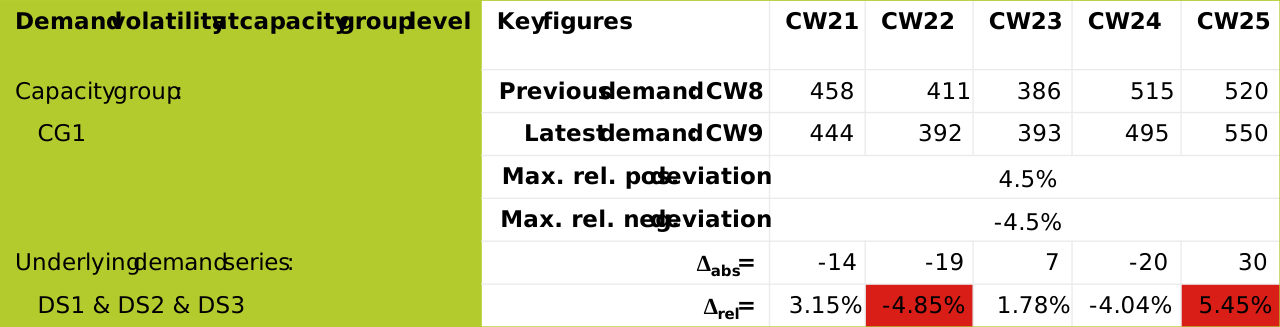
Figure 9: Visualized example of demand deviation and alert threshold comparison
It is recommended that suppliersSupplier In the context of OSim, the producer of goods. organize individual collaborative alignments with customersCustomer In the context of OSim, the receiver of produced goods from a supplier. to discuss the status of significant volatility measurements of demand deviation, ideally at least on a quarterly basis.
The exchange of comments is a key collaborative feature, enabling a dialogue between customersCustomer In the context of OSim, the receiver of produced goods from a supplier. and suppliersSupplier In the context of OSim, the producer of goods.. For details, see Chapter 5.9.
5.11.3 Demand Deviation Metric
The demand deviation metric is generally based on the comparison of the latest demand with a previous demand. It is recommended to compare the latest demand with previous demands on a monthly basis, in line with typical monthly long-term planning cycles and set the measurement interval to 4 weeks.
The demand deviation metric is calculated at the WeekBasedCapacityGroup level, meaning the demands of 1..n material demand series assigned to a specific WeekBasedCapacityGroup are aggregated on a weekly level and form the basis for the calculation. Thus, the time series of aggregated material demands which is measured at a defined point in time in the current week is equal to the latest demand. The time series of aggregated material demands which is measured at a defined point in time in an earlier week is equal to the previous demand.
SuppliersSupplier In the context of OSim, the producer of goods. initiate the calculation of the demand deviation metric by specifying the start date of the calculation StartReferenceDateTime at a future date and time. This marks the point in time of the first measurement of the aggregated material demand. The date and time of subsequent measurements is defined by the measurement interval that also describes the time offset in weeks between the latest demand time series and the previous demand time series.
Calculation
The demand deviation must be calculated as follows:


∑ ≙ sum of demands per calendar week of each material demand series assigned within the WeekBasedCapacityGroup.
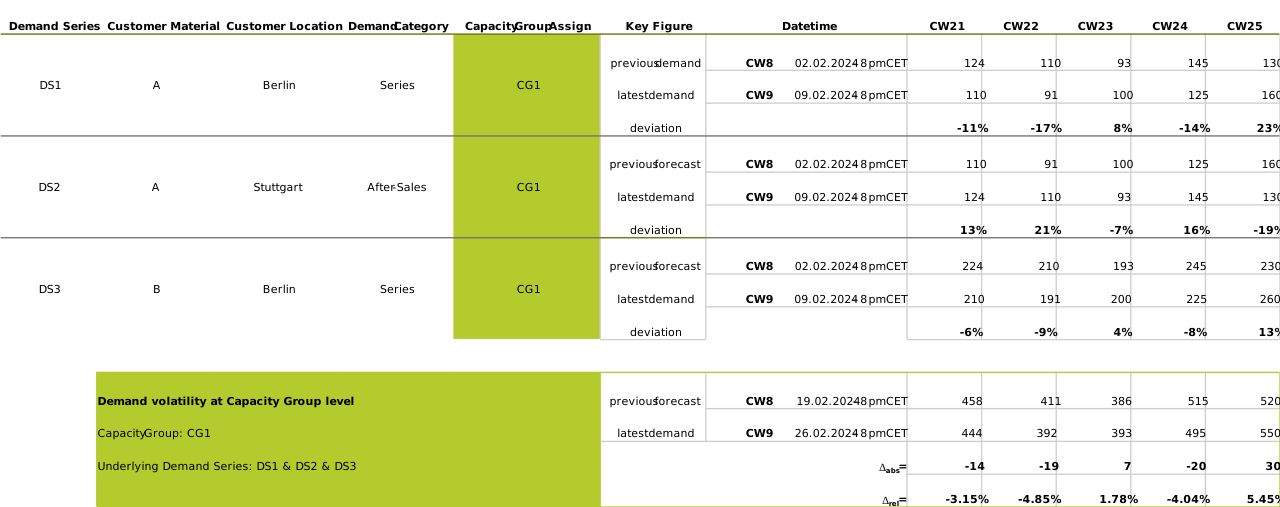
Figure 10: Visualized example of demand deviation calculation at capacity group level
It is recommended to store the inputs for the calculations of the demand deviation metric for at least 6 months.
Alert Threshold
Alert thresholds are positive or negative values of demand deviation that define unacceptable levels of demand volatility with reference to a specific subhorizon.
SuppliersSupplier In the context of OSim, the producer of goods. should specify values for at least one of the following two alert thresholds:
- Maximum relative positive deviation: (e.g. max. 15 % quantity increase compared to previous demand)
- ∆rel. pos. must be ≥ 0 (1 ≙ 100%)
- Maximum relative negative deviation: (e.g. max. 10 % quantity decrease compared to previous demand)
- ∆rel. neg. must be ≥ 0 and ≤ 1 (1 ≙ -100%)
To cover more business scenarios, suppliersSupplier In the context of OSim, the producer of goods. may specify values for the following two alert thresholds:
- Maximum absolute positive deviation: (e.g. max. 1000 units more compared to previous demand)
- ∆abs. pos.
- Maximum absolute negative deviation: (e.g. max. 500 units less compared to previous demand)
- ∆abs. neg.
Threshold values cannot be standardized across the Catena-X network, but must be individually agreed and made transparent between two business partners.
Subhorizons
A subhorizon is a period of time that represents a part of the whole DCM time frame and is used for a specific view on the calculation of the demand deviation metric. SuppliersSupplier In the context of OSim, the producer of goods. may specify subhorizons to allow for different alert thresholds, as the flexibility of supply chains decreases, the closer demand values approach today's date. It is recommended to divide the rolling DCM time frame (typically up to 104 weeks) into multiple subhorizons.
A subhorizon is defined as follows:
For 1,2,3,...h subhorizons (1 ≤ h ≤ 104):
- Subhorizon length l (1 ≤ l ≤ 104, l = number of weeks)
- Subhorizon alert thresholds: one value for each alert threshold to be used within the subhorizon
The start and end of a subhorizon are determined as follows:
- Subhorizon start = week 0 for the first subhorizon OR subhorizon end of the previous subhorizon + 1
- Subhorizon end = subhorizon start + subhorizon length l
It is recommended to apply the following rules:
- The subhorizons are sequenced consecutively (1,2,3,...).
- The sequence starts always with 1.
- The first week of the first subhorizon is denominated as week 0.
- There are no gaps in between the subhorizons, they are always consecutive.
- The entire DCM time frame (104 weeks) does not need to be fully populated with subhorizons.
- In case a subhorizon does not contain any deviation properties, no alert threshold is applicable.
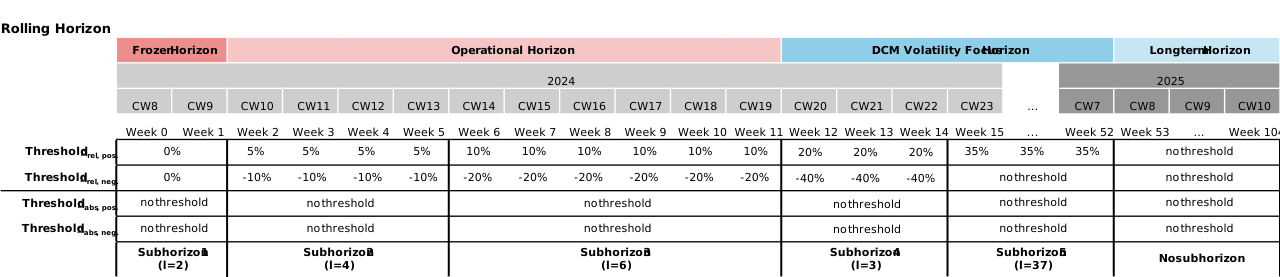
Figure 11: Visualized example of demand deviation subhorizons and related alert thresholds
6 FRAMEWORK AGREEMENT AND POLICIES
This section and all its subsections are normative
All participants involved in the Catena-X DCM use case MUST consent to the Data Exchange Governance framework agreement.
On the connector level the DCM APIAPI An API is a way for two or more computer programs to communicate with each other.-endpoints are presented as data assetsAsset On the Data Provider side, an Asset describes the data set which will be shared or can be consumed by a Data Consumer.:
- WeekBasedMaterialDemand API
- WeekBasedCapacityGroup API
- IdBasedRequestForUpdate API
- IdBasedComment API
The way in which these assetsAsset On the Data Provider side, an Asset describes the data set which will be shared or can be consumed by a Data Consumer. are offered is defined by a contract definition on the connector level. This contract definition brings assetAsset On the Data Provider side, an Asset describes the data set which will be shared or can be consumed by a Data Consumer., usage policy and access policy together. The access policy controls whether a business partner is allowed to see the assetAsset On the Data Provider side, an Asset describes the data set which will be shared or can be consumed by a Data Consumer. as part of a contract offer, when executing a catalog request. The usage policy defines which terms the business partner has to agree to, if he wants to consume the assetAsset On the Data Provider side, an Asset describes the data set which will be shared or can be consumed by a Data Consumer., which is a prerequisite for accessing the APIAPI An API is a way for two or more computer programs to communicate with each other.-endpoint. Access and usage policy can be crafted using zero, one or multiple constraints.
 Figure 12: Visualized relation between contract defnition, assetAsset On the Data Provider side, an Asset describes the data set which will be shared or can be consumed by a Data Consumer. and policies
Both customersCustomer In the context of OSim, the receiver of produced goods from a supplier. and suppliersSupplier In the context of OSim, the producer of goods. MUST implement and uphold access and usage policies in order to guarantee a secure and collaborative data exchange.
In accordance to the conventions defined in CX-0152 as referenced in paragraph Policy Constraints for Data Exchange following constraints can be used to create access and usage policies. Constraints that are marked as mandatory in the column Usage Requirement MUST be used to create the respective policy.
| Policy Type | Constraint | leftOperand ("@context": ["https://w3id.org/catenax/2025/9/policy/context.jsonld"]) | operator | right Operand | Usage Requirement |
|---|---|---|---|---|---|
| Access Policy | BPNLBPNL The unique identifier of a legal entity of a partner within Catena-X (e.g., a company). | BusinessPartnerNumber | isAnyOf, isNoneOf | {{ PARTNER_BPNLs }} | optional |
| Access Policy | BPNLBPNL The unique identifier of a legal entity of a partner within Catena-X (e.g., a company).-Group | BusinessPartnerGroup | isAnyOf, isNoneOf | {{ PARTNER_GROUPs }} | optional |
| Access Policy | Membership | Membership | eq | active | optional |
| Usage Policy | Data Exchange Governance | FrameworkAgreement | eq | DataExchangeGovernance:1.0 | mandatory |
| Usage Policy | Usage Purpose | UsagePurpose | isAnyOf | cx.dcm.base:1 | mandatory |
| Usage Policy | Contract Reference | ContractReference | isAllOf | {{ Contract References }} | optional |
Please note, that the access policy can be created without any constraints. In this case only the MembershipCredential is verified. Further details how to define policies and policy constraints can be found in CX-0152 as referenced in paragraph Policy Constraints for Data Exchange.
7 REFERENCES
7.1 Normative References
This section and all its subsections are normative
- [CX-0001]
v1.0.3EDC Discovery APIAPI An API is a way for two or more computer programs to communicate with each other. - [CX-0002]
v2.2.0Digital Twins in Catena-X - [CX-0003]
v1.2.0SAMM Aspect Meta Model - [CX-0010]
v2.1.0Business Partner Number - [CX-0018]
v3.2.0Dataspace Connectivity - [CX-0126]
v2.0.0Industry Core: Part Type - [CX-0146]
v1.0.1Supply Chain Disruption Notifications - [CX-0152]
v1.0.0Policy Constraints For Data Exchange
7.2 Non-Normative References
This section and all its subsections are non-normative
- [RFC2119]
March 1997Key words for use in RFCs to Indicate Requirement Levels (https://www.rfc-editor.org/rfc/rfc2119) - [RFC8174]
May 2017Ambiguity of Uppercase vs Lowercase in RFC 2119 Key Words (https://www.rfc-editor.org/rfc/rfc8174) - [ISO3166]
2020-08ISO 3166 Country Codes - [ISO8601]
2019-02Date and time format - [RFC4122]
July 2005A Universally Unique IDentifier (UUID) URN Namespace (https://www.rfc-editor.org/rfc/rfc4122) - [RFC9110]
June 2022HTTPHTTP HTTP is an application-layer protocol for transmitting hypermedia documents (such as HTML). It was designed for communication between web browsers and web servers, but can also be used for other purposes. Semantics (https://www.rfc-editor.org/rfc/rfc9110) - [CC-BY-4.0]
Version 4.0Creative Commons Attribution 4.0 International license (https://creativecommons.org/licenses/by/4.0/legalcode.en) - [SMT]
1st VersionGuideline: How to create a Submodel template specification (https://industrialdigitaltwin.org/wp-content/uploads/2022/12/I40-IDTA-WS-Process-How-to-write-a-SMT-FINAL-.pdf) - [I4.0-AAS]
1.0RC02Details of the Asset Administration ShellAsset Administration Shell The AAS is a digital representation of an asset; it is a form of a digital twin. - Part 2 (https://www.plattform-i40.de/IP/Redaktion/EN/Downloads/Publikation/Details_of_the_Asset_Administration_Shell_Part2_V1.html)
7.3 Reference Implementations
This section and all its subsections are non-normative
Not applicable.
ANNEXES
This section and all its subsections are non-normative
Figures
Below are illustrative figures that depict the DCM process from the viewpoints of customersCustomer In the context of OSim, the receiver of produced goods from a supplier. and suppliersSupplier In the context of OSim, the producer of goods..
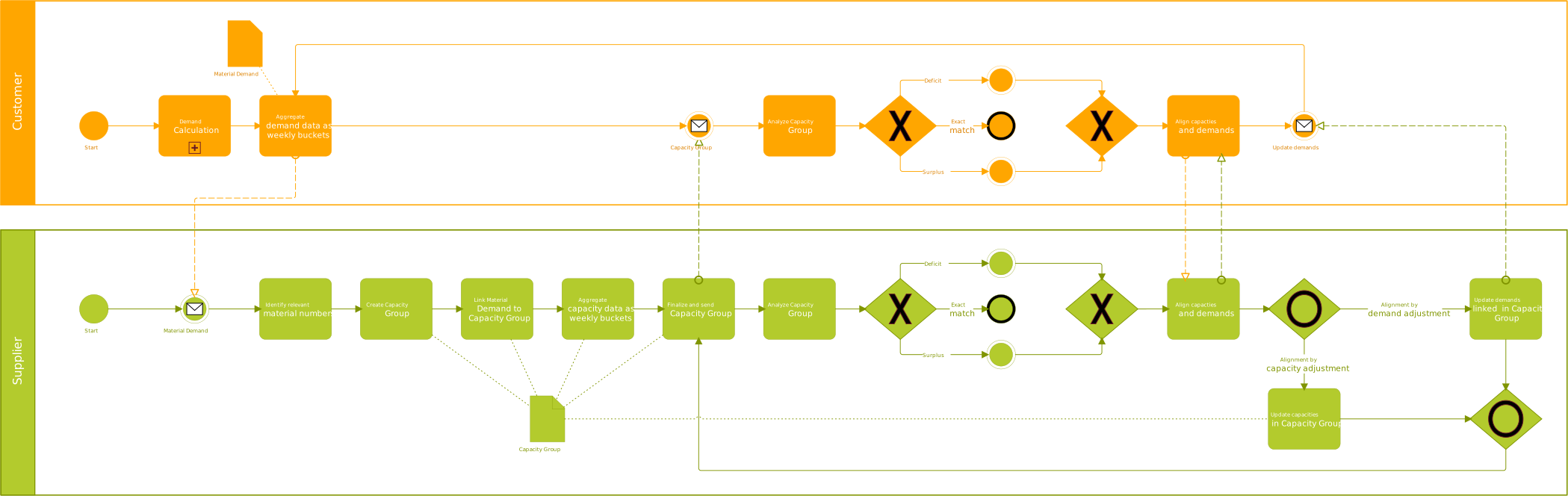
Figure 13: Complete DCM process
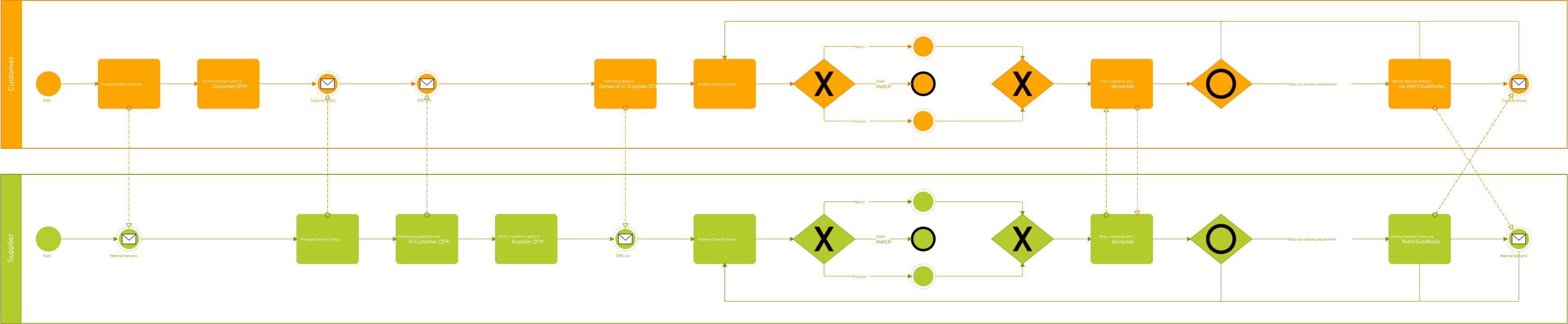
Figure 14: Complete DCM process with digital twins
Tables
Units of measure used in DCM
| Dimension | UN Code | Description (English) | Description (German) | UN Symbol | C-X Symbol | Reference unit used in data models |
|---|---|---|---|---|---|---|
| Mass | GRM | gram | Gramm | g | g | unit:gram |
| Mass | KGM | kilogram | Kilogramm | kg | kg | unit:kilogram |
| Mass | TNE | metric ton | Metrische Tonne | t | t | unit:tonneMetricTon |
| Mass | STN | ton (US) or short ton (UK/US) | US Tonne | ton (US) | ton | unit:tonUsOrShortTonUkorus |
| Mass | ONZ | ounce | Unze | oz | oz | unit:ounceAvoirdupois |
| Mass | LBR | pound | Pfund | lb | lb | unit:pound |
| Length | CMT | centimetre | Zentimeter | cm | cm | unit:centimetre |
| Length | MTR | metre | Meter | m | m | unit:metre |
| Length | KTM | kilometre | Kilometer | km | km | unit:kilometre |
| Length | INH | inch | Zoll | in | in | unit:inch |
| Length | FOT | foot | Fuß | ft | ft | unit:foot |
| Length | YRD | yard | Yard | yd | yd | unit:yard |
| Area | CMK | square centimetre | Quadrat-zentimeter | cm2 | cm2 | unit:squareCentimetre |
| Area | MTK | square metre | Quadratmeter | m2 | m2 | unit:squareMetre |
| Area | INK | square inch | Quadratzoll | in2 | in2 | unit:squareInch |
| Area | FTK | square foot | Quadratfuß | ft2 | ft2 | unit:squareFoot |
| Area | YDK | square yard | Quadratyard | yd2 | yd2 | unit:squareYard |
| Volume | CMQ | cubic centimeter | Kubikzentimeter | cm3 | cm3 | unit:cubicCentimetre |
| Volume | MTQ | cubic meter | Kubikmeter | m3 | m3 | unit:cubicMetre |
| Volume | INQ | cubic inch | Kubikzoll | in3 | in3 | unit:cubicInch |
| Volume | FTQ | cubic foot | Kubikfuß | ft3 | ft3 | unit:cubicFoot |
| Volume | YDQ | cubic yard | Kubikyard | yd3 | yd3 | unit:cubicYard |
| Volume | MLT | millilitrev | Millimeter | ml | ml | unit:millilitre |
| Volume | LTR | litre | Liter | l | l | unit:litre |
| Volume | HLT | hectolitre | Hektoliter | hl | hl | unit:hectolitre |
| Quantum | H87 | piece | Stück | - | pc | unit:piece |
| Quantum | SET | set | Satz | - | set | unit:set |
| Quantum | PR | pair | Paar | - | pr | unit:pair |
| Quantum | ZP | page | Blatt | - | pg | unit:page |
| Mechanic | KWH | kilowatt hour | Kilowattstunde | kW·h | kwh | unit:kilowattHour |
| Time | SEC | second [unit of time] | Sekunde [Maßeinheit der Zeit] | s | s | unit:secondUnitOfTime |
| Time | MIN | minute [unit of time] | Minute [Maßeinheit der Zeit] | min | min | unit:minuteUnitOfTime |
| Time | HUR | hour | Stunde | h | h | unit:hourUnitOfTime |
| Cycle | B7 | cycle | Zyklus | [empty] | cyl | unit:cycle |
ABOUT THIS STANDARD AND MOTIVATION
This section and all its subsections are non-normative
DISCLAIMER AND LIABILITY
This section and all its subsections are non-normative
REVISIONS AND UPDATE
This section and all its subsections are non-normative
COPYRIGHT AND TRADEMARKS
This section and all its subsections are non-normative
Legal
Copyright © 2025 Catena-X Automotive Network e.V. All rights reserved. For more information, please visit here.