CX-0003 SAMM Aspect Meta Model v1.2.0
ABSTRACT
The Semantic Aspect Meta Model (SAMM), an open standard, shall be used for defining the semantics of the different aspects of an assetAsset On the Data Provider side, an Asset describes the data set which will be shared or can be consumed by a Data Consumer. that is represented via a digital twin. Aspect modelsAspect Model A formal, machine-readable semantic description (expressed with RDF/Turtle) of data accessible from an aspect. Note 1: An Aspect Model must adhere to the Semantic Aspect Meta Model (SAMM) and be compliant with its validity rules. Note 2: Aspect Models are logical data models that can be used to detail a conceptual model to describe the semantics of runtime data related to a concept; elements of an Aspect Model can/should refer to terms of a standardized Business Glossary (if existing). are machine readable and other artifacts can be derived from it. The aspect modelAspect Model A formal, machine-readable semantic description (expressed with RDF/Turtle) of data accessible from an aspect. Note 1: An Aspect Model must adhere to the Semantic Aspect Meta Model (SAMM) and be compliant with its validity rules. Note 2: Aspect Models are logical data models that can be used to detail a conceptual model to describe the semantics of runtime data related to a concept; elements of an Aspect Model can/should refer to terms of a standardized Business Glossary (if existing). is the common basis for the httpHTTP HTTP is an application-layer protocol for transmitting hypermedia documents (such as HTML). It was designed for communication between web browsers and web servers, but can also be used for other purposes./RESTREST An architectural style for designing networked applications. APIAPI An API is a way for two or more computer programs to communicate with each other. for accessing data via the standardized digital twin APIAPI An API is a way for two or more computer programs to communicate with each other. of the Asset Administration ShellAsset Administration Shell The AAS is a digital representation of an asset; it is a form of a digital twin..
FOR WHOM IS THE STANDARD DESIGNED
This standard is designed for semantic modelling and usage of semantic models in Catena-X.
COMPARISON WITH THE PREVIOUS VERSION OF THE STANDARD
Changes compared to V1.1.0 of CX-0003:
- Update of references
- Aligned with the newest governance process (the status "standardized" has been removed from semantic models).
Changes compared to V1.0.2 of CX-0003:
- Update to SAMM V2.1.0
- No acceptance of deprecated BAMM aspect modelsAspect Model A formal, machine-readable semantic description (expressed with RDF/Turtle) of data accessible from an aspect. Note 1: An Aspect Model must adhere to the Semantic Aspect Meta Model (SAMM) and be compliant with its validity rules. Note 2: Aspect Models are logical data models that can be used to detail a conceptual model to describe the semantics of runtime data related to a concept; elements of an Aspect Model can/should refer to terms of a standardized Business Glossary (if existing). any longer
- Update to new version of operating model
- Update to conform to new standard document structure
1 Introduction
1.2 Audience & Scope
This section is non-normative
This standard is relevant for the following roles:
- Business Application Provider
- Data Provider / Consumer
- Core Service Provider
- Enablement Service Provider
- Onboarding Service Provider
- Consulting Service Provider
The standard needs to be applied in the following cases for the following roles:
- Business Application Providers who want to request or create proprietary new aspect modelsAspect Model A formal, machine-readable semantic description (expressed with RDF/Turtle) of data accessible from an aspect. Note 1: An Aspect Model must adhere to the Semantic Aspect Meta Model (SAMM) and be compliant with its validity rules. Note 2: Aspect Models are logical data models that can be used to detail a conceptual model to describe the semantics of runtime data related to a concept; elements of an Aspect Model can/should refer to terms of a standardized Business Glossary (if existing).
- Data Providers who need to create digital twins offering data conformant to a specific aspect modelAspect Model A formal, machine-readable semantic description (expressed with RDF/Turtle) of data accessible from an aspect. Note 1: An Aspect Model must adhere to the Semantic Aspect Meta Model (SAMM) and be compliant with its validity rules. Note 2: Aspect Models are logical data models that can be used to detail a conceptual model to describe the semantics of runtime data related to a concept; elements of an Aspect Model can/should refer to terms of a standardized Business Glossary (if existing). and want to understand the underlying metamodel
- Data Consumers who need to understand the data offered by a digital twin and want to understand the underlying metamodel of the corresponding aspect modelAspect Model A formal, machine-readable semantic description (expressed with RDF/Turtle) of data accessible from an aspect. Note 1: An Aspect Model must adhere to the Semantic Aspect Meta Model (SAMM) and be compliant with its validity rules. Note 2: Aspect Models are logical data models that can be used to detail a conceptual model to describe the semantics of runtime data related to a concept; elements of an Aspect Model can/should refer to terms of a standardized Business Glossary (if existing).
- Core, enablement and onboarding service providers who offer services in the context of the Semantic Hub or for tooling based on aspect modelsAspect Model A formal, machine-readable semantic description (expressed with RDF/Turtle) of data accessible from an aspect. Note 1: An Aspect Model must adhere to the Semantic Aspect Meta Model (SAMM) and be compliant with its validity rules. Note 2: Aspect Models are logical data models that can be used to detail a conceptual model to describe the semantics of runtime data related to a concept; elements of an Aspect Model can/should refer to terms of a standardized Business Glossary (if existing).
- Consulting service providers who offer consulting for data consumers and data providers
1.2 Context and Architecture Fit
This section is non-normative
Context
In Catena-X, along with GAIA-X, Digital Twins are to be considered as a core concept to exchange data in the data space.
The Digital Twin Architecture Pattern focuses on ensuring (semantic) interoperability via Digital Twins and Semantic Models in a federated system.
A Digital Twin System forms the basis for comprehensive digitization of production and logistics by gradually creating consistent data homogeneity and interoperability. Since not everyone needs the same set of information, a Digital Twin is a collection of various aspects of an assetAsset On the Data Provider side, an Asset describes the data set which will be shared or can be consumed by a Data Consumer.. An aspect can, for example, bundle all information about machine malfunctions. Such aspects are characterized by concrete aspect modelsAspect Model A formal, machine-readable semantic description (expressed with RDF/Turtle) of data accessible from an aspect. Note 1: An Aspect Model must adhere to the Semantic Aspect Meta Model (SAMM) and be compliant with its validity rules. Note 2: Aspect Models are logical data models that can be used to detail a conceptual model to describe the semantics of runtime data related to a concept; elements of an Aspect Model can/should refer to terms of a standardized Business Glossary (if existing). that describe formally how an aspect is structured. Aspect modelsAspect Model A formal, machine-readable semantic description (expressed with RDF/Turtle) of data accessible from an aspect. Note 1: An Aspect Model must adhere to the Semantic Aspect Meta Model (SAMM) and be compliant with its validity rules. Note 2: Aspect Models are logical data models that can be used to detail a conceptual model to describe the semantics of runtime data related to a concept; elements of an Aspect Model can/should refer to terms of a standardized Business Glossary (if existing). describe things like the units of measurement and possible value range for a temperature sensor in a way that is readable by machines. This allows for faster, more automated responses to the data as it is received. Here, a meta model is a model that defines the constructs and properties used by aspect modelsAspect Model A formal, machine-readable semantic description (expressed with RDF/Turtle) of data accessible from an aspect. Note 1: An Aspect Model must adhere to the Semantic Aspect Meta Model (SAMM) and be compliant with its validity rules. Note 2: Aspect Models are logical data models that can be used to detail a conceptual model to describe the semantics of runtime data related to a concept; elements of an Aspect Model can/should refer to terms of a standardized Business Glossary (if existing).. Expressing this aspect's semantics to consumers of the data can open up completely new possibilities. In other words, an aspect meta model provides the machine-readable language or semantics used across an entire system of aspect modelsAspect Model A formal, machine-readable semantic description (expressed with RDF/Turtle) of data accessible from an aspect. Note 1: An Aspect Model must adhere to the Semantic Aspect Meta Model (SAMM) and be compliant with its validity rules. Note 2: Aspect Models are logical data models that can be used to detail a conceptual model to describe the semantics of runtime data related to a concept; elements of an Aspect Model can/should refer to terms of a standardized Business Glossary (if existing).. Hence, the Semantic Aspect Meta Model (SAMM) allows the creation of meta models to describe the semantics of digital twins by defining their domain-specific aspects, containing information about both the runtime data structure (e.g., that there is a property in the data called "temperature", and that it has a numeric value) and information that is not part of the runtime data (e.g., the unit or range). It does not, however, contain actual runtime data (e.g., a numeric value representing the current temperature), as this will be delivered by an Aspect conforming to this Aspect modelAspect Model A formal, machine-readable semantic description (expressed with RDF/Turtle) of data accessible from an aspect. Note 1: An Aspect Model must adhere to the Semantic Aspect Meta Model (SAMM) and be compliant with its validity rules. Note 2: Aspect Models are logical data models that can be used to detail a conceptual model to describe the semantics of runtime data related to a concept; elements of an Aspect Model can/should refer to terms of a standardized Business Glossary (if existing).. The combination of raw runtime data and its corresponding Aspect modelAspect Model A formal, machine-readable semantic description (expressed with RDF/Turtle) of data accessible from an aspect. Note 1: An Aspect Model must adhere to the Semantic Aspect Meta Model (SAMM) and be compliant with its validity rules. Note 2: Aspect Models are logical data models that can be used to detail a conceptual model to describe the semantics of runtime data related to a concept; elements of an Aspect Model can/should refer to terms of a standardized Business Glossary (if existing). yields information. Moreover, the SAMM allows to reuse semantic descriptions across different aspect modelsAspect Model A formal, machine-readable semantic description (expressed with RDF/Turtle) of data accessible from an aspect. Note 1: An Aspect Model must adhere to the Semantic Aspect Meta Model (SAMM) and be compliant with its validity rules. Note 2: Aspect Models are logical data models that can be used to detail a conceptual model to describe the semantics of runtime data related to a concept; elements of an Aspect Model can/should refer to terms of a standardized Business Glossary (if existing)..
Architecture Overview
This chapter just gives a rough overview of the architecture.
The architectural component "Semantic Hub" is considered to be a core service. The architectural component "Digital Twin Registry" is considered to be an enabling service. "The Enablement Services are a bundle of decentral services that enable participation in the Catena-X data space. Each participant must deploy and use the enablement services to connect to the data space and enable standardized interactions based on the requirements of the respective use case." For more details see Catena-X Operating Model.
The Semantic Hub is a database containing aspect modelsAspect Model A formal, machine-readable semantic description (expressed with RDF/Turtle) of data accessible from an aspect. Note 1: An Aspect Model must adhere to the Semantic Aspect Meta Model (SAMM) and be compliant with its validity rules. Note 2: Aspect Models are logical data models that can be used to detail a conceptual model to describe the semantics of runtime data related to a concept; elements of an Aspect Model can/should refer to terms of a standardized Business Glossary (if existing). released in Catena-X. These aspect modelsAspect Model A formal, machine-readable semantic description (expressed with RDF/Turtle) of data accessible from an aspect. Note 1: An Aspect Model must adhere to the Semantic Aspect Meta Model (SAMM) and be compliant with its validity rules. Note 2: Aspect Models are logical data models that can be used to detail a conceptual model to describe the semantics of runtime data related to a concept; elements of an Aspect Model can/should refer to terms of a standardized Business Glossary (if existing). are accessible via a UI in the Catena-X Portal. The database is synchronized with the public github (see Proof of conformity) containing the machine-readable specification of the aspect modelsAspect Model A formal, machine-readable semantic description (expressed with RDF/Turtle) of data accessible from an aspect. Note 1: An Aspect Model must adhere to the Semantic Aspect Meta Model (SAMM) and be compliant with its validity rules. Note 2: Aspect Models are logical data models that can be used to detail a conceptual model to describe the semantics of runtime data related to a concept; elements of an Aspect Model can/should refer to terms of a standardized Business Glossary (if existing). that shall be conformant to the Semantic Aspect Meta Model as specified in this document. Every aspect modelAspect Model A formal, machine-readable semantic description (expressed with RDF/Turtle) of data accessible from an aspect. Note 1: An Aspect Model must adhere to the Semantic Aspect Meta Model (SAMM) and be compliant with its validity rules. Note 2: Aspect Models are logical data models that can be used to detail a conceptual model to describe the semantics of runtime data related to a concept; elements of an Aspect Model can/should refer to terms of a standardized Business Glossary (if existing). has a unique ID and this is why it can be referenced. Up to now there is a central Semantic Hub for the complete data space. This makes sense for the standardized and released aspect modelsAspect Model A formal, machine-readable semantic description (expressed with RDF/Turtle) of data accessible from an aspect. Note 1: An Aspect Model must adhere to the Semantic Aspect Meta Model (SAMM) and be compliant with its validity rules. Note 2: Aspect Models are logical data models that can be used to detail a conceptual model to describe the semantics of runtime data related to a concept; elements of an Aspect Model can/should refer to terms of a standardized Business Glossary (if existing).. In the future also proprietary aspect modelsAspect Model A formal, machine-readable semantic description (expressed with RDF/Turtle) of data accessible from an aspect. Note 1: An Aspect Model must adhere to the Semantic Aspect Meta Model (SAMM) and be compliant with its validity rules. Note 2: Aspect Models are logical data models that can be used to detail a conceptual model to describe the semantics of runtime data related to a concept; elements of an Aspect Model can/should refer to terms of a standardized Business Glossary (if existing). might be defined. So also decentralized Semantic Hubs will be possible.
A Digital Twin Registry contains the digital twins of a data provider together with access information for the single aspects associated with a digital twin. Additionally, every aspect of a digital twin contains information about its semantics. The semantics is described via an aspect modelAspect Model A formal, machine-readable semantic description (expressed with RDF/Turtle) of data accessible from an aspect. Note 1: An Aspect Model must adhere to the Semantic Aspect Meta Model (SAMM) and be compliant with its validity rules. Note 2: Aspect Models are logical data models that can be used to detail a conceptual model to describe the semantics of runtime data related to a concept; elements of an Aspect Model can/should refer to terms of a standardized Business Glossary (if existing). conformant to the Semantic Aspect Meta Model as specified in this document.
The Eclipse Data Space Connector (EDC) (see standard CX-0018) defines access and usage policies for the different digital twins and aspects of the digital twins.
1.3 Conformance and Proof of Conformity
Conformance
As well as sections marked as non-normative, all authoring guidelines, diagrams, examples, and notes in this specification are non-normative. Everything else in this specification is normative.
The key words MAY, MUST, MUST NOT, OPTIONAL, RECOMMENDED, REQUIRED, SHOULD and SHOULD NOT in this document are to be interpreted as described in [BCP 14], [RFC2119], [RFC8174] when, and only when, they appear in all capitals, as shown here.
Proof of Conformity
This section is non-normative
All participants and their solutions will need to prove that they conform to the Catena-X standards. To validate that the standards are applied correctly, Catena-X employs Conformity Assessment Bodies (CABs).
Every aspect modelAspect Model A formal, machine-readable semantic description (expressed with RDF/Turtle) of data accessible from an aspect. Note 1: An Aspect Model must adhere to the Semantic Aspect Meta Model (SAMM) and be compliant with its validity rules. Note 2: Aspect Models are logical data models that can be used to detail a conceptual model to describe the semantics of runtime data related to a concept; elements of an Aspect Model can/should refer to terms of a standardized Business Glossary (if existing). released in Catena-X MUST be maintained in Tractus-X - SLDT Semantic Models.
For validation of aspect models open-source tool support is available as part of the ESMF SDK.
Every aspect modelAspect Model A formal, machine-readable semantic description (expressed with RDF/Turtle) of data accessible from an aspect. Note 1: An Aspect Model must adhere to the Semantic Aspect Meta Model (SAMM) and be compliant with its validity rules. Note 2: Aspect Models are logical data models that can be used to detail a conceptual model to describe the semantics of runtime data related to a concept; elements of an Aspect Model can/should refer to terms of a standardized Business Glossary (if existing). in Tractus-X - SLDT Semantic Models that has the status "released" MUST be validated without errors against the Semantic Aspect Meta Model. For the current version of the Semantic Aspect Meta Model under consideration see normative references. For the currently used version of the Validator see information in Readme. Newer versions of the validator can be used but need an explicit decision and -- if needed -- a migration path of all existing and released aspect modelsAspect Model A formal, machine-readable semantic description (expressed with RDF/Turtle) of data accessible from an aspect. Note 1: An Aspect Model must adhere to the Semantic Aspect Meta Model (SAMM) and be compliant with its validity rules. Note 2: Aspect Models are logical data models that can be used to detail a conceptual model to describe the semantics of runtime data related to a concept; elements of an Aspect Model can/should refer to terms of a standardized Business Glossary (if existing). to do so.
The governance process for new, updated or deprecated aspect modelsAspect Model A formal, machine-readable semantic description (expressed with RDF/Turtle) of data accessible from an aspect. Note 1: An Aspect Model must adhere to the Semantic Aspect Meta Model (SAMM) and be compliant with its validity rules. Note 2: Aspect Models are logical data models that can be used to detail a conceptual model to describe the semantics of runtime data related to a concept; elements of an Aspect Model can/should refer to terms of a standardized Business Glossary (if existing). is defined by Catena-X e.V. Additionally, the governance process is described in the github project.
Every aspect of a digital twin registered in a digital twin registry (see standard CX-0002) accessible in the Catena-X data space MUST have a semantic description (semantic ID) that is conformant to the unique identifier of the SAMM aspect modelAspect Model A formal, machine-readable semantic description (expressed with RDF/Turtle) of data accessible from an aspect. Note 1: An Aspect Model must adhere to the Semantic Aspect Meta Model (SAMM) and be compliant with its validity rules. Note 2: Aspect Models are logical data models that can be used to detail a conceptual model to describe the semantics of runtime data related to a concept; elements of an Aspect Model can/should refer to terms of a standardized Business Glossary (if existing). associated to it.
1.4 Examples
An example would be an aspect modelsAspect Model A formal, machine-readable semantic description (expressed with RDF/Turtle) of data accessible from an aspect. Note 1: An Aspect Model must adhere to the Semantic Aspect Meta Model (SAMM) and be compliant with its validity rules. Note 2: Aspect Models are logical data models that can be used to detail a conceptual model to describe the semantics of runtime data related to a concept; elements of an Aspect Model can/should refer to terms of a standardized Business Glossary (if existing). to exchange information about the carbon footprint (PCF) of a product. This aspect modelAspect Model A formal, machine-readable semantic description (expressed with RDF/Turtle) of data accessible from an aspect. Note 1: An Aspect Model must adhere to the Semantic Aspect Meta Model (SAMM) and be compliant with its validity rules. Note 2: Aspect Models are logical data models that can be used to detail a conceptual model to describe the semantics of runtime data related to a concept; elements of an Aspect Model can/should refer to terms of a standardized Business Glossary (if existing). would specify that the following information is mandatory to be transferred: the footprint itself but also the product footprint identifier, the product footprint specification version and the product category. Optionally also land use emissions may be provided.
An extract from a corresponding machine-readable specification of the aspect modelAspect Model A formal, machine-readable semantic description (expressed with RDF/Turtle) of data accessible from an aspect. Note 1: An Aspect Model must adhere to the Semantic Aspect Meta Model (SAMM) and be compliant with its validity rules. Note 2: Aspect Models are logical data models that can be used to detail a conceptual model to describe the semantics of runtime data related to a concept; elements of an Aspect Model can/should refer to terms of a standardized Business Glossary (if existing). conformant to the Semantic Aspect Meta Model could look like this:
:ProductFootprintVersionCharacteristic a samm:Characteristic;

    samm:name "ProductFootprintVersionCharacteristic";

    samm:preferredName "Product Footprint Version Characteristic"@en;

    samm:description "Characteristic for defining a product footprint version as specified by the WBCSD (World Business Council for Sustainable Development) Pathfinder initiative."@en;

    samm:see https://wbcsd.github.io/introduction/;

    samm:dataType xsd:positiveInteger.
For more examples of aspect modelsAspect Model A formal, machine-readable semantic description (expressed with RDF/Turtle) of data accessible from an aspect. Note 1: An Aspect Model must adhere to the Semantic Aspect Meta Model (SAMM) and be compliant with its validity rules. Note 2: Aspect Models are logical data models that can be used to detail a conceptual model to describe the semantics of runtime data related to a concept; elements of an Aspect Model can/should refer to terms of a standardized Business Glossary (if existing). conformant to the Semantic Aspect Meta Model see https://github.com/eclipse-tractusx/sldt-semantic-models.
1.5 Terminology
This section is non-normative
Aspect
a domain-specific view on information and functionality associated with a specific Digital Twin with a reference to a concrete Aspect ModelAspect Model A formal, machine-readable semantic description (expressed with RDF/Turtle) of data accessible from an aspect. Note 1: An Aspect Model must adhere to the Semantic Aspect Meta Model (SAMM) and be compliant with its validity rules. Note 2: Aspect Models are logical data models that can be used to detail a conceptual model to describe the semantics of runtime data related to a concept; elements of an Aspect Model can/should refer to terms of a standardized Business Glossary (if existing)..
Note 1 to entry: An Aspect is a software service to retrieve the actual runtime data of a Digital Twin (current or aggregated) from a data source or to trigger operations. Thus, an aspect is built with an implementation that ensures that the exchanged data is compliant to the specification of the referenced Aspect ModelAspect Model A formal, machine-readable semantic description (expressed with RDF/Turtle) of data accessible from an aspect. Note 1: An Aspect Model must adhere to the Semantic Aspect Meta Model (SAMM) and be compliant with its validity rules. Note 2: Aspect Models are logical data models that can be used to detail a conceptual model to describe the semantics of runtime data related to a concept; elements of an Aspect Model can/should refer to terms of a standardized Business Glossary (if existing). via a defined interface.
Note 2 to entry: Aspects are registered (incl. their "APIAPI An API is a way for two or more computer programs to communicate with each other. endpoint" information) with the Digital Twin to which they belong in the Digital Twin Registry.
Note 3 to entry: an aspect corresponds to a Submodel in the Asset Administration ShellAsset Administration Shell The AAS is a digital representation of an asset; it is a form of a digital twin.
[SOURCE: Eclipse Semantic Modeling Framework (ESMF), editorial changes and notes added ]
Aspect Model
a formal, machine-readable semantic description (expressed with RDF/turtle) of data accessible from an Aspect.
Note 1 to entry: An Aspect ModelAspect Model A formal, machine-readable semantic description (expressed with RDF/Turtle) of data accessible from an aspect. Note 1: An Aspect Model must adhere to the Semantic Aspect Meta Model (SAMM) and be compliant with its validity rules. Note 2: Aspect Models are logical data models that can be used to detail a conceptual model to describe the semantics of runtime data related to a concept; elements of an Aspect Model can/should refer to terms of a standardized Business Glossary (if existing). MUST adhere to the Semantic Aspect Meta Model (SAMM), i.e., it utilizes elements and relations defined in the Semantic Aspect Meta Model and is compliant with the validity rules defined by the Semantic Aspect Meta Model.
Note 2 to entry: Aspect modelsAspect Model A formal, machine-readable semantic description (expressed with RDF/Turtle) of data accessible from an aspect. Note 1: An Aspect Model must adhere to the Semantic Aspect Meta Model (SAMM) and be compliant with its validity rules. Note 2: Aspect Models are logical data models that can be used to detail a conceptual model to describe the semantics of runtime data related to a concept; elements of an Aspect Model can/should refer to terms of a standardized Business Glossary (if existing). are logical data models which can be used to detail a conceptual model in order to describe the semantics of runtime data related to a concept. Further, elements of an Aspect modelAspect Model A formal, machine-readable semantic description (expressed with RDF/Turtle) of data accessible from an aspect. Note 1: An Aspect Model must adhere to the Semantic Aspect Meta Model (SAMM) and be compliant with its validity rules. Note 2: Aspect Models are logical data models that can be used to detail a conceptual model to describe the semantics of runtime data related to a concept; elements of an Aspect Model can/should refer to terms of a standardized Business Glossary (if existing). can/should refer to terms of a standardized Business Glossary (if existing).
Note 3 to entry: An Aspect ModelAspect Model A formal, machine-readable semantic description (expressed with RDF/Turtle) of data accessible from an aspect. Note 1: An Aspect Model must adhere to the Semantic Aspect Meta Model (SAMM) and be compliant with its validity rules. Note 2: Aspect Models are logical data models that can be used to detail a conceptual model to describe the semantics of runtime data related to a concept; elements of an Aspect Model can/should refer to terms of a standardized Business Glossary (if existing). describes the semantics of a Submodel.
[SOURCE: Eclipse Semantic Modeling Framework (ESMF), editorial changes and notes added ]
Asset Administration Shell (AAS)
standardized digital representation of an assetAsset On the Data Provider side, an Asset describes the data set which will be shared or can be consumed by a Data Consumer.
Note 1 to entry: Asset Administration ShellAsset Administration Shell The AAS is a digital representation of an asset; it is a form of a digital twin. and Administration Shell are used synonymously.
[SOURCE: IEC 63278-1:2023, note added]
Submodel Template
guides the creation of a Submodel conformant to the Aspect ModelAspect Model A formal, machine-readable semantic description (expressed with RDF/Turtle) of data accessible from an aspect. Note 1: An Aspect Model must adhere to the Semantic Aspect Meta Model (SAMM) and be compliant with its validity rules. Note 2: Aspect Models are logical data models that can be used to detail a conceptual model to describe the semantics of runtime data related to a concept; elements of an Aspect Model can/should refer to terms of a standardized Business Glossary (if existing). and the Asset Administration ShellAsset Administration Shell The AAS is a digital representation of an asset; it is a form of a digital twin..
[SOURCE: IEC 63278-1, extracted from text plus correlation with aspect modelAspect Model A formal, machine-readable semantic description (expressed with RDF/Turtle) of data accessible from an aspect. Note 1: An Aspect Model must adhere to the Semantic Aspect Meta Model (SAMM) and be compliant with its validity rules. Note 2: Aspect Models are logical data models that can be used to detail a conceptual model to describe the semantics of runtime data related to a concept; elements of an Aspect Model can/should refer to terms of a standardized Business Glossary (if existing). added ]
Digital Twin
digital representation, sufficient to meet the requirements of a set of use cases
Note 1 to entry: in this context, the entity in the definition of digital representation is typically an assetAsset On the Data Provider side, an Asset describes the data set which will be shared or can be consumed by a Data Consumer..
[SOURCE: IIC Vocabulary IIC:IIVOC:V2.3:20201025, adapted (an assetAsset On the Data Provider side, an Asset describes the data set which will be shared or can be consumed by a Data Consumer., process, or system was changed to an assetAsset On the Data Provider side, an Asset describes the data set which will be shared or can be consumed by a Data Consumer.)]
Digital representation
information and services representing an entity from a given viewpoint
EXAMPLE 1: examples of information are properties (e.g. maximum temperature), actual parameters (e.g. actual velocity), events (e.g. notification of status change), schematics (electrical), and visualization information (2D and 3D drawings).
EXAMPLE 2: examples of services are assetAsset On the Data Provider side, an Asset describes the data set which will be shared or can be consumed by a Data Consumer. services (for example providing the history of the configuration data or providing the actual velocity) and assetAsset On the Data Provider side, an Asset describes the data set which will be shared or can be consumed by a Data Consumer. related services (for example providing a simulation).
EXAMPLE 3: examples of viewpoints are mechanical, electrical, or commercial characteristics.
[SOURCE: IEC 63278-1:2023, editorial changes]
Submodel
representation of an aspect of an assetAsset On the Data Provider side, an Asset describes the data set which will be shared or can be consumed by a Data Consumer.
[SOURCE: IEC 63278-1:2023]
2 Semantic Aspect Meta Model (SAMM)
2.1 Eclipse Semantic Modeling Framework
The Semantic Aspect Meta Model (SAMM) is specified as an open standard as integral part of the Eclipse Semantic Modeling Framework (ESMF). This part again is part of the Top-Level Project Eclipse Digital Twin. The Eclipse Digital Twin Top-Level Project is a collaborative, open-source initiative at the Eclipse Foundation fostering the development of reference implementations for the activities driven by the Industrial Digital Twin Association (IDTA).
The core of the Eclipse Semantic Modeling Framework is the development of the Semantic Aspect Meta Model (SAMM). Besides the SAMM specifying the language to define the semantics of a submodel in an "Aspect Model", the ESMF also includes an editor, SDKs in different programming languages, a command line tool for validation, generating documentation and different serializations and other functionality easing its usage and implementation in digital twin projects. Also, aasx generators for support of "Asset Administration Shell" are in scope.
Aspect ModelsAspect Model A formal, machine-readable semantic description (expressed with RDF/Turtle) of data accessible from an aspect. Note 1: An Aspect Model must adhere to the Semantic Aspect Meta Model (SAMM) and be compliant with its validity rules. Note 2: Aspect Models are logical data models that can be used to detail a conceptual model to describe the semantics of runtime data related to a concept; elements of an Aspect Model can/should refer to terms of a standardized Business Glossary (if existing). express a schema with a defined Resource Description Framework (RDF) vocabulary and are validated by a comprehensive set of rules in the Shapes Constraint Language (SHACL). Domain semantics are captured by a combination of structural elements, relations, namespaces and reified named concepts.
The Eclipse Semantic Modeling Framework (ESMF) in combination with the specifications of and open-source solutions for the Asset Administration ShellAsset Administration Shell The AAS is a digital representation of an asset; it is a form of a digital twin. accelerates the development of digital twin technologies and drives its adoption in ecosystems.
2.2 Semantic Aspect Meta Model
The Semantic Aspect Meta Model (SAMM) provides a set of predefined objects that allow a domain expert to define aspect modelsAspect Model A formal, machine-readable semantic description (expressed with RDF/Turtle) of data accessible from an aspect. Note 1: An Aspect Model must adhere to the Semantic Aspect Meta Model (SAMM) and be compliant with its validity rules. Note 2: Aspect Models are logical data models that can be used to detail a conceptual model to describe the semantics of runtime data related to a concept; elements of an Aspect Model can/should refer to terms of a standardized Business Glossary (if existing). and complement a digital twin with a semantic foundation.
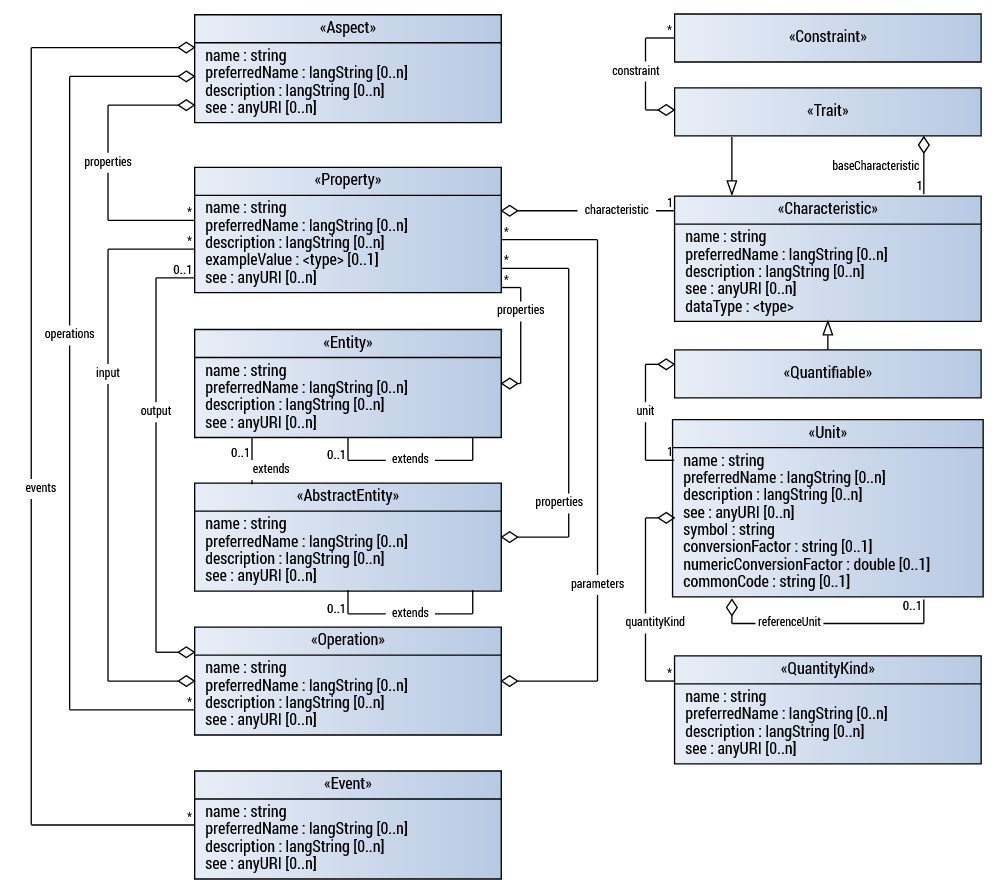
The complete specification and further information about its implementation and requirements can be accessed via the Eclipse Semantic Modeling Framework (ESMF).
Every aspect modelAspect Model A formal, machine-readable semantic description (expressed with RDF/Turtle) of data accessible from an aspect. Note 1: An Aspect Model must adhere to the Semantic Aspect Meta Model (SAMM) and be compliant with its validity rules. Note 2: Aspect Models are logical data models that can be used to detail a conceptual model to describe the semantics of runtime data related to a concept; elements of an Aspect Model can/should refer to terms of a standardized Business Glossary (if existing). within the Eclipse Tractus-X repository SLDT-Semantic-Models that has status "released" MUST be conformant to the Semantic Aspect Meta Model.
Every new aspect modelAspect Model A formal, machine-readable semantic description (expressed with RDF/Turtle) of data accessible from an aspect. Note 1: An Aspect Model must adhere to the Semantic Aspect Meta Model (SAMM) and be compliant with its validity rules. Note 2: Aspect Models are logical data models that can be used to detail a conceptual model to describe the semantics of runtime data related to a concept; elements of an Aspect Model can/should refer to terms of a standardized Business Glossary (if existing). MUST be conformant to the version of the Semantic Aspect Meta Model as noted in the normative reference SAMM.
2.3 Creation and Maintenance
Every aspect modelAspect Model A formal, machine-readable semantic description (expressed with RDF/Turtle) of data accessible from an aspect. Note 1: An Aspect Model must adhere to the Semantic Aspect Meta Model (SAMM) and be compliant with its validity rules. Note 2: Aspect Models are logical data models that can be used to detail a conceptual model to describe the semantics of runtime data related to a concept; elements of an Aspect Model can/should refer to terms of a standardized Business Glossary (if existing). released in Catena-X MUST be maintained in Eclipse Tractus-X: SLDT-Semantic-Models.
Every semantic model MUST have a unique identifier conformant to the meta model identifiers definition in SAMM. For the semantic models developed in the scope of Catena-X the unique identifier MUST start with
urn:samm:io.catenax.
Example for a unique identifier for an aspect modelAspect Model A formal, machine-readable semantic description (expressed with RDF/Turtle) of data accessible from an aspect. Note 1: An Aspect Model must adhere to the Semantic Aspect Meta Model (SAMM) and be compliant with its validity rules. Note 2: Aspect Models are logical data models that can be used to detail a conceptual model to describe the semantics of runtime data related to a concept; elements of an Aspect Model can/should refer to terms of a standardized Business Glossary (if existing). "material for recycling":
urn:samm:io.catenax.material_for_recycling:1.0.0#MaterialForRecylcing
The governance process for new, updated or deprecated aspect modelsAspect Model A formal, machine-readable semantic description (expressed with RDF/Turtle) of data accessible from an aspect. Note 1: An Aspect Model must adhere to the Semantic Aspect Meta Model (SAMM) and be compliant with its validity rules. Note 2: Aspect Models are logical data models that can be used to detail a conceptual model to describe the semantics of runtime data related to a concept; elements of an Aspect Model can/should refer to terms of a standardized Business Glossary (if existing). MUST be followed. The governance process for new, updated or deprecated aspect modelsAspect Model A formal, machine-readable semantic description (expressed with RDF/Turtle) of data accessible from an aspect. Note 1: An Aspect Model must adhere to the Semantic Aspect Meta Model (SAMM) and be compliant with its validity rules. Note 2: Aspect Models are logical data models that can be used to detail a conceptual model to describe the semantics of runtime data related to a concept; elements of an Aspect Model can/should refer to terms of a standardized Business Glossary (if existing). is defined by Catena-X e.V. Additionally, the governance process is described directly in the Eclipse Tractus-X project: GOVERNANCE.md.
NOTE: Older versions of already released or published aspect modelsAspect Model A formal, machine-readable semantic description (expressed with RDF/Turtle) of data accessible from an aspect. Note 1: An Aspect Model must adhere to the Semantic Aspect Meta Model (SAMM) and be compliant with its validity rules. Note 2: Aspect Models are logical data models that can be used to detail a conceptual model to describe the semantics of runtime data related to a concept; elements of an Aspect Model can/should refer to terms of a standardized Business Glossary (if existing). MAY start with
urn:bamm:io.catenax
However, aspect modelsAspect Model A formal, machine-readable semantic description (expressed with RDF/Turtle) of data accessible from an aspect. Note 1: An Aspect Model must adhere to the Semantic Aspect Meta Model (SAMM) and be compliant with its validity rules. Note 2: Aspect Models are logical data models that can be used to detail a conceptual model to describe the semantics of runtime data related to a concept; elements of an Aspect Model can/should refer to terms of a standardized Business Glossary (if existing). with prefix urn:bamm MUST NOT be used any longer.
For migration of older aspect modelsAspect Model A formal, machine-readable semantic description (expressed with RDF/Turtle) of data accessible from an aspect. Note 1: An Aspect Model must adhere to the Semantic Aspect Meta Model (SAMM) and be compliant with its validity rules. Note 2: Aspect Models are logical data models that can be used to detail a conceptual model to describe the semantics of runtime data related to a concept; elements of an Aspect Model can/should refer to terms of a standardized Business Glossary (if existing). see the Migration guide.
:::note[Note] SAMM was named BAMM until end of 2022 (BAMM for BAMM Aspect Meta Model). Renaming was executed in the context of the migration of the corresponding open source projects from Open Manufacturing Platform (OMP), a Linux Foundation project, to Industrial Digital Twin Association (IDTA) and Eclipse Foundation. :::
2.4 Usage
Every aspect of a digital twin registered in a digital twin registry (see CX-0002) accessible in the Catena-X data space MUST have a semantic description (semantic ID) that is conformant to the unique aspect model ID associated to it (see chapter Creation and Maintenance).
Example for semanticId:
urn:samm:io.catenax.material_for_recycling:1.0.0#MaterialForRecycling
3 References
3.1 Normative References
- SAMM Semantic Aspect Meta Model, Version 2.1.0.
- CX-0002 DIGITAL TWINS IN CATENA-X. Download in Catena-X Standard Library.
- Catena-X Operating Model.
3.2 Non-Normative References
This section is non-normative
- Semantic Data Structuring. Whitepaper. 2021-08-16. Open Manufacturing Platform.
- Product Modeling with BAMM. Whitepaper. 2022-11-24. Open Manufacturing Platform.
- ESMF Documentation. Eclipse Semantic Modeling Framework.
Legal
Copyright © 2025 Catena-X Automotive Network e.V. All rights reserved. For more information, please visit here.