CX-0138 Use Case Behaviour Twin Endurance Estimator v1.0.1
ABSTRACT
Behavioral product models, built on a consistent architecture of reusable functional components within ecosystems like Catena-X, unlock a wide range of innovative business ideas and digital services.
The focus of the 'data-centric and model-centric development and operational support' revolves around the 'digital behaviour twin.' This concept maps products, their functions, attributes, and business metrics by using a shared data model.
Part of this digital twin involves services providing information about existing or planned vehicles. Stakeholders like automobile clubs or recycler seek specific details, such as a component's expected lifespan. This information is crucial for determining the viability of recycling components.
This standard focuses on the Endurance Estimator. The Endurance Estimator receives user estimated load, that has been estimated by the service consumer, through the Catena-X network. The user estimated load, combined with additional product knowledge by the service provider, is used to calculate remaining useful life values for specific components.
FOR WHOM IS THE STANDARD DESIGNED
The standard is relevant for the following roles within the scope of the Endurance estimator service:
- data & service provider/consumer
- business application provider
COMPARISON WITH THE PREVIOUS VERSION OF THE STANDARD
The 1.0 version changed from a triangle (originally CX-0089) to an Use Case Standard and consolidates the contents of the previously independent standards CX-0057, CX-0088, CX-0090 within a single comprehensive standard.
1 INTRODUCTION
This document acts as a bracket for single standards required to request "Remaining Useful Life (RUL)" data as well as providing a service for its calculation at a component level. Included are APIsAPI An API is a way for two or more computer programs to communicate with each other. to be provided by the service provider and the service requestor, as well as aspect modelsAspect Model A formal, machine-readable semantic description (expressed with RDF/Turtle) of data accessible from an aspect. Note 1: An Aspect Model must adhere to the Semantic Aspect Meta Model (SAMM) and be compliant with its validity rules. Note 2: Aspect Models are logical data models that can be used to detail a conceptual model to describe the semantics of runtime data related to a concept; elements of an Aspect Model can/should refer to terms of a standardized Business Glossary (if existing). for the respective payloads being exchanged in an asynchronous pattern leveraging those APIsAPI An API is a way for two or more computer programs to communicate with each other..
1.1 AUDIENCE & SCOPE
This section is non-normative
The standard is relevant for the following roles within the scope of Endurance estimator service:
- data & consumer provider/consumer
- business application provider
NOTE: Fulfilling a use-case standard by a data provider/consumer can be done in two ways: A) purchase a certified app for the use case. In this case the data provider/consumer does not need to proof conformity again and B) data provisioning/consumption without a certified app for the use case. In this case the data provider/consumer needs to proof conformity with all single standards listed in this document
1.2 CONTEXT AND ARCHITECTURE FIT
This section is non-normative
This graphic illustrates the principles architecture of the Endurance estimator Service.
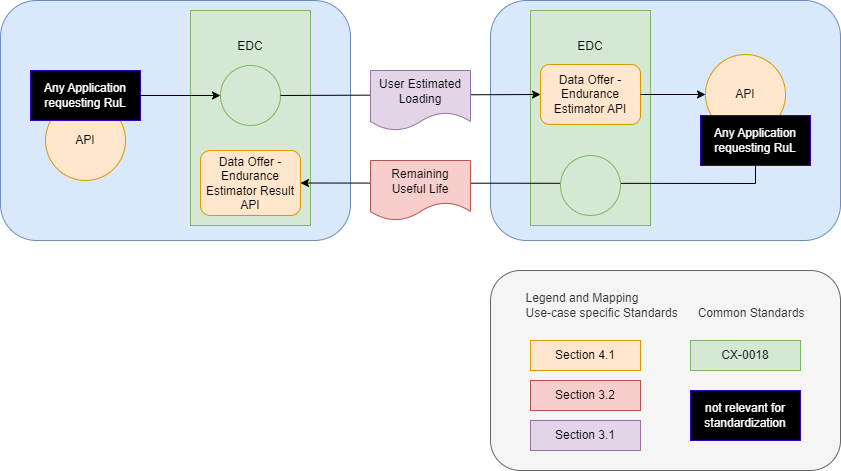
The data provider then has user estimated load available and sends it to the service provider via a connector compliant with [CX-0018] (e.g. Tractus-X EDCTractus-X EDC The Tractus-X Eclipse Dataspace Connector (Tractus-X EDC) is a reference implementation for a connector conformant to CX-0018 and acts as a de-facto standard/reference implementation within Catena-X; other CX-0018-conformant connectors are also valid options.) as a notification payload. After the calculation, the results are transfered back to the data provider through this connector.
This standard contains two aspect modelsAspect Model A formal, machine-readable semantic description (expressed with RDF/Turtle) of data accessible from an aspect. Note 1: An Aspect Model must adhere to the Semantic Aspect Meta Model (SAMM) and be compliant with its validity rules. Note 2: Aspect Models are logical data models that can be used to detail a conceptual model to describe the semantics of runtime data related to a concept; elements of an Aspect Model can/should refer to terms of a standardized Business Glossary (if existing). described in detail in Chapter 3.
- Aspect ModelAspect Model A formal, machine-readable semantic description (expressed with RDF/Turtle) of data accessible from an aspect. Note 1: An Aspect Model must adhere to the Semantic Aspect Meta Model (SAMM) and be compliant with its validity rules. Note 2: Aspect Models are logical data models that can be used to detail a conceptual model to describe the semantics of runtime data related to a concept; elements of an Aspect Model can/should refer to terms of a standardized Business Glossary (if existing). for user estimated loading, acting as the input for the estimation of remaining useful life. (See section 3.1)
- Aspect ModelAspect Model A formal, machine-readable semantic description (expressed with RDF/Turtle) of data accessible from an aspect. Note 1: An Aspect Model must adhere to the Semantic Aspect Meta Model (SAMM) and be compliant with its validity rules. Note 2: Aspect Models are logical data models that can be used to detail a conceptual model to describe the semantics of runtime data related to a concept; elements of an Aspect Model can/should refer to terms of a standardized Business Glossary (if existing). for Remaining Useful Life data, acting as the main output for remaining useful life. (See section 3.2 It also contains the APIAPI An API is a way for two or more computer programs to communicate with each other. descriptions for the APIsAPI An API is a way for two or more computer programs to communicate with each other. to exchange requests as well as results of a remaining useful life calculation:
- APIAPI An API is a way for two or more computer programs to communicate with each other. Endurance Estimator (contains both APIAPI An API is a way for two or more computer programs to communicate with each other. descriptions). (See section 5.1)
The calculation is asynchronous, therefore both parties involved in a calculation request require to provide APIAPI An API is a way for two or more computer programs to communicate with each other. endpoints, as the results are sent back at a later stage and not as part of the HTTPHTTP HTTP is an application-layer protocol for transmitting hypermedia documents (such as HTML). It was designed for communication between web browsers and web servers, but can also be used for other purposes. response body. Since Data Transfer in Catena-X requires IDSAIDSA The IDSA is an organization working to create the future of the global digital economy with International Data Spaces (IDS): a secure, sovereign system of data sharing where participants can realize the full value of their data. compliance, both parties involved must use an IDSAIDSA The IDSA is an organization working to create the future of the global digital economy with International Data Spaces (IDS): a secure, sovereign system of data sharing where participants can realize the full value of their data. compliant connector and provision the APIAPI An API is a way for two or more computer programs to communicate with each other. endpoints as specific data assetsAsset On the Data Provider side, an Asset describes the data set which will be shared or can be consumed by a Data Consumer. in those connectors.
1.3 CONFORMANCE AND PROOF OF CONFORMITY
This section is non-normative
All participants and their solutions will need to proof, that they are conform with the Catena-X standards. To validate that the standards are applied correctly, Catena-X employs Conformity Assessment Bodies (CABs). Since this document describes a set of standards to be fulfilled, participants MUST fulfill all mentioned standards and the respective conformity assessment criteria in addition to the specific criteria mentioned in this document. The specific criteria described in this document are describing the usage of the central tools as well as common tools described in the linked standardization documents and therefore compliance should be checked with the tools provided for these components. The Tractus-X Eclipse Dataspace Connector (EDC) is RECOMMENDED to be used as an IDSAIDSA The IDSA is an organization working to create the future of the global digital economy with International Data Spaces (IDS): a secure, sovereign system of data sharing where participants can realize the full value of their data. compliant connector, as it is the current reference implementation of the IDSA protocolIDSA Protocol The protocol used for data exchange in an International Dataspace; this includes contract negotiation..
1.4 EXAMPLES
The Endurance estimator can be used in many different contexts.
Tier-X: The overall product range becomes more attractive in the offer phase when model-based damage calculation is included as a product-related service.
During the usage phase, OEMs, car dealers and automotive clubs can further interpret the Remaining Useful Life calculation for a vehicle evaluation and offer it as vehicle-related services for their end customersCustomer In the context of OSim, the receiver of produced goods from a supplier. and fleet operators.
Even during the usage phase, but particularly during the recycling phase, OEMs, Tier-X, automotive clubs, car dealers, insurers, fleet operators and recyclers benefit from residual value analyses of the entire vehicle and its components.
1.5 TERMINOLOGY
This section is non-normativ
Business Partner Number (BPNBPN A BPN is the unique identifier of a partner within Catena-X.)
A BPNBPN A BPN is the unique identifier of a partner within Catena-X. is the unique identifier of a partner within Catena-X
Eclipse Dataspace Connector (EDC)
The EDC is a reference implementation of a connector for IDSAIDSA The IDSA is an organization working to create the future of the global digital economy with International Data Spaces (IDS): a secure, sovereign system of data sharing where participants can realize the full value of their data. conform sovereign data exchange
Behavioral Twin
Behavioural product models, based on a structured and consistent architecture of reusable and standard functional components and applied in a common ecosystem.
Notification: Notification - as described in CX-0023 Notification APIAPI An API is a way for two or more computer programs to communicate with each other. v1.2.2, are - in contrast to classical data offers in Catena-X - a way to push data from a sender to a receiver and vice versa.
Aspect ModelAspect Model A formal, machine-readable semantic description (expressed with RDF/Turtle) of data accessible from an aspect. Note 1: An Aspect Model must adhere to the Semantic Aspect Meta Model (SAMM) and be compliant with its validity rules. Note 2: Aspect Models are logical data models that can be used to detail a conceptual model to describe the semantics of runtime data related to a concept; elements of an Aspect Model can/should refer to terms of a standardized Business Glossary (if existing). : a formal, machine-readable semantic description (expressed with RDF/turtle) of data accessible from an Aspect.
: Note 1 to entry: An Aspect ModelAspect Model A formal, machine-readable semantic description (expressed with RDF/Turtle) of data accessible from an aspect. Note 1: An Aspect Model must adhere to the Semantic Aspect Meta Model (SAMM) and be compliant with its validity rules. Note 2: Aspect Models are logical data models that can be used to detail a conceptual model to describe the semantics of runtime data related to a concept; elements of an Aspect Model can/should refer to terms of a standardized Business Glossary (if existing). must adhere to the Semantic Aspect Meta Model (SAMM), i.e., it utilizes elements and relations defined in the Semantic Aspect Meta Model and is compliant to the validity rules defined by the Semantic Aspect Meta Model.
: Note 2 to entry: Aspect modelAspect Model A formal, machine-readable semantic description (expressed with RDF/Turtle) of data accessible from an aspect. Note 1: An Aspect Model must adhere to the Semantic Aspect Meta Model (SAMM) and be compliant with its validity rules. Note 2: Aspect Models are logical data models that can be used to detail a conceptual model to describe the semantics of runtime data related to a concept; elements of an Aspect Model can/should refer to terms of a standardized Business Glossary (if existing). are logical data models which can be used to detail a conceptual model in order to describe the semantics of runtime data related to a concept. Further, elements of an Aspect modelAspect Model A formal, machine-readable semantic description (expressed with RDF/Turtle) of data accessible from an aspect. Note 1: An Aspect Model must adhere to the Semantic Aspect Meta Model (SAMM) and be compliant with its validity rules. Note 2: Aspect Models are logical data models that can be used to detail a conceptual model to describe the semantics of runtime data related to a concept; elements of an Aspect Model can/should refer to terms of a standardized Business Glossary (if existing). can/should refer to terms of a standardized Business Glossary (if existing).
[Source: Catena-X, CX-0002:v1.2]
Usecase specific glossary of used APIAPI An API is a way for two or more computer programs to communicate with each other. and SAMM models can be found in the respective sections in this standard document.
2 RELEVANT PARTS OF THE STANDARD "Use Case Behavioral Twin Endurance estimator"
This section is normantive
2.1 "STANDARDS FOR "Use Case Behavioral Twin Endurance estimator"
This section is normantive
As a Service Provider for an Endurance Estimator Service I need to fulfill the following standards in the following contexts:
- Semantic Model: UserEstimatedLoading (Section 3.1) MUST be understood by my service and MUST be consumed by my service provider APIAPI An API is a way for two or more computer programs to communicate with each other..
- Semantic Model: Remaining Useful Life (Section 3.2) MUST be provided as part of my communication of the result towards the requestor and/or requesting application
- APIAPI An API is a way for two or more computer programs to communicate with each other.: Endurance Estimator (Section 5.1) MUST be followed in terms of all relevant parts for a service provider
As a Service Requestor or Service Requestor Application I need to fulfill the following standards in the following contexts:
- Semantic Model: UserEstimatedLoading (Section 3.1) MUST be provided as part of the request for a remaining useful life calculation towards a service operator's APIAPI An API is a way for two or more computer programs to communicate with each other.
- Semantic Model: Remaining Useful Life (Section 3.2) MUST be consumable by my connected underlying application.
- APIAPI An API is a way for two or more computer programs to communicate with each other.: Endurance estimator (Section 5.1) MUST be followed in terms of all relevant parts for a service requestor.
2.1.1 LIST OF STANDALONE STANDARDS
To participate in the Use Case Behavioral Twin Endurance estimator, the following single standards MUST be fulfilled:
- CX-0018 Dataspace Connectivity 3.0.0
2.1.2 DATA REQUIRED
As a Service Requestor or Service Requestor Application I MUST provide the UserEstimatedLoading in the format of the aspect modelAspect Model A formal, machine-readable semantic description (expressed with RDF/Turtle) of data accessible from an aspect. Note 1: An Aspect Model must adhere to the Semantic Aspect Meta Model (SAMM) and be compliant with its validity rules. Note 2: Aspect Models are logical data models that can be used to detail a conceptual model to describe the semantics of runtime data related to a concept; elements of an Aspect Model can/should refer to terms of a standardized Business Glossary (if existing). described in Section 3.1. As a Service Provider I MUST provide Remaining useful life information in the format of the aspect modelAspect Model A formal, machine-readable semantic description (expressed with RDF/Turtle) of data accessible from an aspect. Note 1: An Aspect Model must adhere to the Semantic Aspect Meta Model (SAMM) and be compliant with its validity rules. Note 2: Aspect Models are logical data models that can be used to detail a conceptual model to describe the semantics of runtime data related to a concept; elements of an Aspect Model can/should refer to terms of a standardized Business Glossary (if existing). described in Section 3.2.
2.1.3 ADDITIONAL REQUIREMENTS
Conventions for Use Case Policy in context data exchange
In alignment with our commitment to data sovereignty, a specific framework governing the utilization of data within the Catena-X use cases has been outlined. A set of specific policies on data offering and data usage level detail the conditions under which data may be accessed, shared, and used, ensuring compliance with legal standards.
For a comprehensive understanding of the rights, restrictions, and obligations associated with data usage in the Catena-X ecosystem, we refer users to
- the detailed ODRL policy repository. This document provides in-depth explanations of the terms and conditions applied to data access and utilization, ensuring that all engagement with our data is conducted responsibly and in accordance with established guidelines.
- the ODRL schema template. This defines how policies used for data sharing/usage should get defined. Those schemas MUST be followed when providing services or apps for data sharing/consuming.
Additional Details regarding Access Policies
A Data Provider may tie certain access authorizations ("Access Policies") to its data offers for members of Catena-X and one or several Data Consumers. By limiting access to certain Participants, Data Provider maintains control over its anti-trust obligations when sharing certain data. In particular, Data Provider may apply Access Policies to restrict access to a particular data offer for only one Participant identified by a specific business partner number:
- Membership
- BPNLBPNL The unique identifier of a legal entity of a partner within Catena-X (e.g., a company).
Additional Details regarding Usage Policies
In the context of data usage policies (“Usage Policies”), Participants and related services MUST use the following policy rules:
- Use Case Framework (“FrameworkAgreement”)
- at least one use case purpose (“UsagePurpose”) from the above mentioned ODRL policy repository.
Additionally, respective usage policies MAY include the following policy rule:
- Reference Contract (“ContractReference”).
Details on namespaces and ODRL policy rule values to be used for the above-mentioned types are provided via the ODRL policy repository.
VERSIONING
Note: Data AssetsAsset On the Data Provider side, an Asset describes the data set which will be shared or can be consumed by a Data Consumer. differentiated only by major version MUST be offered in parallel. The current standard and APIAPI An API is a way for two or more computer programs to communicate with each other. versions mark the start of Life Cycle Management in Catena-X operations. Previous versions are dismissed.
The APIAPI An API is a way for two or more computer programs to communicate with each other. version described in this standard document MUST be published in the property https://w3id.org/catenax/ontology/common#version as version X.Y in dcat:Dataset(http://www.w3.org/ns/dcat#). The requester of an assetAsset On the Data Provider side, an Asset describes the data set which will be shared or can be consumed by a Data Consumer. MUST be able to handle multiple assetsAsset On the Data Provider side, an Asset describes the data set which will be shared or can be consumed by a Data Consumer. for this endpoint, being differentiated only by the version. The requester SHOULD choose the assetAsset On the Data Provider side, an Asset describes the data set which will be shared or can be consumed by a Data Consumer. with the highest compatible version number implemented by themselves. If the requester cannot find a compatible version with their own, the requester MUST terminate the data transfer.
3 ASPECT MODELSAspect Model A formal, machine-readable semantic description (expressed with RDF/Turtle) of data accessible from an aspect. Note 1: An Aspect Model must adhere to the Semantic Aspect Meta Model (SAMM) and be compliant with its validity rules. Note 2: Aspect Models are logical data models that can be used to detail a conceptual model to describe the semantics of runtime data related to a concept; elements of an Aspect Model can/should refer to terms of a standardized Business Glossary (if existing).
The following Aspect ModelsAspect Model A formal, machine-readable semantic description (expressed with RDF/Turtle) of data accessible from an aspect. Note 1: An Aspect Model must adhere to the Semantic Aspect Meta Model (SAMM) and be compliant with its validity rules. Note 2: Aspect Models are logical data models that can be used to detail a conceptual model to describe the semantics of runtime data related to a concept; elements of an Aspect Model can/should refer to terms of a standardized Business Glossary (if existing). are part of this standard:
- UserEstimatedLoading, V 1.0.0, urn:bamm:io.catenax.classified_load_spectrum:1.0.0
- RemainingUsefulLife", V1.0.0, urn:bamm:io.catenax.rul:1.0.0##RemainingUsefulLife
This section is normantive
3.1 ASPECT MODELAspect Model A formal, machine-readable semantic description (expressed with RDF/Turtle) of data accessible from an aspect. Note 1: An Aspect Model must adhere to the Semantic Aspect Meta Model (SAMM) and be compliant with its validity rules. Note 2: Aspect Models are logical data models that can be used to detail a conceptual model to describe the semantics of runtime data related to a concept; elements of an Aspect Model can/should refer to terms of a standardized Business Glossary (if existing). "ClassifiedLoadSpectrum"
The data model UserEstimatedLoading represents the load data of a vehicle component. The load spectrum is a data set that represents the aggregated loading of a component. Any kind of loading is covered: loading can be force or torque or revolutions or temperature or event or similar. The load data is classified and counted with specific counting methods.
This standard defines the format for the counted load data, so that the exchange of load data between different partners is possible.
3.1.1 INTRODUCTION
The aspect modelAspect Model A formal, machine-readable semantic description (expressed with RDF/Turtle) of data accessible from an aspect. Note 1: An Aspect Model must adhere to the Semantic Aspect Meta Model (SAMM) and be compliant with its validity rules. Note 2: Aspect Models are logical data models that can be used to detail a conceptual model to describe the semantics of runtime data related to a concept; elements of an Aspect Model can/should refer to terms of a standardized Business Glossary (if existing). comprises basic vehicle data, vehicle status information, previous usage information and future usage information in a structured form in order to estimate the remaining useful life.
Every data provider of userEstimatedLoading data MUST provide the data conformant to the semantic model specified in this document. The unique identifier of the semantic model specified in this document MUST be used by the data provider to define the semantics of the data being transferred. Every certified business application relying on userEstimatedLoading data MUST be able to consume data conformant to the semantic model specified in this document. This semantic model MUST be made available in the central Semantic Hub. Data consumers and data provider MUST comply with the license of the semantic model.
In the Catena-X data space userEstimatedLoading data MUST be requested and exchanged via a connector compliant with [CX-0018] (e.g. Tractus-X EDCTractus-X EDC The Tractus-X Eclipse Dataspace Connector (Tractus-X EDC) is a reference implementation for a connector conformant to CX-0018 and acts as a de-facto standard/reference implementation within Catena-X; other CX-0018-conformant connectors are also valid options.). The JSON Payload of data providers MUST be conformant to the JSON Schema as specified in this document.
3.1.2 CONTEXT
This section is non-normative
"User estimated loading" is describing the vehicle and the usage of the vehicle. As named, the loading will be estimated from the usage in order to assess the remaining useful life of vehicle respectively the vehicle components. The usage as well as the vehicle data are general information not specified for a specific component. Previous usage as well as future application are included.
3.1.3 EXAMPLES
Example payload in JSON format:
{
    "vehicleStatus": {
        "milage": 123456
    },
    "vehicleData": {
        "grossVehicleWeightKG": 1998,
        "powerKW": 300,
        "energySourceCode": "0008",
        "vehicleType": "limousine",
        "numberOfPoweredAxles": 2
    },

    "history": [
        {
            "percentage": 25,
            "drivingStyle": 80,
            "trailerUse": false,
            "cityDriving": false,
            "hilliness": 80,
            "curviness": 60
        },
        {
            "percentage": 75,
            "drivingStyle": 40,
            "trailerUse": false,
            "cityDriving": true,
            "hilliness": 30,
            "curviness": 50
        }
    ],
      "future": [
        {
            "futureScenarioId": 1,
            "futureScenario": [
                {
                    "percentage": 90.0,
                    "drivingStyle": 30,
                    "trailerUse": false,
                    "cityDriving": true,
                    "hilliness": 10,
                    "curviness": 50
                },
                {
                    "percentage": 10.0,
                    "drivingStyle": 20,
                    "trailerUse": true,
                    "cityDriving": true,
                    "hilliness": 10,
                    "curviness": 50
                }
            ]
        },
        {
            "futureScenarioId": 2,
            "futureScenario": [
                {
                    "percentage": 100,
                    "drivingStyle": 20,
                    "hilliness": 30,
                    "curviness": 20,
                    "trailerUse": true,
                    "cityDriving": false
                }
            ]
        }
    ]
}
3.1.4 SPECIFICATIONS ARTIFACTS
The modeling of the semantic model specified in this document was done in accordance to the "semantic driven workflow" to create a submodel template specification SMT.
This aspect modelAspect Model A formal, machine-readable semantic description (expressed with RDF/Turtle) of data accessible from an aspect. Note 1: An Aspect Model must adhere to the Semantic Aspect Meta Model (SAMM) and be compliant with its validity rules. Note 2: Aspect Models are logical data models that can be used to detail a conceptual model to describe the semantics of runtime data related to a concept; elements of an Aspect Model can/should refer to terms of a standardized Business Glossary (if existing). is written in BAMM 1.0.0 as a modeling language.
Like all Catena-X data models, this model is available in a machine-readable format on GitHub.
3.1.5 LICENSE
This Catena-X data model is made available under the terms of the Creative Commons Attribution 4.0 International (CC-BY-4.0) license, which is available at Creative Commons.
3.1.6 IDENTIFIER OF SEMANTIC MODEL
[Mandatory]
The semantic model has the unique identifier
urn:bamm:io.catenax.user_estimated_loading:1.0.0
This identifier MUST be used by the data provider to define the semantics of the data being transferred.
3.1.7 FORMATS OF SEMANTIC MODEL
3.1.7.1 RDF Turtle
[Mandatory]
The rdf turtle file, an instance of the Semantic Aspect Meta Model, is the master for generating additional file formats and serializations.
The open source command line tool of the Eclipse Semantic Modeling Framework is used for generation of other file formats like for example a JSON Schema, aasx for Asset Administration ShellAsset Administration Shell The AAS is a digital representation of an asset; it is a form of a digital twin. Submodel Template or a HTML documentation.
3.1.7.2 JSON Schema
A JSON Schema can be generated from the RDF Turtle file. The JSON Schema defines the Value-Only payload of the Asset Administration ShellAsset Administration Shell The AAS is a digital representation of an asset; it is a form of a digital twin. for the APIAPI An API is a way for two or more computer programs to communicate with each other. operation "GetSubmodel".
3.1.7.3 aasx
[Mandatory]
An AASX file can be generated from the RDF Turtle file. The AASX file defines one of the requested artifacts for a Submodel Template Specification conformant to [SMT].
Note: As soon as the specification V3.0 of the Asset Administration ShellAsset Administration Shell The AAS is a digital representation of an asset; it is a form of a digital twin. specfication is available an update will be provided.
3.2 ASPECT MODELAspect Model A formal, machine-readable semantic description (expressed with RDF/Turtle) of data accessible from an aspect. Note 1: An Aspect Model must adhere to the Semantic Aspect Meta Model (SAMM) and be compliant with its validity rules. Note 2: Aspect Models are logical data models that can be used to detail a conceptual model to describe the semantics of runtime data related to a concept; elements of an Aspect Model can/should refer to terms of a standardized Business Glossary (if existing). "RemainingUsefulLife"
3.2.1 INTRODUCTION
The data model Remaining Useful Life contains the two relevant values to describe the expected remaining life of a vehicle, remaining running distance and remaining operating hours.
The data model is used for vehicle parts and vehicle components which cannot be visually assessed but need the loading information combined with a damage model to estimate the health of the component.
3.2.2 CONTEXT
This section is non-normative
Remaining useful Life is describing the actual health of a vehicle component. Remaining useful Life is defined for vehicle and vehicle components; the values are “remaining running distance” and “remaining operating hours”. As it is a short-term property, the status of determination is part of the standard. Remaining useful Life is the result of a service determining the health of a vehicle component from the loading the component was subjected to. This loading might before example measured, simulate or estimated, this information on the origin of the loading is part of the standard.
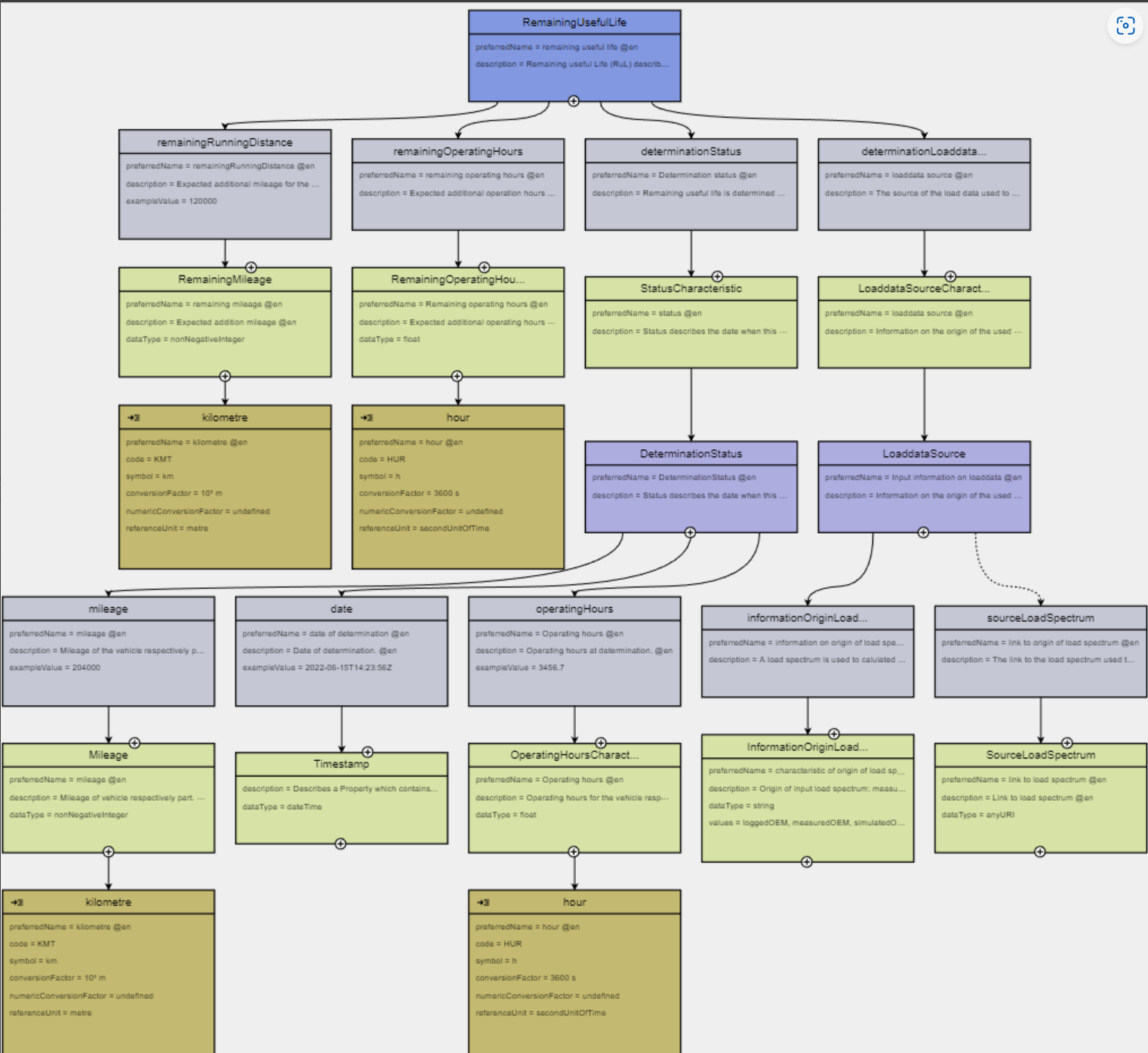 Figure 1: Overview
3.2.3 EXAMPLES
{
  "remainingOperatingHours": 2500,
  "remainingRunningDistance": 150000,
  "determinationStatus": {
    "date": "2022-06-15T14:23:56Z",
    "operatingHours": 3456.7,
    "mileage": 204000
  },
  "determinationLoaddataSource": {
    "informationOriginLoadSpectrum": "loggedOEM"
  }
}
3.2.4 TERMINOLOGY
This section is non-normative
- RemainingRunningDistance: The estimated number of kilometers, the vehicle can drive without expectable failure of the component. This is an integer number, the unit is [km].
- Remaining operating hours: Estimated number of operating hours of the vehicle without expectable failure of the component. Floating number, unit is [h].
- determinationLoaddataSource: The remaining life is estimated from the loading the component was subjected to. The loading of the component might be logged during vehicle life or simulated or estimated: this information on the origin is stored here. If available, the URL of the loadspectrum can be stored here.
- determinationStatus : Comprising “date”, “mileage”, “operatingHours”, the timestamp the remainingUsefulLife was calculated and the according mileage and operating hours of the vehicle.
- sourceLoadSpectrum: if available, the URL of the used load spectrum
- informationOriginLoadSpectrum: enumeration of possible loaddata sources:
- "loggedOEM": the data are collected during usage and provided on OEM side
- "measuredOEM": load data are measured on OEM side
- "simulatedOEM": load data are simulated on OEM side
- "loggedSupplier": the data are collected during usage and provided on supplierSupplier In the context of OSim, the producer of goods. side
- "measuredSupplier": load data are measured on supplierSupplier In the context of OSim, the producer of goods. side
- "simulatedSupplier": load data are simulated on supplierSupplier In the context of OSim, the producer of goods. side
- "otherOrigin": any other origin of load data, may be not even a load spectrum
Additional terminology used in this standard can be looked up in the glossary on the association homepage.
3.2.5 SPECIFICATIONS ARTIFACTS
The modeling of the semantic model specified in this document was done in accordance to the "semantic driven workflow" to create a submodel template specification SMT.
This aspect modelAspect Model A formal, machine-readable semantic description (expressed with RDF/Turtle) of data accessible from an aspect. Note 1: An Aspect Model must adhere to the Semantic Aspect Meta Model (SAMM) and be compliant with its validity rules. Note 2: Aspect Models are logical data models that can be used to detail a conceptual model to describe the semantics of runtime data related to a concept; elements of an Aspect Model can/should refer to terms of a standardized Business Glossary (if existing). is written in BAMM 1.0.0 as a modeling language.
Like all Catena-X data models, this model is available in a machine-readable format on GitHub conformant to CX-0003.
3.2.6 LICENSE
This Catena-X data model is made available under the terms of the Creative Commons Attribution 4.0 International (CC-BY-4.0) license, which is available at Creative Commons.
3.2.7 IDENTIFER OF SEMANTIC MODEL
The semantic model has the unique identifier:
urn:bamm:io.catenax.rul:1.0.0##RemainingUsefulLife
3.2.8 FORMATS OF SEMANTIC MODEL
3.2.8.1 RDF Turtle
The rdf turtle file, an instance of the Semantic Aspect Meta Model, is the master for generating additional file formats and serializations.
The ttl file can be found here:
The open source command line tool of the Eclipse Semantic Modeling Framework is used for generation of other file formats like for example a JSON Schema, aasx for Asset Administration ShellAsset Administration Shell The AAS is a digital representation of an asset; it is a form of a digital twin. Submodel Template or a HTML documentation.
3.2.8.2 JSON Schema
A JSON Schema can be generated from the RDF Turtle file. The JSON Schema defines the Value-Only payload of the Asset Administration ShellAsset Administration Shell The AAS is a digital representation of an asset; it is a form of a digital twin. for the APIAPI An API is a way for two or more computer programs to communicate with each other. operation "GetSubmodel".
3.2.8.3 aasx
An AASX file can be generated from the RDF Turtle file. The AASX file defines one of the requested artifacts for a Submodel Template Specification conformant to [SMT].
Note: As soon as the specification V3.0 of the Asset Administration ShellAsset Administration Shell The AAS is a digital representation of an asset; it is a form of a digital twin. specfication is available an update will be provided.
4 APPLICATION PROGRAMMING INTERFACES
This section is normantive
The headings below should only be understood as a suggestion
4.1 Endurance Estimator APIAPI An API is a way for two or more computer programs to communicate with each other.
Endurance Estimator is a service which estimates the remaining useful life of a vehicle using basic information of the vehicle and the usage. It is aimed for normal customerCustomer In the context of OSim, the receiver of produced goods from a supplier. without access to specific technical vehicle data or logged data stored in the ECU. Usage data are estimated according to application like trailer use and geografical conditions like hilliness. This document sets the standards for the APIAPI An API is a way for two or more computer programs to communicate with each other. for the usage of services which estimates a so-called "remaining useful life value" (RUL-value) using estimated load data (UserEstimatedLoading).
4.1.1 PRECONDITIONS AND DEPENDENCIES
The Endurance Estimator service was designed with interoperability in mind, thus the communication in both directions (input/input) fully supports the Catena-X Notification standard.
The two APIsAPI An API is a way for two or more computer programs to communicate with each other. described support the implementation of the dynamic behavior (i.e., service) of components (e.g., engine, gearbox..) in a digital behavior twin.
As the process is asynchronous, there are two APIsAPI An API is a way for two or more computer programs to communicate with each other. for different types of participants in the network.
- APIAPI An API is a way for two or more computer programs to communicate with each other. endpoint to be provided by a Service Provider providing a service to predict the expected lifetime based on user estimated loading.
- APIAPI An API is a way for two or more computer programs to communicate with each other. endpoint to be provided by a Service Requestor application or participant to receive the outcome of such an analysis in an asynchronous manner.
It is a non-central APIAPI An API is a way for two or more computer programs to communicate with each other., which can be implemented for various components. It relies on a load spectrum as input in order to calculate and return the corresponding RUL value. The basic idea for the functionality of this APIAPI An API is a way for two or more computer programs to communicate with each other. has been derived from CX-0023:v1.2 Notification APIAPI An API is a way for two or more computer programs to communicate with each other..
As already mentioned in the Introduction, this standard provides the specification of the HTTPHTTP HTTP is an application-layer protocol for transmitting hypermedia documents (such as HTML). It was designed for communication between web browsers and web servers, but can also be used for other purposes. RESTREST An architectural style for designing networked applications. APIAPI An API is a way for two or more computer programs to communicate with each other. endpoint to request (with an according UserEstimatedLoading as input) and sending RUL value via the Catena X Dataspace. Without this APIAPI An API is a way for two or more computer programs to communicate with each other. an interoperability between different application, with an aim to receive RUL data, is not given.
4.1.2 APIAPI An API is a way for two or more computer programs to communicate with each other. SPECIFICATION
4.1.2.1 APIAPI An API is a way for two or more computer programs to communicate with each other. Endpoints & resources
The notification APIAPI An API is a way for two or more computer programs to communicate with each other. MUST be implemented as specified in the [openAPI] documentation as stated here:
- POST /apiAPI An API is a way for two or more computer programs to communicate with each other./v1/routine/notification
In fact, it is OPTIONAL to implement the endpoint paths exactly as described above. The reason is that those endpoints are not called from any supply chain partner directly. Rather, they are called from the Eclipse Dataspace Connector (EDC) or a similar IDSAIDSA The IDSA is an organization working to create the future of the global digital economy with International Data Spaces (IDS): a secure, sovereign system of data sharing where participants can realize the full value of their data. compliant connector as part of its data assetsAsset On the Data Provider side, an Asset describes the data set which will be shared or can be consumed by a Data Consumer.. In that sense, it is just important to implement endpoints that can process the defined request body and respond with the HTTPHTTP HTTP is an application-layer protocol for transmitting hypermedia documents (such as HTML). It was designed for communication between web browsers and web servers, but can also be used for other purposes. status codes and - if required - reply with the defined response body.
The EDCs/IDSAIDSA The IDSA is an organization working to create the future of the global digital economy with International Data Spaces (IDS): a secure, sovereign system of data sharing where participants can realize the full value of their data. compliant data assetsAsset On the Data Provider side, an Asset describes the data set which will be shared or can be consumed by a Data Consumer. will act similar to a reverse proxy for the notification endpoints, therefore rather the EDC data assetsAsset On the Data Provider side, an Asset describes the data set which will be shared or can be consumed by a Data Consumer. are of significance, which should be exposed towards Catena-X through the Data Offer Catalogues in the EDC or any other IDSA ProtocolIDSA Protocol The protocol used for data exchange in an International Dataspace; this includes contract negotiation. compatible connector.
4.1.2.2 Available Data Types
The APIAPI An API is a way for two or more computer programs to communicate with each other. MUST use JSON as the payload transported via HTTPHTTP HTTP is an application-layer protocol for transmitting hypermedia documents (such as HTML). It was designed for communication between web browsers and web servers, but can also be used for other purposes.. The APIsAPI An API is a way for two or more computer programs to communicate with each other. payload consists of a general notification header and a use-case specific content dictionary. The request and response are linked by the unique notificationID.
Notification Request Payload Structure
The main part of the content dictionary MUST follow the main input towards the endurance estimator.
{
    "header": {
        "notificationId": "b1a15145-4533-48e3-8d80-f5b83cc6c201",
        "referencedNotificationId": null,
        "relatedNotificationId": null,
        "senderBPN": "BPNL00000002HCQ9",
        "senderAddress": "https://connector2.cp.int.adac.openresearch.com",
        "recipientBPN": "https://edc-ocp0900009.apps.c7von4sy.westeurope.aroapp.io/BPNL00000003B2OM",
        "recipientAddress": "BPNL00000003B2OM",
        "severity": "MINOR",
        "status": "SENT",
        "targetDate": "2023-02-03T11:58:00.326439Z",
        "timeStamp": "2023-02-03T11:58:00.326439Z",
        "classification": "RemainingUsefulLifeEstimator",
        "respondAssetId": "enduranceEstimatorResult-receipt"
    },
    "content": {
        "requestRefId": "b1a15145-4533-48e3-8d80-f5b83cc6c201",
        "enduranceEstimatorInputs": [
            {
                "userEstimatedLoading": {
                    <UserEstimatedLoading as per semantic model : AspectModel_UserEsimatedLoading Section 3.1>
                }
            }
        ]
    }
}
Notification Response Payload Structure
The "Remaining Useful Life" as endurance estimator output MUST follow the semantics described in the corresponding model:
{
    "header": {
      "referencedNotificationID": "notification-UUID",
      "senderBPN": "BPNL0000000",
      "senderAddress": "https://edc-xxxx.xx/BPNL0000000",
      "classification": "EnduranceEstimatorResult",
      "recipientAddress": "https://connectorxx.com",
      "recipientBPN": "BPNL0000000",
      "severity": "MINOR",
      "status": "SENT",
      "targetDate": "target-date",
      "timeStamp": "time-stamp",
      "respondAssetId": "urn:pilot:service:EndurancePredictorEstimationNotification"
    },
    "content": {
      "enduranceEstimatorOutputs": [
        {
          "remainingUsefulLife": {
              <RuL as per standard as specified in section 3.2: Semantic Model: Remaining Useful Life>
          }
        }
      ]
    }
  }
Notification Response Error Payload Structure
{
    "header": {
      "referencedNotificationID": "notification-UUID",
      "senderBPN": "BPNL0000000",
      "senderAddress": "https://edc-xxxx.xx/BPNL0000000",
      "classification": "EndurancePredictorResult",
      "recipientAddress": "https://connectorxx.com",
      "recipientBPN": "BPNL0000000",
      "severity": "MINOR",
      "status": "SENT",
      "targetDate": "target-date",
      "timeStamp": "time-stamp",
      "respondAssetId": "urn:pilot:service:EndurancePredictorEstimationNotification"
    },
    "content": {
        "type": "Error",
        "message": "Error Message",
        "enduranceEstimatorOutputs": []
    }
  }
4.1.3 DATA ASSETAsset On the Data Provider side, an Asset describes the data set which will be shared or can be consumed by a Data Consumer. STRUCTURE
When using the EDC, the following assetAsset On the Data Provider side, an Asset describes the data set which will be shared or can be consumed by a Data Consumer. MUST be registered by the specific roles in this process. Other connectors implementing the IDSA ProtocolIDSA Protocol The protocol used for data exchange in an International Dataspace; this includes contract negotiation. require a similar data assetAsset On the Data Provider side, an Asset describes the data set which will be shared or can be consumed by a Data Consumer. with the same structure and provisioning towards Catena-X.
4.1.3.1 Service Consumer
As an application provider or an data consumer calling an endurance predictor of another participant an APIAPI An API is a way for two or more computer programs to communicate with each other. for asynchronous receival of the result is required. The corresponding data assetAsset On the Data Provider side, an Asset describes the data set which will be shared or can be consumed by a Data Consumer. MUST look like the following:
{
  "@context": {
    "cx-common": "https://w3id.org/catenax/ontology/common#"
  },
  "asset": {
    "@type": "Asset",
    "@id": "enduranceEstimatorResult-receipt",
    "properties": {
      "dct:type": {
        "@id": "EnduranceEstimatorResult"
      },
      "cx-common:name": "enduranceEstimatorResult-receipt",
      "cx-common:description": "Asset to receive endurance estimator results.",
      "cx-common:version": "1.0",
      "cx-common:contenttype": "application/json"
    }
  },
  "dataAddress": {
    "@type": "DataAddress",
    "type": "HttpData",
    "baseUrl": "https://{{httpServerWhichOffersTheHttpEndpoint}}/api/v1/routine/notification",
    "proxyMethod": "true",
    "proxyQueryParams": "true",
    "proxyBody": "true"
  }
}
The variable {{httpServerWhichOffersTheHttpEndpoint}} MUST be set to the HTTPHTTP HTTP is an application-layer protocol for transmitting hypermedia documents (such as HTML). It was designed for communication between web browsers and web servers, but can also be used for other purposes. server that offers the endpoint. The path /apiAPI An API is a way for two or more computer programs to communicate with each other./v1/routine/notification MAY align with the HTTPHTTP HTTP is an application-layer protocol for transmitting hypermedia documents (such as HTML). It was designed for communication between web browsers and web servers, but can also be used for other purposes. POST path as stated in 2.2.1. In that sense it can change dependent on the endurance application.
4.1.3.2 Service Provider
As an service provider or data provider providing an endpoint for an endurance estimator service, an APIAPI An API is a way for two or more computer programs to communicate with each other. for receival of the request including the user estimated loading data is required. The corresponding data assetAsset On the Data Provider side, an Asset describes the data set which will be shared or can be consumed by a Data Consumer. MUST look like the following:
{
  "@context": {
    "cx-common": "https://w3id.org/catenax/ontology/common#"
  },
  "asset": {
    "@type": "Asset",
    "@id": "enduranceEstimatorRequest-receipt",
    "properties": {
      "dct:type": {
        "@id": "EnduranceEstimatorRequest"
      },
      "cx-common:name": "enduranceEstimatorRequest-receipt",
      "cx-common:description": "Asset to receive endurance estimator requests incl. load spectrum.",
      "cx-common:version": "1.0",
      "cx-common:contenttype": "application/json"
    }
  },
  "dataAddress": {
    "@type": "DataAddress",
    "type": "HttpData",
    "baseUrl": "https://{{httpServerWhichOffersTheHttpEndpoint}}/api/v1/routine/notification",
    "proxyMethod": "true",
    "proxyQueryParams": "true",
    "proxyBody": "true"
  }
}
The variable {{httpServerWhichOffersTheHttpEndpoint}} MUST be set to the HTTPHTTP HTTP is an application-layer protocol for transmitting hypermedia documents (such as HTML). It was designed for communication between web browsers and web servers, but can also be used for other purposes. server that offers the endpoint. The path /apiAPI An API is a way for two or more computer programs to communicate with each other./v1/routine/notification MAY align with the HTTPHTTP HTTP is an application-layer protocol for transmitting hypermedia documents (such as HTML). It was designed for communication between web browsers and web servers, but can also be used for other purposes. POST path as stated in 2.2.1. In that sense it can change dependent on the endurance application.
The variable {{httpServerWhichOffersTheHttpEndpoint}} MUST be set to the HTTPHTTP HTTP is an application-layer protocol for transmitting hypermedia documents (such as HTML). It was designed for communication between web browsers and web servers, but can also be used for other purposes. server that offers the endpoint. The path /apiAPI An API is a way for two or more computer programs to communicate with each other./v1/routine/notification MAY align with the HTTPHTTP HTTP is an application-layer protocol for transmitting hypermedia documents (such as HTML). It was designed for communication between web browsers and web servers, but can also be used for other purposes. POST path as stated in 2.2.1. In that sense it can change dependent on the endurance application.
4.1.4 ERROR HANDLING
The following httpHTTP HTTP is an application-layer protocol for transmitting hypermedia documents (such as HTML). It was designed for communication between web browsers and web servers, but can also be used for other purposes. response codes MUST be defined for HTTPHTTP HTTP is an application-layer protocol for transmitting hypermedia documents (such as HTML). It was designed for communication between web browsers and web servers, but can also be used for other purposes. POST endpoint for the Endurance estimator endpoint.
| Code | Description |
|---|---|
| 202 | Accepted |
| 400 | Request body was malformed |
5 REFERENCES
5.1 NORMATIVE REFERENCES
- CX–0018:v3.0 Dataspace Connectivity
- CX-0023:v1.2 Notification APIAPI An API is a way for two or more computer programs to communicate with each other.
- CX-0003:v1.1 SAMM Aspect Meta Model
5.2 NON-NORMATIVE REFERENCES
This section is non-normative
5.3 REFERENCE IMPLEMENTATIONS
This section is non-normative
Legal
Copyright © 2025 Catena-X Automotive Network e.V. All rights reserved. For more information, please visit here.